Designing WebSocket Systems: Connections, Sessions, Reconnection, and Server Internals
Published:
1. Why WebSockets Exist
Most web interactions begin with the client asking for something. A browser sends an HTTP request, the server returns a response, and the exchange ends. That model is a good fit for loading a page, submitting a form, or fetching a record.
Some applications need the server to speak first.
Consider an order-tracking page. The browser loads the current order state, but the next change may originate minutes later in a warehouse service:
PLACED -> PACKED -> DISPATCHED -> DELIVERED
The browser could poll every few seconds. Most requests would return no change, and increasing the polling interval would make the page feel stale. The same problem appears in chat, collaborative editing, multiplayer games, live market data, and operational dashboards.
A WebSocket is an application protocol for exchanging messages over a persistent, bidirectional connection. Persistent means the connection remains available after one message. Bidirectional means either endpoint can initiate the next message. The client is the endpoint that opens the connection; the server is the endpoint that accepts it.
After one opening handshake, either side can send without first creating a new HTTP request-response exchange.
ordinary HTTP
    client request -> server response

WebSocket after opening
    client <-------- messages --------> server
That is the problem WebSockets solve: low-latency, two-way communication over a long-lived connection.
They solve only the communication problem. WebSocket does not provide durable storage, event replay, application acknowledgements, user presence, or exactly-once processing. If an order update must survive a server crash and be replayed after the client reconnects, another part of the system must retain it.
WebSocket = persistent bidirectional transport
WebSocket != durable message broker
The Questions a WebSocket Design Must Answer
A useful WebSocket design explains more than the opening handshake. It should answer the questions operators and interviewers eventually ask:
| Question | Where this article answers it |
|---|---|
How does a browser turn a wss:// URL into an open WebSocket? | Opening handshake, frames, subprotocols, and close handling. |
| What remains allocated while a connection is idle for minutes or hours? | Kernel socket state, file descriptors, userspace connection objects, timers, and registrations. |
| How does the server send an event to the correct live client? | Local connection registries, event-loop ownership, output queues, and backpressure. |
| What happens when the client changes network or IP address? | The TCP path dies; the client reconnects, authenticates again, restores subscriptions, and resumes from application state. |
| What happens when a gateway is drained, replaced, or crashes? | Existing sockets close or time out; clients reconnect through load balancing, directory state is updated, and replay fills missed events. |
| How does authentication work for a long-lived connection? | Handshake or first-message identity, ongoing authorization, expiry, refresh, revocation, and per-command checks. |
| How does one server manage many open sockets? | Non-blocking sockets, readiness notification, one owner per connection, incremental reads and writes, and bounded queues. |
The central rule is that the WebSocket connection is a live transport path, not the whole application session. Identity, permissions, subscriptions, delivery progress, and replay state must live in application state that can survive a reconnect.
The Path From Browser to Gateway
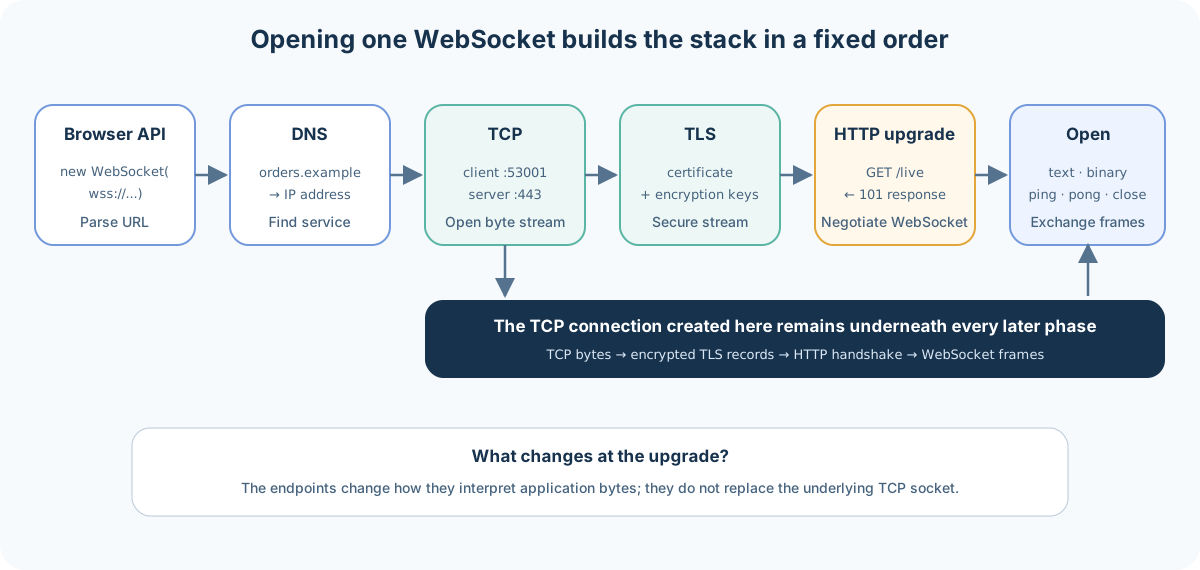
For an order update to reach the page without a new HTTP request, the browser and server establish the following chain:
new WebSocket(url)
    -> DNS, TCP, and TLS
    -> HTTP WebSocket upgrade
    -> text/binary messages and WebSocket frames
    -> ping, pong, and close
    -> listening and connected sockets
    -> file descriptor and Connection object
    -> epoll readiness and event-loop callbacks
    -> application routing and output queues
    -> reconnect, replay, and gateway-fleet routing
The browser exposes this chain as one WebSocket object. Behind it, TCP keeps an ordered byte stream, TLS protects that stream, and WebSocket adds message boundaries and control frames. On the server, an accepted socket is associated with protocol state, an authenticated session, subscriptions, timers, and queued output.
Most connections are idle most of the time. Their state remains in memory while an event loop waits for useful work instead of assigning a waiting thread to every client. When the order service produces an update, application routing finds the correct live connection and its owner sends the corresponding WebSocket message.
If the network changes or a gateway fails, that transport connection cannot be moved or repaired. The client opens a new one, and the application restores identity, subscriptions, and missed events from state that lives outside the WebSocket.
What to remember: WebSocket solves long-lived, two-way message transport. It does not by itself make messages durable or reconstruct a session after a connection fails.
2. Opening a WebSocket from the Browser
Suppose the order page runs:
const socket = new WebSocket("wss://orders.example.com/live");

socket.addEventListener("open", () => {
    console.log("order stream is ready");
});

socket.addEventListener("message", event => {
    renderOrderUpdate(JSON.parse(event.data));
});

socket.addEventListener("close", event => {
    scheduleReconnect(event.code);
});
orders.example.com is an intentionally fictional hostname used throughout the explanation; this snippet will not connect as written. To run it, replace the URL with a WebSocket endpoint you control. The later C++ fragments expose individual server mechanisms and fit together as one design, but they omit the TLS library, HTTP parser, WebSocket codec, error plumbing, and build setup required for a production server.
The constructor returns a JavaScript object immediately while connection setup continues asynchronously. Its readyState moves through four values:
| Browser state | Numeric value | Meaning |
|---|---|---|
CONNECTING | 0 | DNS, TCP, TLS, or the WebSocket handshake is still in progress. |
OPEN | 1 | The opening handshake succeeded and messages can be exchanged. |
CLOSING | 2 | The closing handshake has started. |
CLOSED | 3 | The connection closed or never opened successfully. |
The browser reports lifecycle through open, message, error, and close events. Calling send() while the object is still CONNECTING throws an error; application code normally waits for open.
This one constructor starts several protocols underneath the object. Understanding their order is the foundation for everything the server does later.
The kernel is the privileged core of the operating system. Among other jobs, it owns network interfaces, the TCP implementation, sockets, and their buffers. Browser and gateway code run in userspace and ask the kernel to perform network operations through system calls.
The layers are not interchangeable:
| Term | Direct definition |
|---|---|
| DNS | Translates a service name such as orders.example.com into network addresses. |
| IP | Moves packets between network interfaces identified by IP addresses. |
| TCP | Creates one reliable, ordered byte stream between two endpoints. |
| TLS | Encrypts that byte stream and authenticates the server. |
| HTTP upgrade | Negotiates changing the application protocol on the existing connection. |
| WebSocket | Frames text, binary data, and control signals over the established stream. |
Step 1: Find the Service
The URL contains four useful instructions:
wss                       use WebSocket over TLS
orders.example.com        find this service through DNS
443                       use the default wss destination port
/live                     request this WebSocket endpoint
DNS is the naming system the client uses to obtain one or more IP addresses for orders.example.com. It commonly returns an edge proxy or load balancer—a front server that accepts or forwards connections—rather than the gateway process that ultimately handles WebSocket messages.
Several hostnames can share the same edge address. TLS Server Name Indication (SNI) carries the requested hostname during TLS setup. Together with the later HTTP Host header and request path, it helps the edge select the intended certificate and service.
The URL identifies where and how to start connecting. It does not uniquely identify the resulting connection: one browser can open several WebSockets to the same URL.
Step 2: Establish TCP and TLS
The client asks its operating system to create a TCP connection to the selected address and port. A TCP connection is a kernel-maintained, reliable, ordered byte stream between two endpoints. TCP handles sequence numbers, acknowledgements, retransmission, congestion control, and flow control.
Sequence numbers let TCP restore byte order. Retransmission replaces detected missing data. Flow control prevents a fast sender from overwhelming the receiver’s buffers; congestion control reduces sending pressure when the network path appears overloaded.
Because the scheme is wss://, the endpoints next perform a TLS handshake over that TCP connection. TLS establishes encryption keys, authenticates the server certificate, and protects subsequent bytes from observation or modification in transit.
At this point there is still no open WebSocket. There is an encrypted TCP channel on which the client can attempt the WebSocket opening handshake.
Step 3: Upgrade the Connection
The connection starts with HTTP because HTTP already provides the web-facing setup mechanisms the service needs: host and path routing, cookies and other authentication information, browser Origin, and integration with proxies and load balancers that support WebSocket upgrades. The server can inspect those details and accept or reject the connection before creating a long-lived WebSocket session.
HTTP’s normal protocol is still request followed by response. It does not let either endpoint subsequently send a WebSocket frame whenever it wants. Client and server therefore need an explicit point at which they agree to stop parsing ordinary HTTP messages and start parsing WebSocket frames.
That agreement is the HTTP upgrade. It does not replace TCP, create a second connection, or add encryption. It changes the application protocol spoken over the TCP and TLS connection that already exists:
before 101 response   interpret application bytes as HTTP
after 101 response    interpret application bytes as WebSocket frames
Without this agreement, one side could send WebSocket frames while the other continued waiting for an HTTP request, causing the same bytes to be interpreted under different rules.
For the common HTTP/1.1 WebSocket form, the client makes that request as:
GET /live HTTP/1.1
Host: orders.example.com
Upgrade: websocket
Connection: Upgrade
Sec-WebSocket-Key: <random nonce>
Sec-WebSocket-Version: 13
Origin: https://www.example.com
Sec-WebSocket-Protocol: orders.v1
The server validates the request, selects the /live endpoint, applies origin and authentication policy, and returns:
HTTP/1.1 101 Switching Protocols
Upgrade: websocket
Connection: Upgrade
Sec-WebSocket-Accept: <value derived from the client's nonce>
Sec-WebSocket-Protocol: orders.v1
The WebSocket-specific headers have separate purposes:
| Header | Purpose |
|---|---|
Upgrade: websocket | Request or confirm the WebSocket protocol transition. |
Connection: Upgrade | Mark Upgrade as applying to this connection. |
Sec-WebSocket-Version: 13 | State the protocol version defined by RFC 6455. |
Sec-WebSocket-Key | Supply a fresh browser nonce for handshake verification. |
Sec-WebSocket-Accept | Prove the server processed that nonce as a WebSocket server. |
Origin | Tell the server which web origin initiated the browser connection. |
Sec-WebSocket-Protocol | Negotiate one application-level subprotocol. |
The server computes Sec-WebSocket-Accept by appending the protocol’s fixed GUID to the client’s key, hashing the result with SHA-1, and Base64-encoding the hash:
accept = Base64(SHA-1(clientKey + WebSocketGUID))
The Sec-WebSocket-Key proves that the server understood the WebSocket handshake. It is not a password, session token, or encryption key. User identity comes from a separate mechanism such as a cookie, a short-lived connection ticket, or an authenticated first application message.
This constraint matters in browsers: the standard WebSocket constructor accepts a URL and optional subprotocol names, but no arbitrary request-header map. Browser applications therefore cannot simply attach a custom Authorization header as they might with fetch().
Common browser authentication patterns include:
- an existing secure, same-site cookie sent with the handshake
- a short-lived, single-use connection ticket in the URL
- an authentication message sent immediately after
open
Long-lived bearer tokens in URLs are risky because URLs can appear in logs and monitoring systems. Cookie-based servers validate Origin because a malicious page may otherwise ask the victim’s browser to open a credentialed WebSocket.
Before sending 101, the server can reject the request as ordinary HTTP—for example with 401, 403, or 404. Browser JavaScript generally receives an error and eventual close, not unrestricted access to the failed handshake response.
Subprotocols and Extensions
WebSocket defines transport messages but not the meaning of an order message. A subprotocol names an application protocol layered on top. The browser can offer one or more names:
const socket = new WebSocket(
    "wss://orders.example.com/live",
    ["orders.v2", "orders.v1"]
);
The request lists those names in Sec-WebSocket-Protocol. The server selects at most one offered value and returns it in the response. After opening, socket.protocol contains the selected name. This prevents client and server from silently speaking incompatible application formats.
An extension changes how WebSocket itself operates. Extensions are offered and accepted through Sec-WebSocket-Extensions; the browser exposes the negotiated result through socket.extensions. A common example is permessage-deflate, which compresses message data. Compression reduces bandwidth but adds CPU, memory, latency, and security considerations, so the gateway includes it in capacity testing rather than treating it as free.
Status 101 Switching Protocols is the server’s confirmation. Only after the browser validates that response does the WebSocket become OPEN. The complete stack is now:
TCP connection
    -> TLS session
    -> HTTP Upgrade request and response
    -> WebSocket frames
If the open Event Never Fires
The browser deliberately exposes little detail about a failed handshake to JavaScript, but its developer tools and the server logs can locate the failed phase. Check in this order:
| Observation | Likely area to inspect |
|---|---|
| No network request appears | Invalid URL, page code did not run, or browser policy blocked it. |
| DNS or connection error | Hostname, port, firewall, listener, or load-balancer routing. |
| TLS or certificate error | Certificate name, trust chain, expiry, or TLS configuration. |
HTTP response is not 101 | Path, authentication, Origin, upgrade headers, or proxy configuration. |
| Server selects no offered protocol | Client and server subprotocol lists do not overlap. |
101 succeeds, then immediate close | Invalid first frame, failed first-message authentication, or application policy. |
An HTTPS page should normally use wss://; browsers block insecure active content in secure pages. At a reverse proxy, both the Upgrade and connection-upgrade intent must reach the upstream. On the server, log a handshake request ID, rejection reason, selected subprotocol, and eventual Close code without logging credentials or URL tokens.
Step 4: Exchange Messages
After the 101 response, HTTP parsing stops on this connection. Both endpoints now interpret the following bytes as WebSocket frames.
The browser API presents messages. The wire protocol transports those messages in one or more frames:
socket.send(JSON.stringify({ type: "subscribe", orderId: "A123" }));
Conceptually, that call follows this path:
JavaScript string
    -> one WebSocket text message
    -> one or more masked client frames
    -> TLS records
    -> TCP byte stream
A WebSocket message is either text or binary. Text must be valid UTF-8. Binary is an uninterpreted sequence of bytes; the application decides whether those bytes contain an image, Protocol Buffers, MessagePack, or something else. In a browser, incoming text is delivered as a string. Incoming binary is a Blob by default, or an ArrayBuffer after setting:
socket.binaryType = "arraybuffer";
A Frame Header Gives Bytes Meaning
Each frame begins with a compact header. The important fields are:
| Field | What it tells the receiver |
|---|---|
FIN | Whether this is the final frame of the current message. |
RSV1–3 | Extension bits; zero unless a negotiated extension defines them. |
opcode | Whether the frame starts text/binary data, continues a message, or carries a control signal. |
MASK | Whether a four-byte masking key is present. |
| payload length | How many payload bytes follow; larger lengths use extra header bytes. |
| masking key | Four bytes used to unmask client-to-server payload. |
| payload | Message data or control-frame data. |
The first two header bytes therefore answer most immediate parsing questions: is the message finished, what kind of frame is this, is it masked, and how is its length encoded? The decoder may still need more bytes before the full header or payload is available.
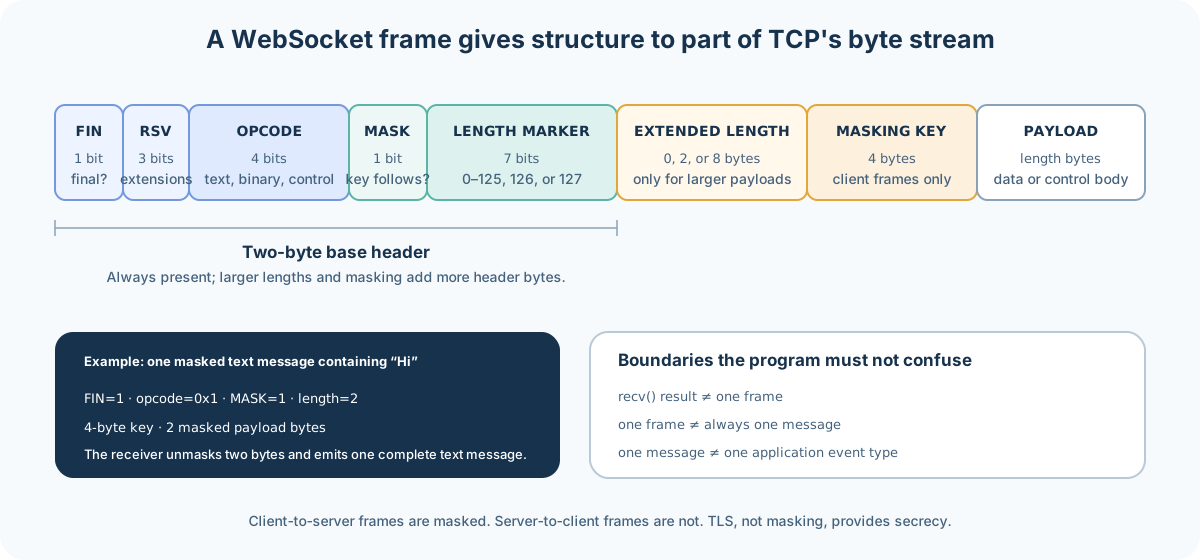
The defined opcodes are small but important:
| Opcode | Frame type | Role |
|---|---|---|
0x0 | Continuation | Continue a fragmented text or binary message. |
0x1 | Text | Start a UTF-8 text message. |
0x2 | Binary | Start a binary message. |
0x8 | Close | Begin or acknowledge the closing handshake. |
0x9 | Ping | Ask the peer for a Pong. |
0xA | Pong | Reply to a Ping, carrying the same application data. |
Other opcodes are either reserved for future use or invalid unless an extension defines them.
Messages Can Span Frames
Fragmentation lets one message be divided across frames. A large text message might arrive as:
text frame, FIN=0          starts the message
continuation, FIN=0        adds more payload
continuation, FIN=1        finishes the message
The browser normally hides those boundaries: its message event fires after the complete message has been reassembled. A server decoder, however, must remember the message type and accumulated data across reads and frames. It must also enforce a maximum message size while accumulating; otherwise a peer can consume unbounded memory without ever setting FIN.
A Ping, Pong, or Close frame may appear between fragments. These control frames must be handled immediately rather than appended to the data message. Control frames are never fragmented and their payload is at most 125 bytes.
Reads Do Not Match Frames
TCP preserves byte order but not WebSocket boundaries. One recv() can return:
half of a frame header
one complete frame plus part of the next
several complete frames
The server therefore appends received bytes to an input buffer and runs an incremental decoder. The decoder reads a header only when enough header bytes exist, waits for the stated payload length, validates the frame, and then continues with any bytes left in the buffer. Section 6 implements this process.
WebSocket messages from one endpoint arrive in their sent order because they share one ordered TCP stream. WebSocket does not provide named channels or message priorities within that stream. A very large message can delay a small urgent message behind it, so applications that need independent traffic classes may use separate connections or a carefully designed subprotocol.
Client Frames Are Masked, Not Encrypted
Every frame sent by a client to a server must have MASK=1 and use a newly chosen unpredictable four-byte key. The payload byte at position i is XORed with key byte i mod 4. The server reverses the same operation before interpreting the payload. Frames sent by a server to a client are not masked.
Masking prevents client-controlled bytes from looking like another protocol to broken intermediaries. It does not make the contents secret: the key is inside the frame. wss:// and TLS provide confidentiality and integrity.
Ping, Pong, and Application Heartbeats
Ping and Pong test whether the WebSocket path is responsive. When an endpoint receives a Ping, it sends a Pong with the same payload. A server can measure the time between its Ping and the matching Pong and close a connection that misses a deadline.
Browser JavaScript cannot construct protocol Ping or Pong frames. The browser handles incoming Ping and the required Pong internally. If browser code needs to observe liveness itself, the application defines ordinary messages such as {"type":"heartbeat"} and {"type":"heartbeat_ack"}. Section 8 explains why heartbeats are needed even when a socket appears open.
Closing Is a Protocol Exchange
socket.close(code, reason) sends a Close control frame and moves the browser to CLOSING. The peer normally replies with its own Close frame, after which the TCP connection is closed. The code communicates a broad reason:
| Code | Typical meaning |
|---|---|
1000 | Normal completion. |
1001 | Endpoint is going away, such as a page navigation or server drain. |
1002 | The peer violated the WebSocket protocol. |
1008 | Application policy violation. |
1009 | Message is too large. |
1011 | Server hit an unexpected condition. |
Not every valid wire-level code can be supplied to the browser’s close() method. Browser JavaScript may specify 1000 or an application code from 3000 through 4999; servers and browser internals can use other defined protocol codes such as 1001 or 1002.
Code 1006 is special: APIs use it to report that the connection ended abnormally without receiving a Close frame. An endpoint never sends 1006 in a frame. The browser’s close event also exposes reason and wasClean, but applications should still treat reconnect and state recovery as explicit work.
send() Can Queue Data
An open socket is not proof that the network can currently keep up. Browser send() queues data and returns; it does not wait for the peer to receive it. socket.bufferedAmount reports application bytes queued by prior send() calls that have not yet been passed to the network. It excludes WebSocket framing overhead and buffering deeper in the operating system or network.
The browser API has no general drain event. A producer that may outrun the connection must check bufferedAmount, pace or coalesce updates, and impose a limit instead of building an unlimited queue. The server needs the same policy for its own output queues, as Section 7 shows.
This distinction matters to the server:
TCP                    ordered bytes, no message boundaries
WebSocket               frames and text/binary messages
order-tracking protocol event types, sequence numbers, payloads
The network transports bytes. The WebSocket layer validates frames and reconstructs messages. The order application decides what those messages mean and whether they require acknowledgement, storage, replay, or deduplication.
What to remember:
new WebSocket(...)asynchronously builds WebSocket framing on top of TCP and usually TLS. The browser exposes complete text or binary messages; the wire carries frames, plus Ping, Pong, and Close control frames.send()queues data—it does not prove delivery.
3. Connection Identity and Network Changes
Now that a WebSocket has a place in the stack, we can answer a practical question: what exactly is the connection that stays open, and why does it stop working when the client moves to a different network?
This section uses a small networking model to support the WebSocket lifecycle. The point is not to turn the article into a TCP guide. The point is to separate transport identity from application identity, because that separation explains client IP changes, NATs, proxies, reconnects, and server-side routing.
Server Ports and Client Ports Have Different Roles
An IP address identifies a network interface at the IP layer. A port is a 16-bit TCP or UDP endpoint number on a host. A socket is the kernel object that holds the communication endpoint and its protocol state.
The server binds a listening socket to a well-known address and port. A listening socket waits for new TCP connection attempts; it does not represent one authenticated WebSocket client. Production wss:// traffic commonly arrives on port 443.
The client normally does not listen on a famous port. When it creates an outbound connection, its operating system selects a temporary, or ephemeral, source port.
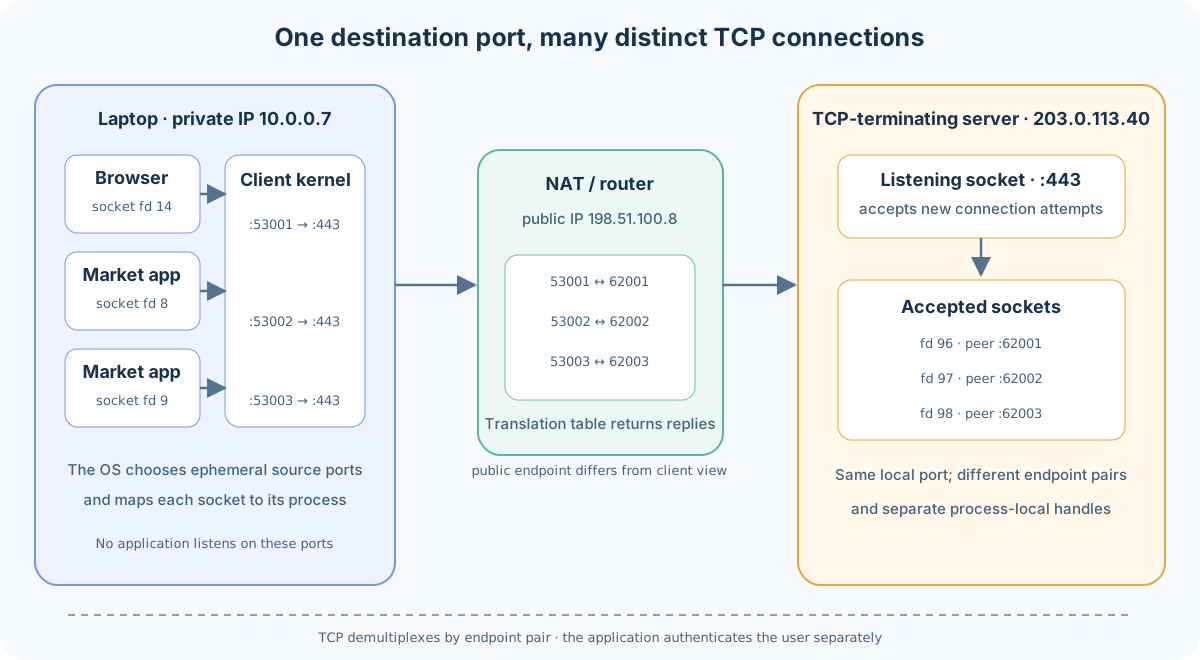
One laptop might therefore have:
browser:      10.0.0.7:53001 -> 203.0.113.40:443
market app:   10.0.0.7:53002 -> 203.0.113.40:443
market app:   10.0.0.7:53003 -> 203.0.113.40:443
chat app:     10.0.0.7:53001 -> 192.0.2.25:443
The chat connection can reuse source port 53001 because its destination is different. TCP does not identify a connection by one port. A connection is defined by its two endpoints; for packet demultiplexing it is commonly written as:
(protocol, source IP, source port, destination IP, destination port)
Here, protocol means TCP at the IP layer, not WebSocket. WebSocket frames are inside the TCP byte stream and, for wss://, inside TLS as well.
The client kernel uses the complete endpoint pair to find the correct socket. That socket belongs to a process, which accesses it through a local handle. Packets do not contain the application name or authenticated user ID.
One Listener, Many Connected Sockets
The listening socket is not used to carry every client’s WebSocket messages. It receives new TCP connection attempts. After the TCP handshake completes, accept() returns a new connected socket for one client while leaving the listener available for later clients.
listening socket on :443
    |
    +-- accept() -> client A socket -> fd 96
    +-- accept() -> client B socket -> fd 97
    +-- accept() -> client C socket -> fd 98
All three connected sockets can have local port 443; their remote endpoints differ. The server’s kernel therefore knows which received bytes belong in which socket buffer.
accept() is a TCP operation. It does not authenticate the user or complete the WebSocket upgrade. Those steps happen later on the accepted socket.
The four server operations have direct meanings:
socket()   create a kernel socket and return its file descriptor
bind()     assign the socket a local address and port
listen()   mark it as a listener and create connection queues
accept()   take one completed connection and return a new connected socket
In abbreviated C++, listener setup looks like:
int listenFd = ::socket(
    AF_INET,
    SOCK_STREAM | SOCK_NONBLOCK | SOCK_CLOEXEC,
    0
);

::bind(listenFd, serverAddress, serverAddressLength);
::listen(listenFd, SOMAXCONN);

// Later, when a completed connection is queued:
int clientFd = ::accept4(
    listenFd,
    nullptr,
    nullptr,
    SOCK_NONBLOCK | SOCK_CLOEXEC
);
listenFd continues to represent the service endpoint. clientFd represents one accepted TCP connection. Real code checks every return value and normally sets options such as address reuse before bind().
In the flags above, AF_INET selects IPv4, SOCK_STREAM selects byte-stream semantics used by TCP, SOCK_NONBLOCK enables non-blocking operations, and SOCK_CLOEXEC prevents an unrelated program launched with exec() from inheriting the descriptor. SOMAXCONN asks Linux for its configured maximum listener backlog—the queue limit for completed connections waiting to be accepted.
NAT and Proxies Change What Each Hop Sees
Network Address Translation (NAT) rewrites address and often port fields while retaining a table that can reverse the translation for reply traffic. A home router or carrier NAT can translate the browser’s private endpoint:
inside:   10.0.0.7:53001
outside:  198.51.100.8:62001
target:   203.0.113.40:443
The client kernel sees the inside endpoint. The Internet-facing peer sees the outside endpoint. The NAT keeps a table so reply traffic returns to the correct device and socket. That is how many devices can share one public IPv4 address.
A Layer 4, or L4, load balancer works mainly with IP and TCP information and may translate addresses while forwarding a flow. A Layer 7, or L7, proxy understands an application protocol such as HTTP. It can terminate the client connection and open another connection to the gateway:
client <== TCP connection A ==> proxy <== TCP connection B ==> gateway
The gateway may therefore see the proxy as its TCP peer. A trusted proxy can forward the original address for logging or rate limiting, but that address is not socket identity and must not be treated as authenticated user identity.
A Network Change Creates a New Connection
If the laptop moves from Wi-Fi to a mobile network, its source address and NAT mapping change. Ordinary TCP cannot attach the new address to the established endpoint pair. The old connection is no longer a usable path.
Neither endpoint necessarily discovers the failure immediately. A socket can still appear ESTABLISHED while packets disappear into the old path. A failed write, TCP timeout, keepalive probe, or WebSocket heartbeat eventually exposes the failure.
The client then creates a new TCP connection, negotiates TLS again, repeats the WebSocket handshake, authenticates, and restores application state. This is a new transport connection even if the operating system happens to reuse a port number.
Similarly, changing a DNS record does not move an established connection. DNS selects an endpoint when a connection is created; a new answer affects a later connection or reconnect.
Do Not Collapse the Identity Layers
The running example has several identifiers because each layer answers a different question:
| Layer | Example | What it identifies | Survives reconnect? |
|---|---|---|---|
| Service | wss://orders.example.com/live | Where a new client should connect | Usually |
| TCP endpoint pair | 198.51.100.8:62001 <-> 203.0.113.40:443 | One connection at one TCP hop | No |
| File descriptor | 96 | A handle inside one process | No |
| Connection ID | 1041 | One logical socket lifetime in the gateway | No |
| Session and user | tab-8, user 42 | Authenticated application identity | Can |
The network routes packets using addresses. The kernel demultiplexes TCP using endpoint pairs. The process uses a file descriptor. The gateway uses a generation-safe connection ID. The order service routes an update using user or subscription identity.
That separation is the mental model for the rest of the article.
Scope: The implementation below models the common HTTP/1.1 upgrade case, where one WebSocket uses one TCP connection. HTTP/2 extended
CONNECTcan carry several logical WebSockets as separate streams over one TCP connection. In that model, the stream ID adds another demultiplexing layer, but the same ownership and backpressure principles still apply.
What to remember: A server port is a meeting point for new connections, not a unique connection ID. The kernel distinguishes established TCP connections by their complete endpoint pairs and gives the process a separate descriptor for each accepted socket.
4. What a WebSocket Server Keeps Open
Once the upgrade succeeds, no thread needs to execute continuously to keep the connection alive. State remains in the kernel and in the gateway process.
This is the first important separation between state and execution. A connection can continue to exist while no CPU instruction is currently being executed for it.
Kernel State
For every TCP connection, the kernel tracks information such as:
- local and remote addresses and ports
- TCP sequence and acknowledgement numbers
- retransmission and congestion-control state
- receive and send buffers
- negotiated TCP options
- lifecycle state such as
ESTABLISHEDorCLOSE_WAIT
Received bytes remain in the socket receive buffer until the application reads them. Bytes accepted from the application remain in the send path while TCP transmits and acknowledges them.
For the running connection, an incoming packet follows this path:
network interface receives packet
    -> kernel IP and TCP code identifies the endpoint pair
    -> TCP validates ordering and sequence numbers
    -> payload is appended to this socket's receive buffer
    -> socket becomes readable
    -> gateway can copy the available bytes with recv()
The kernel does not parse those bytes as JSON or associate them with user 42. That work belongs to the gateway process after the bytes are read.
The File Descriptor
Linux exposes the accepted socket to the process as a file descriptor:
int clientFd = ::accept4(
    listenFd,
    nullptr,
    nullptr,
    SOCK_NONBLOCK | SOCK_CLOEXEC
);
The descriptor is not the network identity or the user. It is a small integer index in one process’s descriptor table. Another process can also have an unrelated descriptor 96, and Linux can reuse 96 after this socket closes.
Delayed work must therefore not identify a logical connection by descriptor alone. A gateway assigns a monotonically increasing connection ID or generation and validates it before applying asynchronous results.
The Userspace Connection Object
The kernel transports bytes but knows nothing about users, subscriptions, partially decoded WebSocket messages, or application delivery policy. The gateway keeps that state in a connection object:
struct Connection {
    ConnectionId id;                  // 1041
    int fd;                           // 96, valid only in this process
    Phase phase;                      // handshake, open, closing
    std::optional<UserId> userId;     // 42 after authentication

    InputBuffer input;
    std::deque<PendingWrite> output;
    std::size_t queuedBytes = 0;

    TimePoint lastActivity;
    TimePoint heartbeatDeadline;
};
An idle connection therefore consumes some combination of:
one file descriptor
+ kernel TCP state and socket buffers
+ optional TLS state
+ one userspace Connection object
+ subscriptions and timers
+ event-loop registration
Idle is cheaper than active, but not free. Output queued for a slow client can cost much more memory than the base connection object, so real capacity must be measured under a realistic workload.
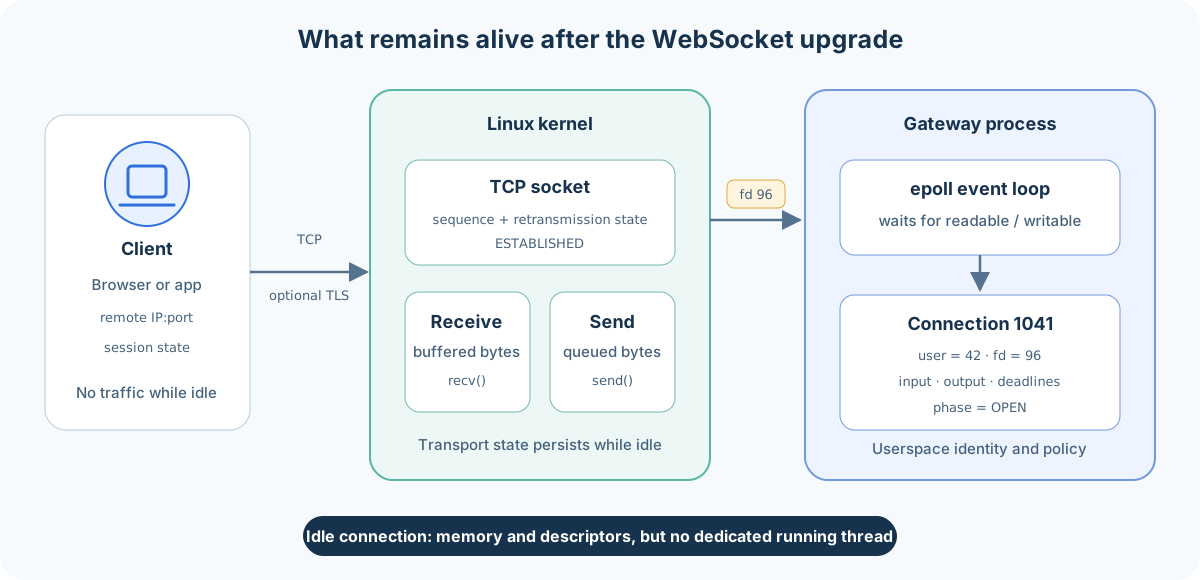
What to remember: The kernel owns TCP transport state and byte buffers. The gateway owns protocol parsing, authenticated identity, subscriptions, timers, and delivery policy. An idle connection retains both kinds of state without requiring a dedicated running thread.
5. Server Internals: Waiting for Many WebSockets
An event loop is a thread that repeatedly waits for events and invokes the short handlers responsible for them. It is a scheduling structure, not a separate network protocol.
The problem in this section is waiting. A gateway may own 100,000 connections, while only a few hundred have work at a given instant. How does one thread find those few without checking every socket continuously?
The first-pass answer is short:
make sockets non-blocking
    -> ask Linux to report which sockets may make progress
    -> handle only those sockets
    -> return to waiting
On Linux, the reporting mechanism is epoll. The next two subsections explain why blocking I/O is replaced by non-blocking I/O. That model is enough to continue to the connection lifecycle in Section 6. The detailed epoll subsections are implementation depth for readers designing or debugging a gateway runtime.
The Blocking Model
A blocking operation suspends its calling thread until it can make progress. With TLS and detailed error handling omitted, the simplest server gives every connection a blocking loop:
void handleClient(int fd) {
    performWebSocketHandshake(fd);

    while (auto message = readWebSocketMessage(fd)) {
        processMessage(fd, *message);
    }

    ::close(fd);
}
When no bytes are available, the thread sleeps inside recv(). This is easy to reason about for one client: execution resumes when that client sends data.
The expensive version is one operating-system thread per connection. Every thread needs stack and scheduler state even though most spend nearly all their time asleep. A burst can also wake thousands of threads and make the scheduler move among them.
The scalable goal is not to eliminate threads. It is to multiplex many logical connections over a much smaller number of threads.
What Non-Blocking Mode Changes
A non-blocking socket makes an operation return instead of suspending the thread when it cannot make progress immediately. Linux reports that case with EAGAIN or EWOULDBLOCK:
ssize_t count = ::recv(fd, buffer, capacity, 0);

if (count == -1 &&
    (errno == EAGAIN || errno == EWOULDBLOCK)) {
    // Reading now would block. Let another connection run.
}
The important recv() outcomes are:
| Result | Meaning |
|---|---|
count > 0 | This many bytes were copied from the kernel receive buffer. |
count == 0 | The peer performed an orderly TCP shutdown. |
EAGAIN | No bytes can be read without waiting right now. |
| another error | The read path failed and the connection usually closes. |
Non-blocking mode prevents one idle socket from stopping the thread. It does not tell the thread which socket has data.
The server could scan every descriptor:
for each of 100,000 connections:
    call recv()
    usually receive EAGAIN
repeat
That spends CPU repeatedly proving that idle sockets are still idle. The kernel already knows when bytes enter a socket buffer, so the process needs a way to ask the kernel for only the sockets whose state may allow progress.
Optional Deep Dive: the epoll API and Its Semantics
epoll is a Linux readiness-notification interface. It lets a process register file descriptors and block one thread until the kernel reports that one or more registered objects may be ready for I/O.
The receptionist analogy captures only the scheduling idea: the event loop does not call every room; it receives the list that currently needs attention. From this point onward, the real actors are file descriptors, kernel socket buffers, an epoll ready list, and an event-loop thread.
epoll has three core operations:
| Operation | Direct meaning |
|---|---|
epoll_create1() | Create an empty kernel epoll instance and return its descriptor. |
epoll_ctl() | Add, modify, or remove a watched descriptor. |
epoll_wait() | Sleep until registrations are ready, then copy their event records to userspace. |
The epoll descriptor is itself a process-local file descriptor. It represents the kernel object that owns the watch set; it is not a client connection.
Registering Interest
The server first creates an epoll instance and registers its listening socket:
constexpr std::uint64_t kListenerToken = 0;

int epollFd = ::epoll_create1(EPOLL_CLOEXEC);

epoll_event listenerEvent{};
listenerEvent.events = EPOLLIN;
listenerEvent.data.u64 = kListenerToken;

::epoll_ctl(
    epollFd,
    EPOLL_CTL_ADD,
    listenFd,
    &listenerEvent
);
Read this code as:
create an epoll watch set
    -> add listenFd
    -> report when accepting may make progress
    -> return token 0 with that event
When client fd 96 is accepted, the gateway assigns connection ID 1041 and registers the socket separately:
epoll_event clientEvent{};
clientEvent.events = EPOLLIN | EPOLLRDHUP;
clientEvent.data.u64 = 1041;

::epoll_ctl(
    epollFd,
    EPOLL_CTL_ADD,
    96,
    &clientEvent
);
The most relevant flags are:
| Flag | What the event means |
|---|---|
EPOLLIN | Reading may make progress without blocking. |
EPOLLOUT | Writing may make progress without blocking. |
EPOLLRDHUP | The stream peer closed its writing side or closed the connection. |
EPOLLERR | An error is pending on the underlying object. |
EPOLLHUP | The object has been hung up. |
EPOLLOUT is normally enabled only while the application has queued output. A healthy stream socket is often writable, so watching it permanently can produce events even when the application has nothing to send. EPOLLERR and EPOLLHUP are reported when present even if the application did not explicitly request them.
The data.u64 field is opaque application data returned with the event. Using connection ID 1041 rather than fd 96 lets dispatch validate the logical connection generation.
Interest Set and Ready Set
Suppose the process currently owns:
fd 4   listening socket
fd 8   eventfd used to wake the loop
fd 96  connection 1041 — idle
fd 97  connection 1042 — received bytes
fd 98  connection 1043 — has queued output
Its conceptual epoll state might be:
interest set
    fd 4  -> EPOLLIN
    fd 8  -> EPOLLIN
    fd 96 -> EPOLLIN | EPOLLRDHUP
    fd 97 -> EPOLLIN | EPOLLRDHUP
    fd 98 -> EPOLLIN | EPOLLOUT | EPOLLRDHUP

ready now
    fd 97 -> EPOLLIN
    fd 98 -> EPOLLOUT
The interest set describes what the process wants to hear about. The ready set contains registrations whose current state satisfies that interest. epoll_wait() returns records from the ready set, not every watched descriptor.
What Happens When a Packet Arrives
For connection 1042, the path is conceptually:
1. A network packet arrives at the machine.
2. The kernel's IP and TCP code matches its endpoint pair to fd 97's socket.
3. TCP validates and orders the payload, then appends bytes to the receive queue.
4. The socket changes from not-readable to readable.
5. Its epoll registration becomes ready.
6. The kernel wakes a thread sleeping in epoll_wait().
7. epoll_wait() returns { connectionId: 1042, events: EPOLLIN }.
8. The event loop finds Connection 1042 and calls its readable handler.
9. The handler calls recv() until EAGAIN or its work budget is exhausted.
epoll does not copy WebSocket payload into the application’s input buffer. It only reports readiness. The later recv() performs the byte copy, and the WebSocket decoder interprets those bytes.
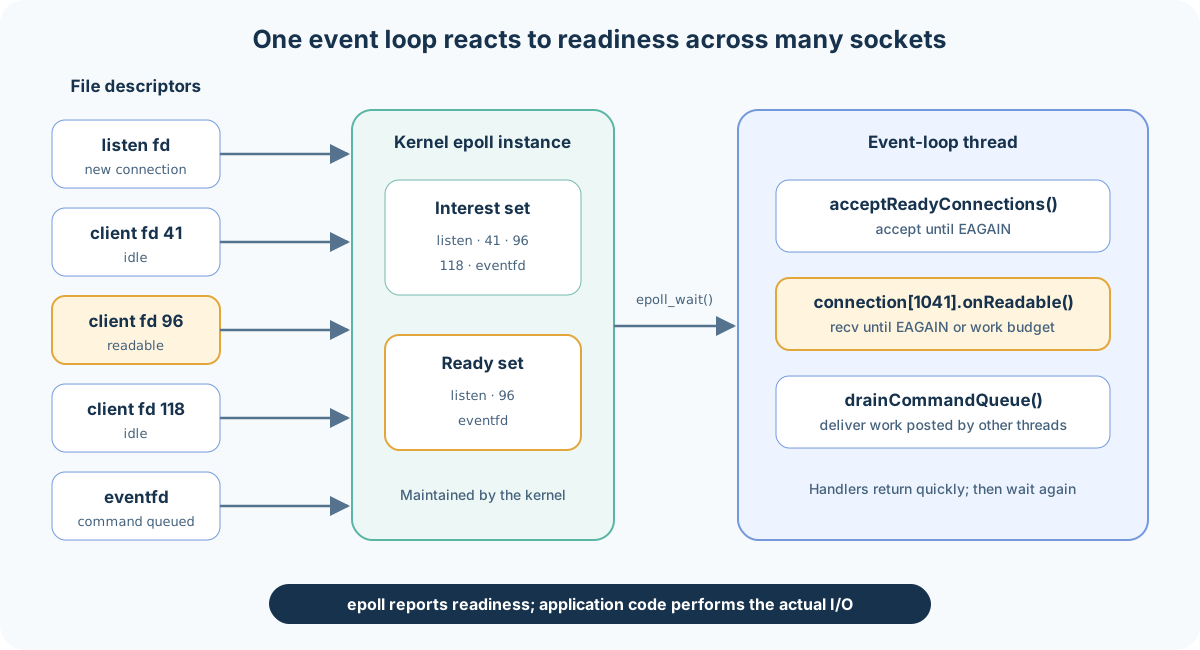
Waiting and Dispatching
The event loop repeatedly waits and dispatches short handlers:
while (running) {
    int count = ::epoll_wait(
        epollFd,
        events.data(),
        static_cast<int>(events.size()),
        -1  // wait indefinitely; timers and eventfd can wake the loop
    );

    if (count == -1) {
        if (errno == EINTR) {
            continue;
        }
        throw std::system_error(errno, std::generic_category());
    }

    for (int i = 0; i < count; ++i) {
        const epoll_event& event = events[i];

        if (event.data.u64 == kListenerToken) {
            acceptReadyConnections();
        } else {
            dispatchConnectionEvent(event);
        }
    }
}
EINTR means a signal interrupted the wait before it produced a normal result; the loop can retry. Other errors indicate that the wait itself failed.
A timeout of -1 means wait indefinitely. Production loops also register a timer source or calculate a finite timeout so heartbeat and shutdown deadlines can wake the loop.
Readiness Is Not Completion
An EPOLLIN event does not mean that a complete WebSocket message is waiting. It means a read may currently make progress. The available bytes could contain half an HTTP header, one WebSocket frame header, several messages, or a peer shutdown indication.
Likewise, EPOLLOUT does not mean the remote browser received anything. It means the local socket may currently accept some bytes into its send path.
Readiness can also change between notification and the system call. Handlers must still process the actual result from accept4(), recv(), or send() and must always tolerate EAGAIN.
Accept Until EAGAIN
One listener notification can correspond to several queued connections. The handler accepts until none can be obtained without waiting:
void EventLoop::acceptReadyConnections() {
    while (true) {
        int fd = ::accept4(
            listenFd_, nullptr, nullptr,
            SOCK_NONBLOCK | SOCK_CLOEXEC
        );

        if (fd >= 0) {
            addConnection(fd);
        } else if (errno == EINTR) {
            continue;
        } else if (errno == EAGAIN || errno == EWOULDBLOCK) {
            return;
        } else {
            recordAcceptError(errno);
            return;
        }
    }
}
addConnection() assigns a connection ID, stores the Connection, and registers the descriptor. The listener remains registered for future clients.
Level-Triggered and Edge-Triggered Readiness
By default, epoll is level-triggered. As long as unread bytes remain, the socket continues to satisfy readable interest and can be returned by a later epoll_wait():
level-triggered
    unread bytes remain -> socket remains readable -> another event can arrive
With EPOLLET, readiness is edge-triggered. The application is notified when the state changes to ready. It must drain the non-blocking operation until EAGAIN; leaving bytes unread may not produce another readiness transition:
edge-triggered
    not ready -> ready -> one edge
    handler must drain until EAGAIN
Edge-triggered operation can reduce repeated notifications, but it makes missed drains more dangerous. A level-triggered loop is easier to introduce and debug. The handlers in this article drain operations but assume the default level-triggered registration unless stated otherwise.
Ownership and Fairness
One event loop should normally own a connection for its entire lifetime. Only that loop reads its socket, advances parsing state, changes write interest, and destroys it. Other threads submit commands to the owner instead of mutating the connection directly. This turns many locking problems into ordered events.
Draining forever would create a different problem: one busy connection could starve all other ready connections. Production loops impose a budget such as a maximum number of bytes, messages, or microseconds per callback. If the budget is exhausted before EAGAIN, level-triggered readiness can return the socket again on a later turn.
What to remember: Non-blocking mode prevents one socket operation from suspending the thread.
epolltells that thread which registered descriptors may currently make progress. The event loop still performs the actualaccept4(),recv(), andsend()operations and must handle their real results.
6. The Gateway Lifecycle of One WebSocket
An accepted socket is not immediately ready for application messages. It moves through a series of partial, failure-prone phases.
A state machine represents this lifecycle as a current phase plus the events that are allowed to move it to another phase. The connection object stores the phase because one callback may receive only enough bytes to make part of a transition.
These are gateway phases, not the four browser readyState values from Section 2. In particular, the browser becomes OPEN when it accepts the 101 response. The application may still restrict that WebSocket to one authentication message before allowing normal subscriptions or commands.
The phases have direct meanings:
| Phase | What the gateway is doing |
|---|---|
| Accepted | The TCP socket exists, but higher-level setup is incomplete. |
| TLS handshake | Negotiate encryption when TLS terminates at this gateway. |
| Opening handshake | Validate HTTP headers, origin, path, and any cookie or ticket authentication; then send 101. |
| WebSocket open | The WebSocket protocol is active; optionally allow only a first authentication message. |
| Application ready | Identity and permissions are established, so normal application messages may flow. |
| Closing | Exchange close frames or wait for a bounded flush deadline. |
| Closed | Remove all registrations and release the socket and buffers. |
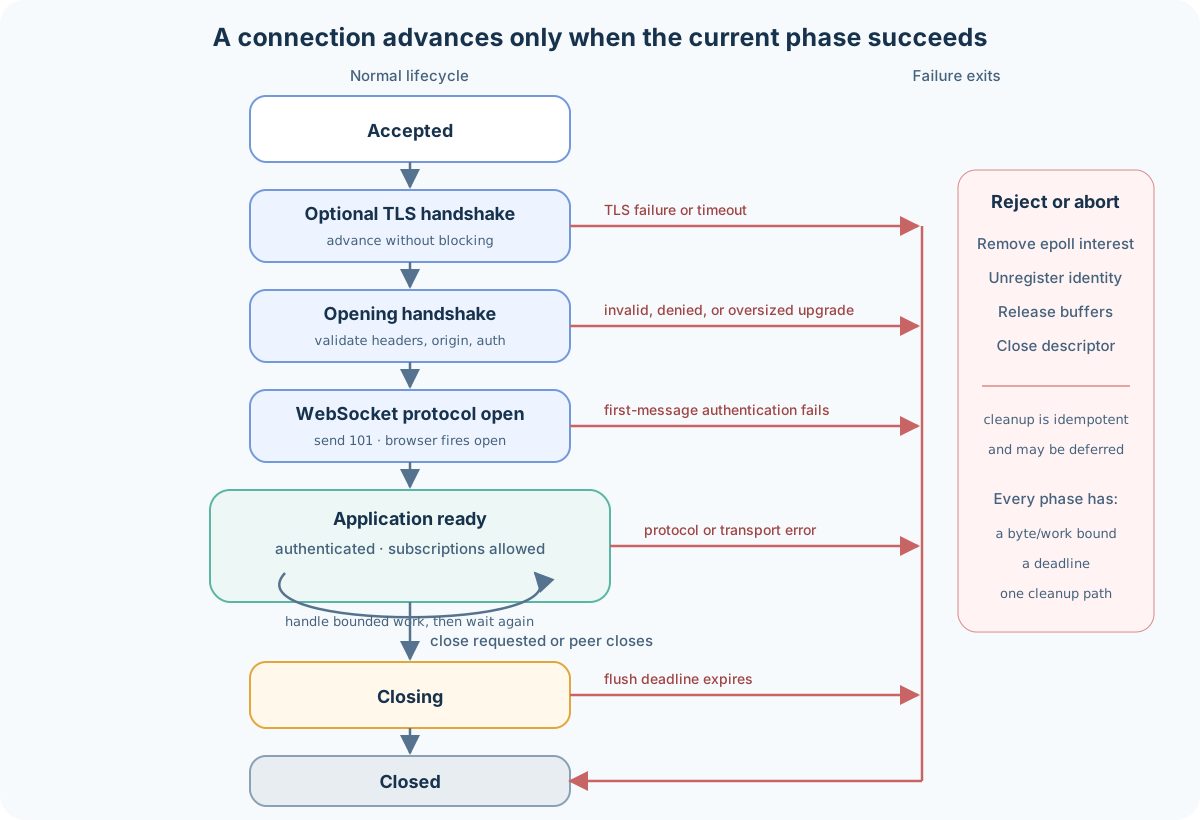
Cookie or ticket authentication can finish during the opening handshake. With first-message authentication, the connection enters WebSocket-open but not application-ready; only the authentication message is accepted until identity is established. This is one gateway state machine supporting the alternatives introduced in Section 2.
Every setup phase needs both a byte bound and a deadline. Otherwise a client can occupy a socket forever by sending a TLS handshake, HTTP header, or authentication message one byte at a time.
Useful limits include:
- maximum TLS and upgrade duration
- maximum HTTP header bytes
- maximum unauthenticated lifetime
- maximum WebSocket frame and message size
- maximum work per event-loop turn
- maximum queued output
- maximum close-handshake duration
Incremental Reads
An input buffer is userspace memory that retains bytes read from the socket but not yet consumed by the current protocol decoder. A decoder examines that buffer and reports one of three outcomes: a complete protocol unit, incomplete input, or invalid input.
TCP exposes an ordered stream, not HTTP, WebSocket-frame, or application-message boundaries. For example, the upgrade can arrive as:
first recv():   "GET /live HTTP/1.1\r\nHost: orders.exa"
second recv():  "mple.com\r\nUpgrade: websocket\r\n...\r\n\r\n"
The first call is successful even though it does not contain a complete HTTP request. The gateway appends those bytes to the input buffer and waits. After the second call, the HTTP decoder finds the terminating blank line and can validate the complete upgrade.
The same rule applies after opening. A 200-byte WebSocket frame might arrive as 60 bytes, then 140 bytes; several small frames might arrive in one read.
A readable handler therefore drains currently available bytes, feeds them to the decoder, and retains any incomplete suffix:
socket becomes readable
    -> read until EAGAIN or work budget
    -> feed bytes into TLS if this gateway terminates TLS
    -> feed decrypted bytes into HTTP or WebSocket decoder
    -> emit every complete application message
    -> retain incomplete protocol state in Connection
The handler never waits for the next byte. It returns to the event loop, and Linux reports the socket again when more input arrives.
An abbreviated plaintext read loop makes that contract explicit:
void Connection::onReadable() {
    constexpr std::size_t kBudget = 256 * 1024;
    std::array<std::byte, 16 * 1024> chunk;
    std::size_t consumedThisTurn = 0;

    while (consumedThisTurn < kBudget) {
        ssize_t count = ::recv(fd_, chunk.data(), chunk.size(), 0);

        if (count > 0) {
            input_.append(chunk.data(), static_cast<std::size_t>(count));
            consumedThisTurn += static_cast<std::size_t>(count);

            if (!decodeEveryCompleteUnit()) {
                beginClose(CloseReason::ProtocolError);
                return;
            }
        } else if (count == 0) {
            beginClose(CloseReason::PeerClosedTcp);
            return;
        } else if (errno == EINTR) {
            continue;
        } else if (errno == EAGAIN || errno == EWOULDBLOCK) {
            return;
        } else {
            beginClose(CloseReason::ReadError);
            return;
        }
    }
}
decodeEveryCompleteUnit() changes meaning with the phase: TLS records during TLS setup, HTTP headers during upgrade, and WebSocket frames while open. A production TLS library owns its own encrypted buffers and non-blocking state, but the outer rule remains “advance until more socket readiness is required.”
Blocking database queries, expensive compression, and large transformations do not belong on this shared loop. They run in a bounded worker pool and post their result back to the owning loop. The completion includes connection 1041, not only fd 96, because the client may disconnect before the work finishes.
Partial Writes
An output queue retains encoded bytes that the application wants to send but the socket has not yet accepted. Each queued item stores both its immutable bytes and the offset of the first unsent byte.
Writing has the same incremental shape as reading. Suppose one encoded message contains 1,000 bytes:
send(fd, bytes[0..999]) returns 400
    -> bytes 0..399 entered the local send path
    -> queue retains offset 400

later EPOLLOUT
send(fd, bytes[400..999]) returns 600
    -> queued item is complete and can be removed
A successful send() returns the number of bytes accepted into the local kernel send path. It does not prove that TCP transmitted them, that the peer acknowledged them, or that the browser application processed them.
If only part of a message can be written, the connection records an offset and enables writable interest:
output queue has data
    -> attempt non-blocking write
    -> complete: remove written item
    -> partial: retain offset and wait for EPOLLOUT
    -> EAGAIN: wait for EPOLLOUT
    -> error: begin cleanup
Writable interest is disabled when the queue becomes empty. Healthy TCP sockets are frequently writable, so leaving EPOLLOUT enabled with no pending data can wake the loop continuously.
The relevant send() outcomes mirror recv():
| Result | Meaning |
|---|---|
count > 0 | Advance this connection’s write offset by count. |
EAGAIN | Keep the unsent suffix and wait for EPOLLOUT. |
EINTR | Retry the interrupted system call. |
| another error | Stop writing and begin connection cleanup. |
When the gateway terminates TLS, raw recv() and send() are replaced by the TLS library’s non-blocking operations. A TLS read can require the socket to become writable and a TLS write can require it to become readable, so the TLS state machine determines the next readiness interest.
Closing and Descriptor Reuse
A clean WebSocket close tries to exchange protocol close frames before closing TCP. If the server initiates normal shutdown, it queues a Close frame, stops accepting new data messages, waits only up to a configured deadline for the peer’s Close, and then closes TCP. If the peer initiates, the server validates the code and UTF-8 reason, replies with a Close if it has not already sent one, and finishes the transport shutdown. Once a Close frame has been sent, neither endpoint sends further data frames.
Errors and attacks may require immediate teardown. In either case cleanup must be idempotent because the same failure can appear through a read result, a write error, EPOLLERR, a heartbeat deadline, and an application command.
Cleanup removes the exact connection generation from user and subscription registries, removes epoll interest, closes the descriptor, releases buffers, and destroys the connection object.
Consider why the generation matters:
1. user A owns fd 96 as connection 1041
2. work starts for connection 1041
3. user A disconnects; fd 96 is closed
4. user B connects; Linux reuses fd 96 for connection 1042
5. user A's work completes
A completion addressed only to fd 96 could leak user A’s result to user B. A completion addressed to connection 1041 is rejected because that generation no longer exists.
What to remember: Network reads and writes are incremental. A readiness event permits an attempt; the system-call result states what actually happened. The
Connectionobject preserves the protocol phase, incomplete input, unsent output, and generation across event-loop turns.
7. Sending Server Events to the Client
Reading client messages is only half the job. The defining feature of the order-tracking connection is that an event created elsewhere can reach the browser without a new request.
The Local Connection Registry
A connection registry is an application data structure that maps stable application identities—users, devices, rooms, or subscriptions—to the local connections that should receive their events. It is not a kernel table and is not derived from IP addresses.
After authentication, the gateway records which connections belong to the user. The value is a collection because user 42 may have several tabs or devices, potentially owned by different event loops:
user 42
    -> loop 2, connection 1041
    -> loop 5, connection 2088
The application decides whether an update goes to every session, one device, or one designated session. IP addresses and ports play no role in that policy.
The registry entry includes the loop because socket ownership is also a concurrency rule. A broker-consumer or worker thread must not call send() on fd 96 directly while loop 2 can simultaneously change its queue or close it. Instead, the producer creates a command:
struct DeliverToConnection {
    ConnectionId connectionId;
    std::shared_ptr<const std::string> encodedMessage;
};

loops[2].post(DeliverToConnection{
    .connectionId = ConnectionId{1041},
    .encodedMessage = orderDispatchedBytes
});
Loop 2 later validates that connection 1041 still exists and appends the message to that connection’s output queue. Sharing immutable encoded bytes avoids copying the same payload for every local recipient, while each connection retains its own write offset.
When the order service publishes ORDER_DISPATCHED, the local path is:
application event for user 42
    -> find user 42's local connection routes
    -> post a command to each owning event loop
    -> validate that each ConnectionId still exists
    -> append encoded bytes to its output queue
    -> write when the socket can make progress
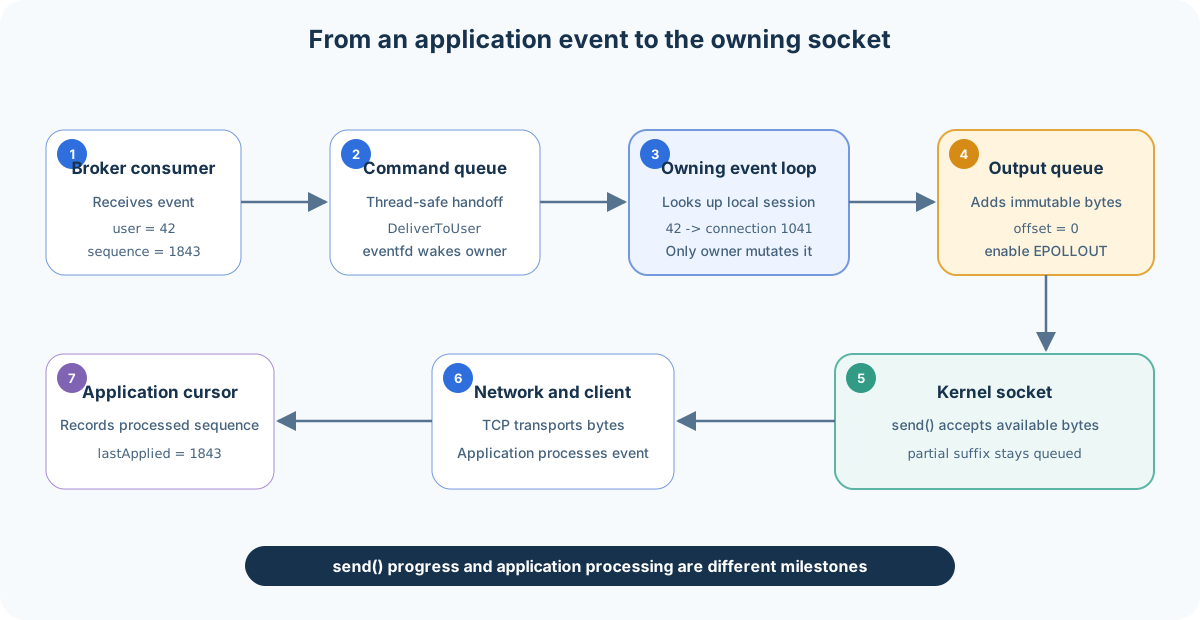
Optional Detail: Waking the Owning Loop
If another thread posts a command while the loop sleeps in epoll_wait(), a Linux eventfd can wake it. An eventfd is a kernel counter exposed through a file descriptor. Writing an integer increments the counter and makes the descriptor readable; reading returns the counter and clears or reduces it.
The event loop registers that descriptor with epoll:
producer thread
    -> push DeliverToConnection into thread-safe command queue
    -> write 1 to loop 2's eventfd

kernel
    -> eventfd becomes readable
    -> epoll_wait() wakes with EPOLLIN for fd 8

loop 2
    -> read eventfd counter
    -> drain command queue
    -> enqueue bytes on connection 1041
The counter does not contain the command. It is only the wake-up signal; the thread-safe queue contains the actual work. This converts cross-thread work into another event handled by the same socket owner.
Backpressure
Backpressure is the condition in which a downstream stage accepts work more slowly than an upstream stage produces it. The pressure first appears as growing buffers or failed/partial non-blocking writes.
Suppose the gateway produces 100 KB/s for a client whose network currently accepts 10 KB/s. The missing 90 KB/s must accumulate somewhere:
application output queue
    -> kernel send buffer
    -> network
    -> client
TCP eventually stops accepting more bytes into its send buffer. That is transport backpressure: the receiver’s advertised TCP window, congestion control, or local send-buffer capacity prevents the sender from continuing at the desired rate. TCP does not decide what the application should do with new order, presence, or telemetry events that have not entered the socket.
An unbounded userspace queue converts one slow client into a memory leak. For C slow clients with Q queued bytes each:
queued payload memory ~= C * Q

200,000 clients * 32 KiB ~= 6.1 GiB
That excludes queue nodes, allocators, connection objects, TLS state, and kernel buffers.
The correct policy depends on the data:
- Disconnect a client that exceeds a hard limit and let it resynchronize.
- Drop transient updates such as old cursor positions.
- Coalesce many state changes into the newest value.
- Sample high-frequency telemetry.
- Persist and replay business events that must not disappear.
- Slow the source when the entire gateway is overloaded.
Per-connection limits contain one slow consumer. Process-wide and per-loop limits protect against thousands of clients becoming slow together during a network incident. Useful signals include total queued bytes, event-loop lag, memory high-water marks, broker-consumer lag, and slow-consumer disconnects.
The browser sees a smaller version of the same pressure through socket.bufferedAmount. The server can react to EPOLLOUT when its local send path has space; browser JavaScript has no equivalent general-purpose writable or drain event. Browser producers therefore sample bufferedAmount, pace work, and stop enqueueing above an application-defined threshold.
Backpressure is not merely a networking setting. It is a product decision about which information may be delayed, combined, dropped, or replayed.
What to remember: The connection registry answers which local socket should receive an application event. The owning event loop performs the mutation and write. If that socket cannot keep up, bounded application policy—not TCP alone—decides what happens to newly produced events.
8. Silence, Failure Detection, and Reconnection
An idle TCP connection sends no application data. Silence can mean the user is healthy and inactive, or it can mean the browser was suspended, a NAT mapping expired, the network changed, an intermediary discarded state, or the client process died.
The server may not receive a prompt TCP FIN or RST. It needs an explicit failure-detection policy.
A TCP FIN announces an orderly shutdown: the peer will send no more bytes. A TCP RST aborts the connection immediately. Both are useful signals when they arrive, but a broken network path may deliver neither one.
Heartbeats
Section 2 described the Ping and Pong frames themselves. The server now needs a policy for when to send them and how long to wait for a response.
A heartbeat is periodic traffic whose missing response lets the application declare the path unhealthy after a deadline. WebSocket defines ping and pong control frames: an endpoint can send ping, and a compliant peer responds with pong. Some applications instead exchange their own heartbeat messages so they can include session or timing information.
In a browser, JavaScript cannot send protocol Ping frames or receive a ping event. The browser handles protocol Ping/Pong internally. A server may send Ping and observe Pong; browser code that needs its own timer uses ordinary application messages and requires the server to answer them.
TCP keepalive probes whether the remote TCP endpoint remains reachable, but operating-system defaults are often much slower than an application needs. WebSocket ping/pong or application heartbeats can ask a stronger question: is this session responding within the service deadline?
TCP keepalive          can the transport peer still be reached?
application heartbeat is this session responsive enough for the product?
Every intermediary has its own idle timeout:
client -> NAT/carrier -> edge -> load balancer -> gateway
The heartbeat interval must be shorter than the smallest relevant timeout, with scheduling and network margin. More aggressive heartbeats detect failure faster but consume bandwidth, event-loop work, and mobile radio power. Large fleets add jitter so clients do not all ping at the same instant.
For example, if an edge proxy closes connections after 60 seconds of complete inactivity, a 90-second ping interval cannot keep the path alive. A service might choose a 25-second interval with per-connection random jitter and declare failure only after several missed deadlines. The exact values come from the actual intermediary timeouts and the product’s failure-detection requirement.
Reconnection Rebuilds Application Continuity
When TCP dies, a new socket cannot inherit its kernel state. The client creates a new connection and repeats discovery, TCP, TLS, WebSocket upgrade, and authentication. It also restores subscriptions.
A reconnect creates a new transport connection. A resume reconstructs the logical application session on that connection. They are separate actions.
The browser’s WebSocket object does not perform this recovery automatically. Application code or a client library owns reconnect backoff, authentication, subscription restoration, and replay state.
If missed events matter, the client includes a replay cursor: an application-defined position recording the last event it processed durably.
client last processed sequence: 1842
server current sequence:         1847
replay required:                 1843..1847
The durable store retains those events; the new WebSocket only transports them. This separates two forms of continuity:
transport connection = disposable byte path
application session  = identity, subscriptions, and replay position
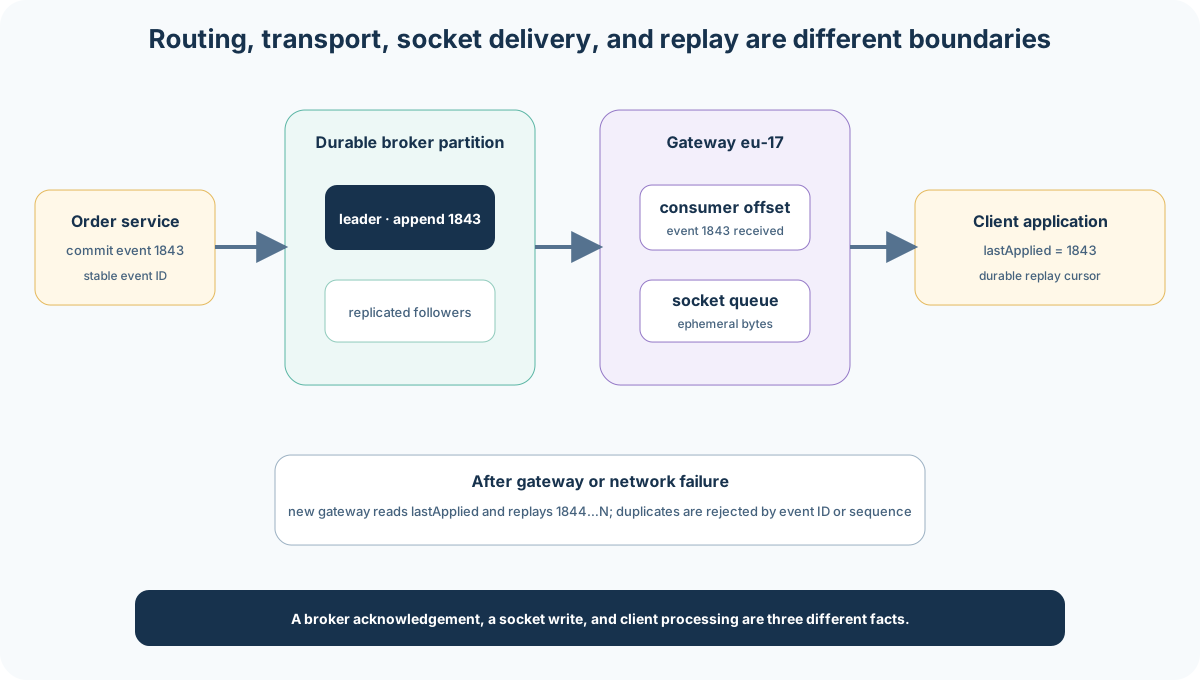
What a Successful Send Proves
Delivery crosses several boundaries:
gateway queues bytes
    -> send() accepts bytes
    -> peer TCP acknowledges them
    -> browser runtime reads them
    -> application callback runs
    -> application records the new sequence
send() proves only an early local step. If durable storage deletes event 1843 immediately after send() succeeds, a later disconnect can lose the event from the user’s perspective.
Retries create duplicates. If the browser applies 1843 but its acknowledgement is lost, the server may replay it. A typical client applies events idempotently:
sequence <= lastApplied       -> duplicate, ignore
sequence == lastApplied + 1   -> apply and advance
sequence > lastApplied + 1    -> gap, request replay
An idempotent operation can be applied more than once without changing the final result after the first application. The sequence check makes replayed events idempotent from this client’s perspective.
This produces application-level at-least-once delivery: the system prefers a possible duplicate over silently losing a durable event. WebSocket itself promises neither replay nor exactly-once effects.
Reconnect Storms and Graceful Draining
If a gateway closes 100,000 sockets at once, 100,000 clients may reconnect at once and overload DNS, TLS termination, authentication, and subscription restoration. Exponential backoff increases the delay after each failed attempt. Jitter adds randomness so clients do not retry in lockstep. Servers also bound handshake concurrency and recover capacity gradually.
A graceful deployment stops accepting new connections, leaves load-balancer rotation, drains existing sessions for a bounded period, and closes the remainder in controlled batches. Backoff is still necessary because crashes do not drain gracefully.
What to remember: Silence is not proof of health or failure. Heartbeats turn silence into a bounded decision. After failure, a new WebSocket restores only transport; application identity, subscriptions, missed events, and duplicate handling must be reconstructed explicitly.
9. Scaling and Replacing WebSocket Gateways
At this point the protocol and one-gateway story are complete. Sections 9 and 10 are the production extension: they explain how the same ownership model survives additional CPU cores, machines, failures, and operational limits. They do not change the WebSocket wire protocol.
The single-loop design has one owner and little synchronization, but its parsing, TLS work, queue management, and system calls still execute on one CPU core.
A CPU core can execute one hardware instruction stream at a time, ignoring simultaneous-multithreading details. An event-loop thread that remains busy has therefore reached a computational limit even if the machine has other idle cores.
Multiple Cores
A common gateway runs one event loop per core or small CPU set. Each connection belongs to exactly one loop for its lifetime:
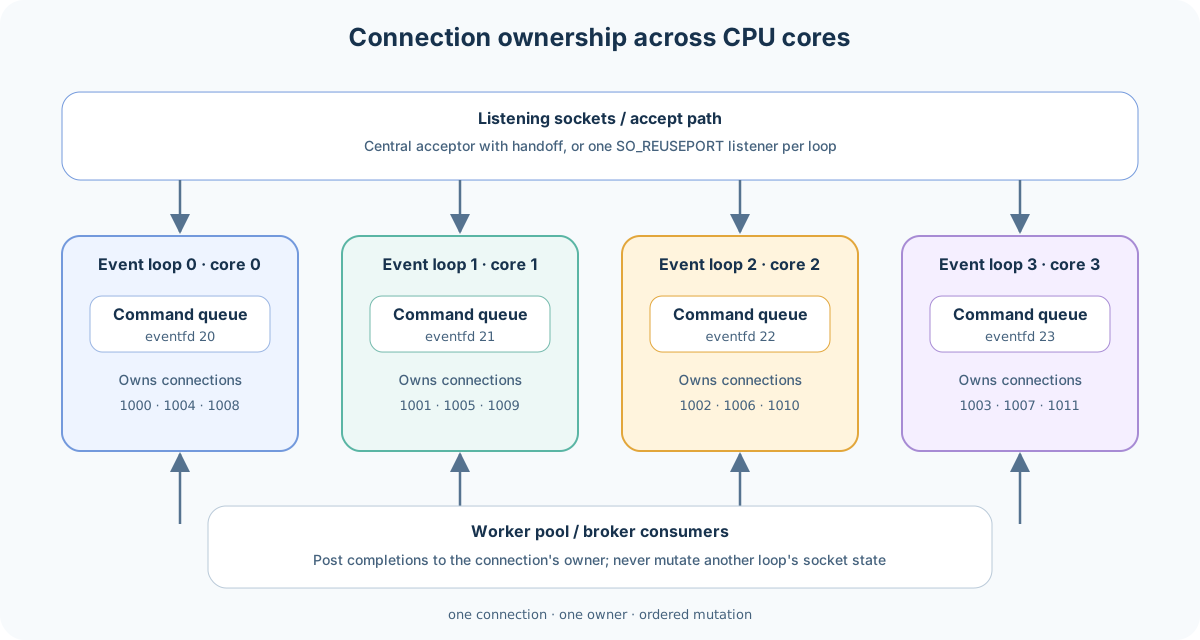
This is sharding by ownership: divide the connection table into independent subsets, each mutated by one loop. For example:
loop 0 owns connections 1000, 1004, 1008, ...
loop 1 owns connections 1001, 1005, 1009, ...
loop 2 owns connections 1002, 1006, 1010, ...
loop 3 owns connections 1003, 1007, 1011, ...
The exact assignment can be round-robin, hash-based, or load-aware. The important invariant is that one live connection has one current owner.
A central acceptor is one thread that calls accept4() and hands each new descriptor to an owner loop. Alternatively, Linux SO_REUSEPORT allows several listening sockets to bind the same local address and port, so each loop can accept connections assigned to its listener by the kernel.
Neither strategy guarantees equal ongoing work. Equal connection counts do not mean equal traffic: one loop may own active market-data clients while another owns idle dashboards.
Most gateways do not migrate live sockets between loops. Migration would need to transfer the descriptor, TLS and decoder state, queued output, timers, subscriptions, and pending completions without losing order. It is simpler to balance at accept or reconnect time.
A worker pool is a bounded set of threads that executes work inappropriate for the event loop, such as blocking database calls or expensive CPU transformations. Its queue must also be bounded. Moving a slow database call off the event loop does not solve overload if millions of database tasks accumulate elsewhere.
Production C++ systems usually use Boost.Asio and Beast, libevent, libuv, Folly, Seastar, uWebSockets, or another mature runtime. Their APIs may use callbacks or coroutines, but the underlying ownership remains recognizable:
request asynchronous operation
    -> runtime registers interest
    -> kernel reports progress
    -> runtime resumes the owning connection
Multiple Gateways
A gateway is the server process or machine that terminates WebSocket connections and owns their live state. A load balancer accepts or forwards new connections across a fleet of gateways.
When one machine is insufficient, the load balancer chooses a gateway while a connection is established. Unlike a sequence of short HTTP requests, the WebSocket remains attached to that gateway until it closes. Adding a new gateway changes placement of new connections but does not automatically move existing ones.
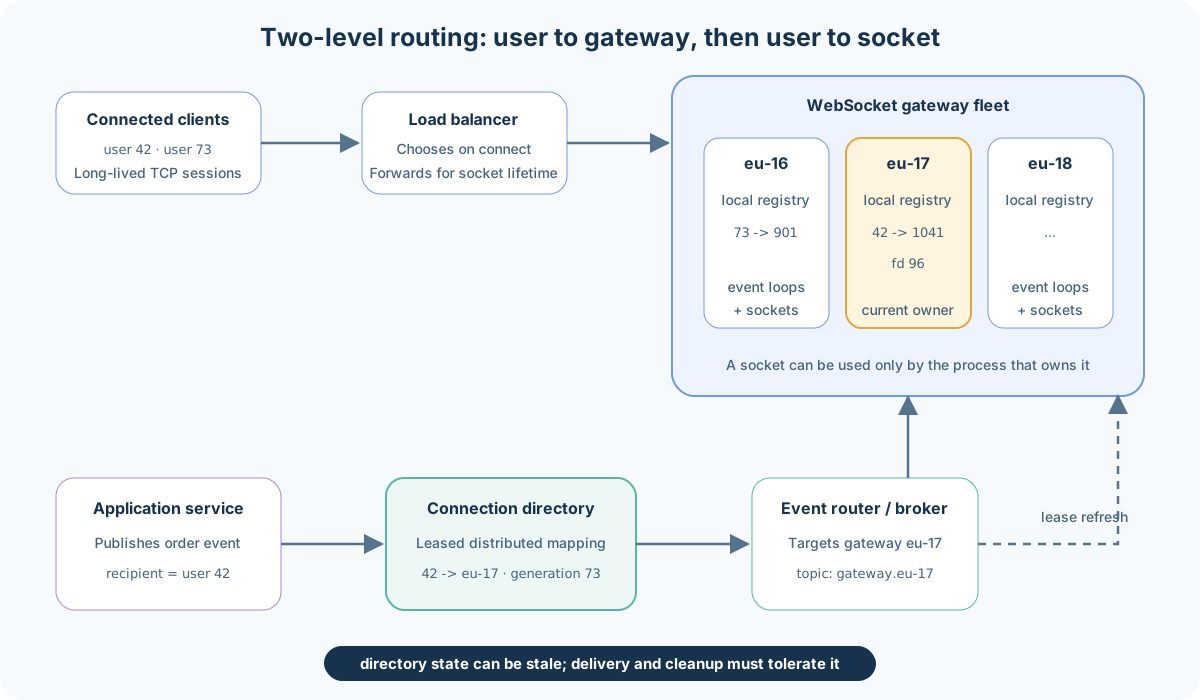
An order event now needs two levels of routing:
distributed: user 42 -> gateway eu-17
local:       user 42 -> loop 2, connection 1041
Load-balancer stickiness does not solve this problem. It may influence where a reconnecting client lands, but it does not tell the order service where the current live socket resides and cannot preserve a socket through gateway failure.
What Happens When a Gateway Is Replaced?
A live WebSocket is owned by one gateway process. Replacing that process cannot move the existing TCP connection to a new process on another machine. A deploy or failover therefore has to choose one of two paths.
In a graceful drain, the gateway:
- stops accepting new WebSocket upgrades;
- leaves load-balancer rotation for new connections;
- continues serving existing connections for a bounded drain window;
- optionally sends an application notice or WebSocket Close with a retryable reason;
- removes directory entries as connections close;
- lets clients reconnect and resume on newer gateways.
In a crash or hard replacement, those steps are compressed by failure. The gateway stops renewing directory leases, clients eventually detect silence or receive transport errors, and reconnect attempts land on healthy gateways. The new gateway authenticates the client, recreates subscriptions, writes a newer directory claim, and asks the replay store for events after the client’s last processed cursor.
old gateway dies
    -> old TCP connection becomes unusable
    -> directory lease expires or is superseded
    -> client reconnects through load balancer
    -> new gateway authenticates and registers ownership
    -> replay restores missed durable events
This is why durable session state cannot live only in the gateway’s memory. The gateway owns the live socket. The application owns identity, authorization, subscriptions, and replay position.
Directory, Broker, and Replay Store
Three components have distinct jobs:
connection directory  where is the user's socket now?
broker                 how does an event reach that gateway?
replay store           what has the client not processed yet?
Collapsing them into a vague “messaging layer” hides failure semantics.
A connection directory is an index of current routing claims. A broker transports events between services and gateway consumers. A replay store retains durable ordered events long enough for a reconnecting client to request what it missed.
A directory entry may contain:
userId:        42
gatewayId:     eu-17
connectionId:  1041
sessionId:     tab-8
generation:    73
leaseExpiry:   <timestamp>
The directory stores a versioned routing claim, not the socket. The socket exists only in eu-17 and its kernel. Leases, generations, and conditional updates help a reconnect supersede stale placement.
A lease is a claim that expires unless its owner renews it. The expiration prevents a crashed gateway from appearing authoritative forever. A generation is a monotonically newer version used to reject delayed work for an older session.
One-to-one delivery can route to the owning gateway. A large room should route one copy to every gateway with at least one participant, then fan out locally, rather than producing one broker message per participant or broadcasting to uninterested gateways.
At scale, the directory is partitioned so different servers own different subsets of users, and replicated so each subset has copies across failure domains. A quorum-backed directory requires enough replicas—commonly a majority—to accept an authoritative update. If it loses quorum, a gateway must choose an explicit policy: reject new globally routable sessions, accept clearly degraded local-only sessions, or use bounded stale routes with known duplicate and miss risks. Pretending registration succeeded makes a live socket undiscoverable to the rest of the system.
If the broker is unavailable, established WebSockets can remain open while external server-push delivery pauses. Durable events wait in replicated storage; ephemeral updates may be dropped. The gateway must not acknowledge a durable event merely because it entered an in-memory socket queue.
Multi-Region Placement
A region is a geographically separate deployment containing gateways and supporting services. Clients normally connect to a nearby healthy region. Events may originate in a different region and must reach the region that owns the socket.
During regional failure, clients reconnect elsewhere and create new directory entries. Whether old durable events are immediately available depends on the application’s replication contract. Synchronous replication waits for remote confirmation before acknowledging a write. Asynchronous replication acknowledges locally and copies later, allowing a bounded amount of recent data to be unavailable or lost during failover. That possible loss window is the recovery-point objective. WebSockets provide none of those data guarantees.
Presence is consequently approximate. “Online” usually means at least one sufficiently fresh session lease is known, not that a globally synchronous boolean is true. That is useful for UI presence but unsafe as a strong authorization or financial fact.
What to remember: Scaling preserves the same ownership chain rather than replacing it. A user routes to one or more gateways; each gateway routes to an owner loop; the loop owns the
Connection; the kernel owns the socket. The directory locates live state, the broker transports events, and the replay store restores durable history.
10. Long-Lived Sessions, Capacity, and Operations
A long-lived connection reserves resources before it does useful work. A production gateway must keep identity current, bound every phase, and observe the dimensions that can grow.
Long-Lived Authentication and Authorization
Authentication determines who the peer is. Authorization determines what that authenticated identity may do. Authentication identifies the session; authorization still applies to every subscription and sensitive command. Long-lived credentials also need an expiry or revocation policy: close and reconnect, refresh the session, periodically revalidate, or authorize each action independently.
Browsers can attach cookies to a WebSocket handshake. A malicious origin may try to open a socket with the victim’s ambient credentials, so cookie-based servers validate the Origin header against an allowlist.
There are two common moments to authenticate:
| Pattern | How it works | Trade-off |
|---|---|---|
| Handshake authentication | The gateway validates a cookie or short-lived ticket before returning 101. | The connection is known before WebSocket messages flow, but browser clients cannot set arbitrary headers. |
| First-message authentication | The gateway accepts the upgrade, then allows only an authentication message until identity is established. | Works with token-style protocols, but the unauthenticated lifetime and bytes must be tightly bounded. |
A connection that stays open for hours should not treat the first successful authentication as permanent authority. Practical systems choose one or more continuity rules:
- close the socket when the session expires and let the client reconnect;
- send a refresh message and require a new short-lived token before a deadline;
- periodically revalidate the session against an auth service or local revocation snapshot;
- authorize every subscription and sensitive command using current policy;
- close or downgrade the connection when the user is revoked, disabled, or loses permission for a stream.
Subscription authorization matters because a user can authenticate correctly and still request the wrong room, account, document, instrument, or order. A long-lived socket is not a permanent authorization bypass; it is only a transport for commands that still need policy checks.
Resource Bounds
An internet-facing gateway should bound at least:
- connections and establishment rate per source and account
- concurrent TLS and incomplete upgrade handshakes
- handshake bytes and unauthenticated lifetime
- inbound frame, message, and message-rate limits
- parsing work per event-loop turn
- subscriptions per connection
- queued output per connection, loop, and process
- worker-queue depth and dependency concurrency
- heartbeat, idle, and close deadlines
These controls protect against attacks, buggy clients, and ordinary dependency slowdowns.
Capacity Is More Than Connection Count
Process memory is roughly:
connections
* (userspace state + average queued output + TLS state + allocator overhead)
Kernel TCP state and allocated socket buffers must be measured separately. Socket autotuning, kernel version, TLS library, allocator, and workload all change the result.
File-descriptor planning includes client sockets plus listeners, epoll instances, wake and timer descriptors, broker and database connections, logs, and headroom. Process, service-manager, and system-wide limits must agree.
Clients and NATs also have finite address/port capacity. Many simultaneous connections from one source IP to the same destination need distinct source ports from the configured ephemeral range. A load test concentrated behind a few source addresses can exhaust client or NAT mappings before the gateway reaches its own limit.
For event rate R, encoded size S, and average fanout F:
outbound application bandwidth ~= R * S * F
A 1 KB event sent 1,000 times per second to 100 recipients is about 100 MB/s before TLS, TCP, IP overhead, and retransmission. Connection count alone says nothing about this cost.
Steady state and recovery are different workloads. A fleet that can maintain a million idle sockets may be unable to recreate them quickly after a regional disconnect. Capacity tests include DNS, accepts, TLS handshakes, authentication, directory registration, and subscription restoration.
Observe Ownership and Progress
Useful metrics include:
- active, opening, and closing connections
- establishment latency and failure reason by phase
- normal, abnormal, heartbeat, and slow-consumer disconnects
- active connections and event-loop lag per loop
- maximum callback duration and timer scheduling lag
- bytes read and written
- queued output bytes per connection, loop, and process
- worker and command-queue depth
- broker-to-gateway, gateway-to-socket, and client-acknowledgement progress
- reconnect and resubscription rate
Aggregate CPU can hide one saturated loop, and “message sent” can hide that only the gateway queue advanced. Metrics should preserve these separate stages.
Failure paths must be tested rather than inferred: kill a gateway, pause a broker consumer, suspend a client’s receive path, expire a directory lease, change a client’s network, and restart a fleet in stages. Verify that queues remain bounded and that reconnect, routing, replay, and duplicate handling behave as designed.
What to remember: Capacity is multi-dimensional: connection state, queued bytes, descriptors, bandwidth, establishment rate, and recovery load can fail independently. Bounds keep failure finite; metrics reveal which ownership or delivery stage has stopped advancing.
11. When WebSockets Are the Wrong Tool
WebSockets are valuable when both endpoints send frequently or server-to-client latency matters enough to justify persistent connection infrastructure. They are not the default for every changing page.
| Mechanism | Good fit | Main trade-off |
|---|---|---|
| Ordinary HTTP | Client-driven, cacheable, independent operations | Server cannot initiate an update |
| Polling | Infrequent changes and loose freshness requirements | Repeated requests and stale intervals |
| Long polling | Server updates through conservative HTTP infrastructure | Repeated request lifecycle and retry complexity |
| Server-Sent Events | Browser-oriented, server-to-client streams | Client commands still use HTTP; one-way stream |
| WebSocket | Low-latency bidirectional sessions | Stateful connection ownership and recovery |
Choose WebSockets when the product benefits from a persistent bidirectional channel and the team is prepared to operate heartbeats, backpressure, graceful draining, reconnects, replay, distributed routing, and per-connection limits.
The protocol removes repeated request overhead. It moves complexity into the lifecycle of the connection.
What to remember: Use the least stateful mechanism that meets the product’s communication requirement. WebSocket is most valuable when the application genuinely needs a low-latency, bidirectional session.
12. The Complete Mental Model and Design Checklist
Return to the order-tracking browser.
- The browser resolves
orders.example.comand creates TCP, TLS, and WebSocket protocol state. - Client and server kernels distinguish the TCP flow using endpoint pairs; NAT or proxies may translate or terminate those pairs along the path.
- The gateway accepts a connected socket as fd
96, assigns connection1041, completes the upgrade, authenticates user 42 during the handshake or first message, and makes the connection application-ready on loop 2. - While the connection is idle, kernel state, a userspace object, and event registrations remain. No dedicated thread runs beside it.
- When the order service publishes sequence
1843, distributed routing finds gatewayeu-17; the local registry finds loop 2 and connection1041. - The owner loop queues the bytes and writes them as the socket becomes ready, subject to bounded backpressure policy.
- If the client’s network changes, the old TCP connection dies. A new connection authenticates and resumes after sequence
1842from durable application state.
The single-process model is:
non-blocking sockets
    + readiness notification
    + one owner per connection
    + bounded protocol and output state
The distributed model adds:
user or subscription
    -> owning gateway
    -> owning event loop
    -> generation-safe Connection
    -> kernel socket
WebSocket provides the live byte path. The surrounding system provides identity, pressure policy, failure detection, routing, durability, and recovery. Keeping those responsibilities separate is what makes the server understandable—and operable.
When designing a WebSocket system, make these choices explicit:
| Design area | Questions to answer |
|---|---|
| Product fit | Does the application need low-latency bidirectional communication, or would polling, long polling, SSE, or ordinary HTTP be simpler? |
| Opening path | Which hostname, TLS termination point, HTTP path, subprotocol, extension, and proxy behavior are expected before 101? |
| Authentication | Is identity established during the handshake or in the first message, and how are expiry, refresh, revocation, and origin checks handled? |
| Authorization | Which subscriptions and commands require policy checks after the socket is already open? |
| Connection identity | Which IDs belong to the network, kernel, process, gateway, user session, device, tab, and subscription? |
| Server ownership | Which event loop owns each connection, and how do worker threads or broker consumers post work back to that owner? |
| Message model | What are the message types, ordering guarantees, acknowledgement rules, idempotency keys, and replay cursors? |
| Backpressure | Which events are delayed, coalesced, dropped, persisted, replayed, or used to disconnect a slow client? |
| Failure detection | What heartbeat interval, timeout, jitter, idle policy, and close behavior match the product’s needs and intermediary limits? |
| Reconnection | How does the client back off, authenticate again, restore subscriptions, and request missed events? |
| Gateway replacement | How do deploys drain sockets, how do crashes expire ownership, and how do new gateways supersede old directory claims? |
| Fleet routing | How do services find the gateway that currently owns a user’s socket, and how is that directory partitioned, replicated, leased, and observed? |
| Durability | Which events must survive gateway failure, and which store owns replay after reconnect? |
| Capacity | How many active, idle, opening, closing, slow, and reconnecting sockets can the fleet handle with real TLS, buffers, queues, and dependencies? |
| Operations | Can metrics explain where progress stopped: DNS, accept, TLS, upgrade, auth, directory, broker, event loop, output queue, kernel, network, or client acknowledgement? |
Compact Glossary
| Term | Meaning in this article |
|---|---|
| Kernel | Privileged operating-system core that owns TCP, sockets, and their buffers. |
| System call | Controlled operation through which userspace asks the kernel to do work. |
| Endpoint | One IP address and TCP port, such as 203.0.113.40:443. |
| TCP connection | One reliable ordered byte stream between two endpoints. |
| Socket | Kernel object containing endpoint, TCP, and buffer state. |
| Listening socket | Socket waiting for new TCP connection attempts. |
| Connected socket | Socket representing one established TCP connection. |
| File descriptor | Process-local integer handle used to access a socket or another kernel object. |
| Ephemeral port | Temporary client-side source port selected for an outbound connection. |
| WebSocket message | Complete text or binary unit exposed to the application. |
| WebSocket frame | Wire-level unit carrying part or all of a message, or one control signal. |
| Opcode | Frame-header value identifying continuation, text, binary, Close, Ping, or Pong. |
| Fragmentation | Splitting one text or binary message across several WebSocket frames. |
| Control frame | Close, Ping, or Pong frame; at most 125 payload bytes and never fragmented. |
| Masking | Reversible client-frame transformation required by WebSocket; it is not encryption. |
| Subprotocol | Named application protocol selected from values offered during the handshake. |
| Extension | Negotiated change to WebSocket operation, such as per-message compression. |
| Close code | Numeric category carried in a Close frame to explain why closing began. |
bufferedAmount | Browser count of application bytes queued by send() but not yet passed to the network. |
| Non-blocking I/O | Operation returns EAGAIN instead of suspending the thread when it cannot progress. |
| Readiness | Kernel indication that an I/O attempt may currently make progress. |
| Interest set | Descriptors and event types registered with an epoll instance. |
| Ready set | Registered objects whose current state satisfies the requested interest. |
| Event loop | Thread that waits for events and runs short handlers for their owners. |
| Connection ID | Gateway-assigned logical identity for one socket lifetime, independent of descriptor reuse. |
| Backpressure | Downstream work is accepted more slowly than upstream work is produced. |
| Heartbeat | Periodic exchange used to detect an unresponsive connection within a deadline. |
| Replay cursor | Application position recording the last event processed by a client. |
| Gateway | Process or machine that terminates and owns live WebSocket connections. |
| Connection directory | Distributed index that maps application identities to current gateway ownership. |
| Broker | Infrastructure that transports events from producers to gateway consumers. |
| Replay store | Durable ordered history used to restore events missed during disconnection. |
References
- IETF, RFC 6455: The WebSocket Protocol
- WHATWG, WebSockets Standard
- IETF, RFC 9293: Transmission Control Protocol
- IETF, RFC 5382: NAT Behavioral Requirements for TCP
- IETF, RFC 8441: Bootstrapping WebSockets with HTTP/2
- Linux man-pages,
socket(7) - Linux man-pages,
tcp(7) - Linux man-pages,
accept(2)andaccept4(2) - Linux man-pages,
connect(2) - Linux man-pages,
epoll(7) - Linux man-pages,
eventfd(2) - Boost.Beast, WebSocket documentation and asynchronous examples
- Linux man-pages,
epoll_ctl(2) - Linux man-pages,
epoll_wait(2) - Linux man-pages,
recv(2)andsend(2)
Leave a Comment