Inside a Global Request Path: Edge, Backbone, Load Balancing, and Backend Routing
Published:
1. Why the Request Path Matters
An application request often looks simple from the client:
GET /payments/42 HTTP/1.1
Host: api.example.com
The client sends one request to one hostname and receives one response. The system behind that hostname is usually many layers: edge locations, backbone links, regional ingress, Layer 4 load balancers, Layer 7 proxies, backend services, and databases.
The useful mental model is a sequence of selection decisions:
client
    -> global routing chooses an edge or region
    -> edge proxy accepts and classifies the request
    -> private backbone carries dynamic traffic inward
    -> regional L4 load balancer chooses an L7 proxy
    -> L7 proxy matches the application route
    -> scheduler chooses an eligible backend
    -> backend executes the request
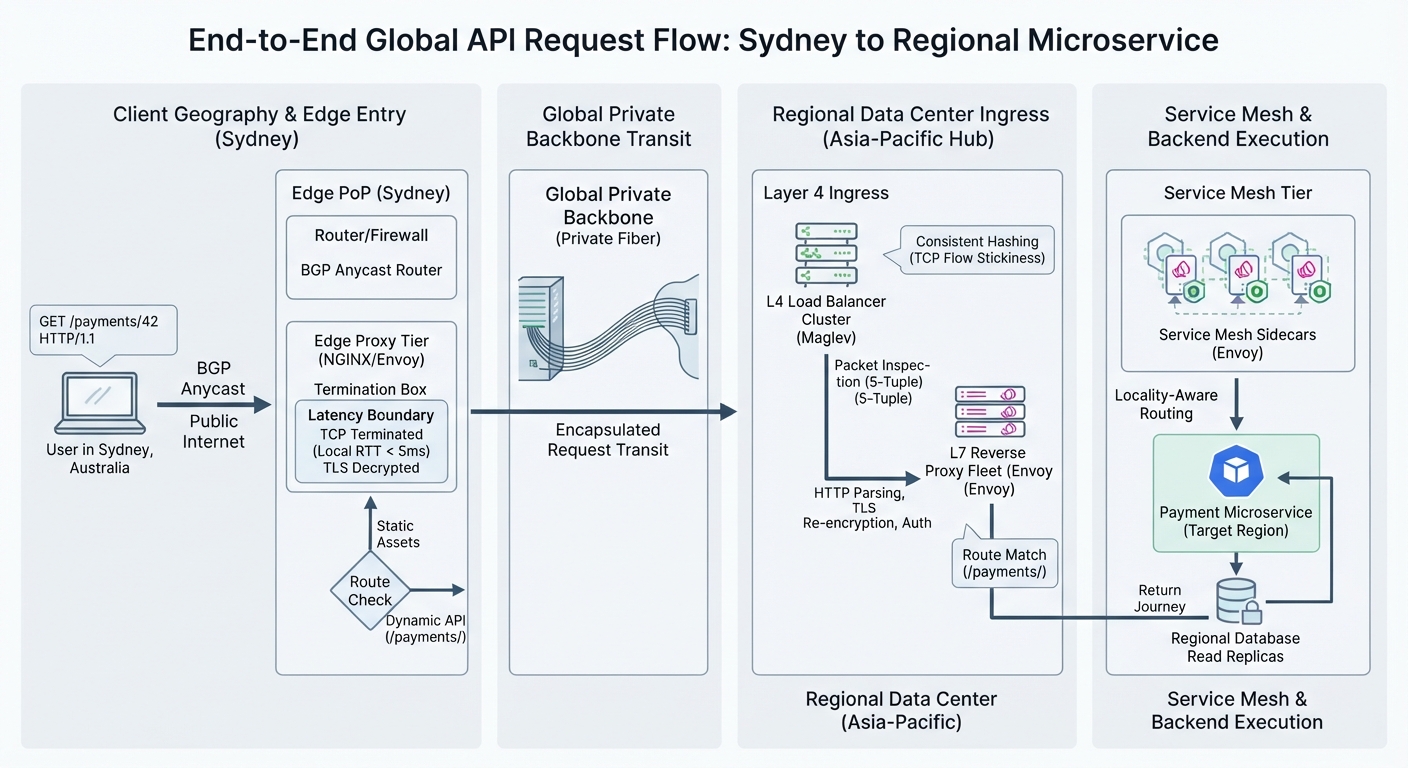
Each step owns different state. Global routing owns reachability to an entry point. The edge owns client-facing transport and cache policy. The L4 tier owns flow-to-proxy assignment. The L7 proxy owns HTTP routing, security policy, timeouts, retries, and backend selection. The backend owns business execution.
That separation matters during failures. Keeping the public address reachable is not the same as preserving a TCP connection, an in-flight HTTP request, or a payment workflow.
What to remember: The request moves through routing, transport, protocol, and application decisions. No one layer owns the whole interaction.
2. The Simple Path and the Global Path
A single-region service has a shorter path:
client -> regional load balancer -> application backend
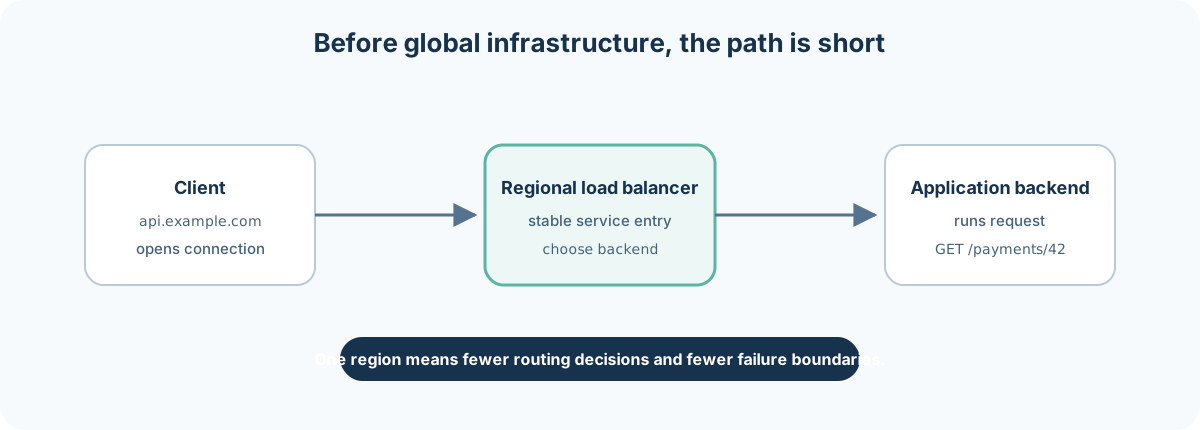
The client resolves api.example.com, opens a connection, and reaches infrastructure in one region.
The model breaks down as the service becomes global. A user in Sydney should not always cross the public Internet to a server in Virginia. Static assets should be reusable near users. A regional outage should not make the only service address disappear.
A global path therefore adds an edge layer:
client
    -> nearby edge point of presence
    -> private or controlled transit
    -> regional application infrastructure
The edge is not the application backend. It is a geographically distributed front door. It can terminate connections, enforce policies, serve cacheable content, and forward dynamic requests inward.
For GET /payments/42, the response is usually dynamic. The edge classifies the request and forwards it toward the payments service.
3. Global Routing: Reaching a Nearby Entry Point
The first decision is where the client enters the provider network.
A global service usually does not publish one address tied to one data center. The same service name or address may be reachable from many locations. Two common mechanisms are DNS-based steering and Anycast.
With DNS-based steering, the DNS answer can vary by requester location, latency, health, or policy:
api.example.com -> 198.51.100.10
With Anycast, multiple points of presence advertise the same IP prefix using BGP, the Border Gateway Protocol. Internet routing carries the packet toward one of those sites, often a nearby one.
same VIP advertised in London
same VIP advertised in Singapore
same VIP advertised in Virginia
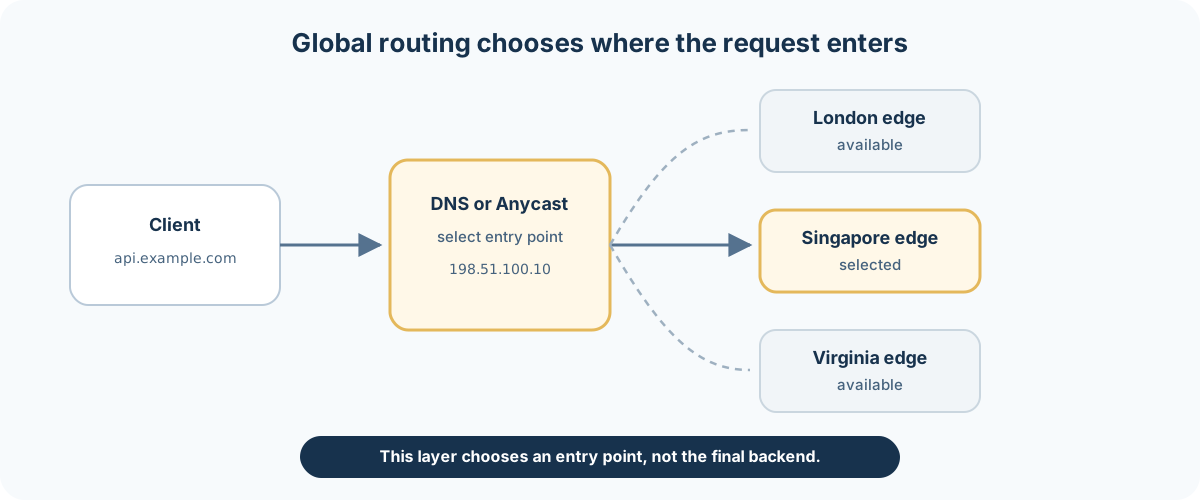
The VIP, or virtual IP, is the stable service address presented to clients. It is not the permanent address of one application server. It represents an entry point into a load-balancing or edge tier.
Global routing does not understand the application request. BGP does not know that /payments/42 is a payments API. DNS does not know whether backend B2 is overloaded. This layer moves traffic to an entry point; later layers perform protocol and application routing.
What to remember: Global routing chooses a network entry point, not the final application backend.
4. Edge Termination and Request Classification
After global routing, the request reaches an edge point of presence, or PoP. The edge runs proxy software such as Envoy, NGINX, Apache Traffic Server, HAProxy, or an internal equivalent. Some platforms also run small sandboxed edge functions.
The edge commonly performs several jobs:
- accepting the client TCP or QUIC connection;
- terminating TLS when policy allows it;
- applying HTTP routing and security rules;
- checking local cache state for cacheable content;
- forwarding dynamic traffic toward regional infrastructure.
For a static object, the request may end at the edge:
GET /assets/logo.png
    -> edge cache hit
    -> response returned from the PoP
For the payment request, the edge normally forwards the request:
GET /payments/42
    -> dynamic API route
    -> forward toward payments region
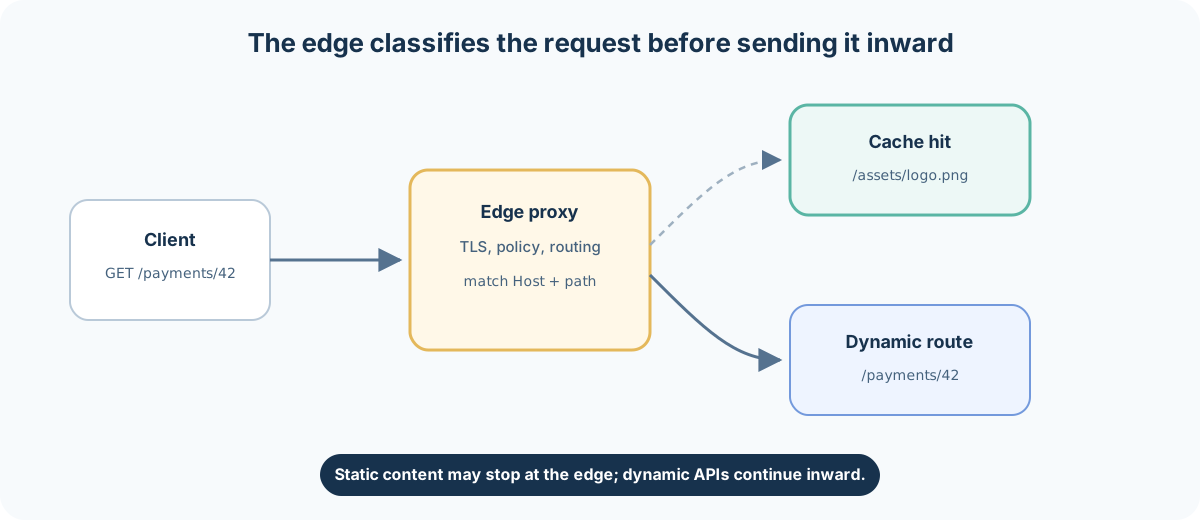
The edge follows configuration distributed by a control plane:
virtual_host: api.example.com
routes:
  - match:
      prefix: "/assets/"
    action:
      type: "cache_lookup"
      ttl: "86400s"

  - match:
      prefix: "/payments/"
    action:
      type: "forward"
      upstream: "payments-regional-ingress"
The proxy matches the Host header and path prefix against this local configuration. Cacheable routes can use local RAM or SSD storage. Dynamic routes are forwarded to the configured upstream.
The internals can be complex, but the request-path role is simple: execute the current policy snapshot quickly and safely.
What to remember: The edge can answer cacheable requests locally. Dynamic requests continue toward regional services.
5. Backbone Transit: Moving Dynamic Traffic Inward
When the edge cannot complete the request locally, it forwards the request toward the regional infrastructure that owns the service. Large providers often use private backbone links or controlled interconnects for this leg.
The path may look like:
client
    -> nearby edge PoP
    -> provider backbone
    -> regional data-center ingress
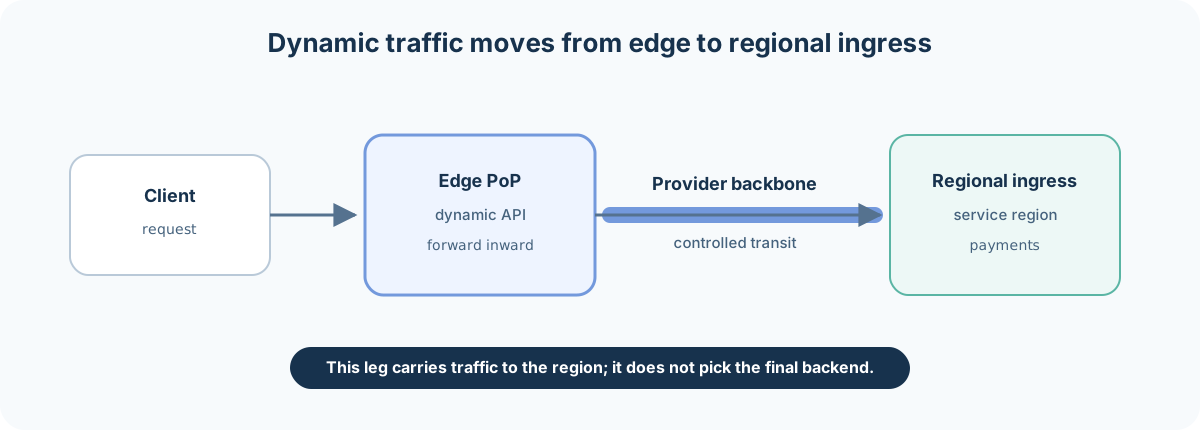
This leg carries traffic toward regional ingress. The edge-to-region decision can depend on geography, service ownership, capacity, compliance boundaries, failure state, and control-plane policy.
6. Regional Ingress and Layer 4 Load Balancing
At regional ingress, traffic reaches a Layer 4 load-balancing tier. The L4 tier works mostly with transport information: IP addresses, ports, and protocol. It does not parse /payments/42 or inspect application headers.
A common flow key is the five-tuple:
(source IP, source port, destination IP, destination port, protocol)
The L4 balancer receives packets, but it does not make an independent scheduling decision for every packet. It first derives a flow key from the packet headers. For TCP, packets from the same connection usually have the same five-tuple, so the balancer can treat them as one flow.
A stateful L4 balancer may keep a per-flow table:
flow key                                      selected target
----------------------------------------------------------------
TCP 1.2.3.4:51000 -> 198.51.100.10:443        L7 proxy P2
TCP 1.2.3.4:51001 -> 198.51.100.10:443        L7 proxy P1
The first packet creates the mapping. Later packets with the same flow key reuse it:
packet arrives
    -> compute five-tuple
    -> existing flow mapping? yes -> reuse selected proxy
                              no  -> choose proxy and store mapping
Some L4 designs avoid a mutable table and use deterministic hashing instead:
hash(five_tuple) -> L7 proxy P2
As long as the proxy set is stable, packets with the same five-tuple compute the same target.
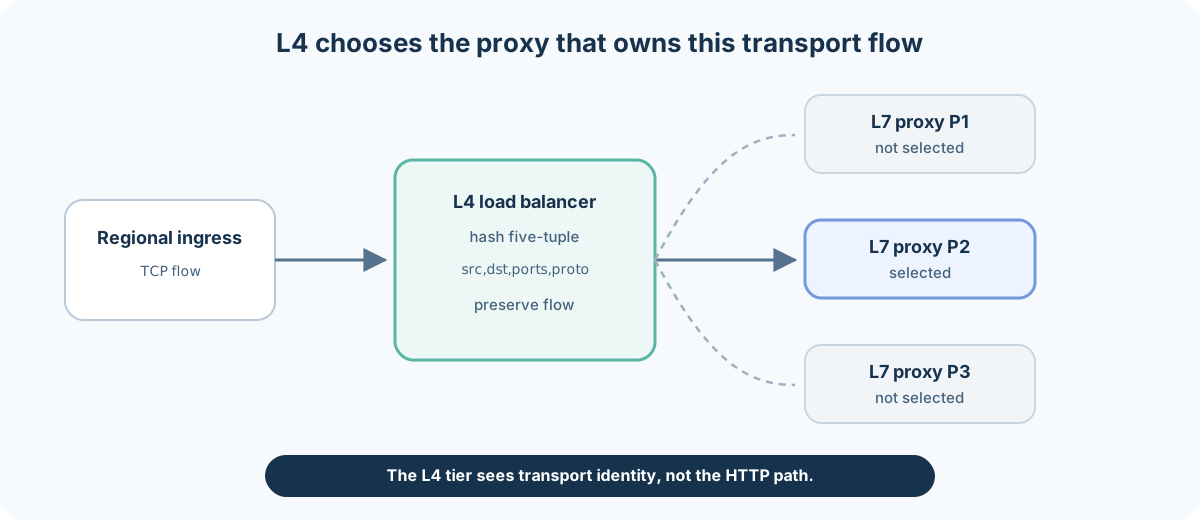
Consistent hashing or lookup-table designs limit movement when proxy membership changes. If one proxy is removed, only part of the traffic should move.
The key rule is flow preservation:
first packet of connection -> select P2
later packets              -> continue to P2
Round-robin per packet would break TCP. Packets from one connection could land on different proxies, none of which has the full connection state. The important rule is: packets arrive individually, but related packets are grouped into a flow before choosing where they go.
This tier often sits after the edge and after backbone transit, at the door of the regional data center:
edge PoP
    -> backbone transit
    -> regional L4 load balancer
    -> regional L7 proxy fleet
The placement can vary by provider, but the role is stable: spread transport flows across a proxy fleet while preserving flow state.
What to remember: The regional L4 tier usually chooses a proxy, not the final application container.
7. Layer 7 Proxying and Application Routing (API Gateway)
The L7 proxy understands the application protocol. For HTTP, it can parse the host, path, method, and headers. L7 proxy is the API Gateway
GET /payments/42 HTTP/1.1
Host: api.example.com
Authorization: Bearer ...
This is where the request becomes an application route:
host api.example.com
path /payments/42
    -> payments service
The L7 proxy can apply policies that an L4 balancer cannot see:
- route by hostname, path, method, or header;
- validate authentication metadata;
- enforce rate limits;
- apply request and response timeouts;
- attach tracing headers;
- choose retry behavior;
- select a backend pool for the matched service.
The proxy keeps a local, versioned snapshot of service discovery and configuration. It does not ask a central database for every request:
parse request
    -> match route
    -> read local pool snapshot
    -> choose eligible backend
For the payments route, the snapshot might contain:
payments pool
    B1 = 10.0.1.11:8443  healthy, accepting new work
    B2 = 10.0.1.12:8443  healthy, accepting new work
    B3 = 10.0.1.13:8443  unhealthy
The proxy filters the pool before scheduling. A backend that is unhealthy, draining, overloaded, or circuit-broken should not receive new work.
known pool:     B1, B2, B3
eligible pool:  B1, B2
selected:       B2
Policy:
virtual_host: api.example.com
routes:
  - match:
      path_prefix: "/payments/"
      methods: ["GET", "POST"]
    policy:
      require_auth: true
      rate_limit:
        key: "user_id"
        requests_per_minute: 120
      timeout_ms: 800
      retries:
        attempts: 1
        retry_on: ["connect-failure", "reset", "gateway-error"]
      circuit_breaker:
        max_pending_requests: 500
    upstream:
      cluster: "payments"
      load_balancing: "least_requests"
      locality: "same_zone_preferred"

  - match:
      path_prefix: "/assets/"
      methods: ["GET"]
    policy:
      require_auth: false
      cache:
        ttl_seconds: 86400
    upstream:
      cluster: "static-assets"
For GET /payments/42, the proxy can now make decisions that an L4 balancer cannot make:
Host header matches api.example.com
Path matches /payments/
Method is GET
Authentication is required
Rate limit key comes from the authenticated user
Timeout is 800 ms
Backend cluster is payments
Load-balancing policy is least requests
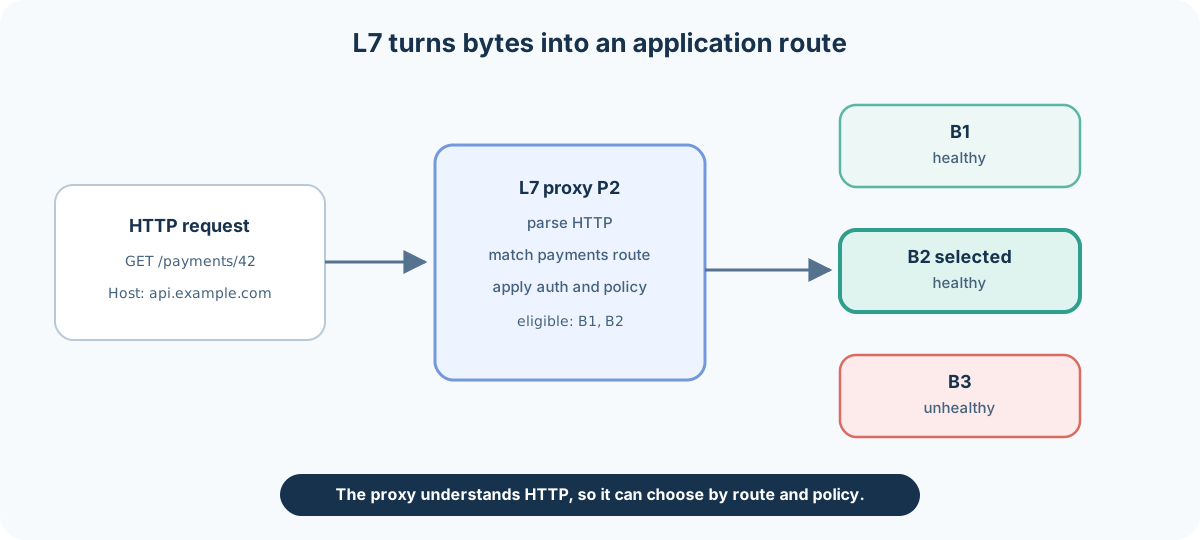
Scheduling policy may use round robin, weighted round robin, least requests, power of two choices, locality, endpoint-reported load, or circuit breakers.
The proxy often uses a persistent backend connection pool:
client connection -> L7 proxy -> reused connection to B2
Reusing warm backend connections avoids opening a new socket for every request.
8. Backend Execution and the Return Path
After selection, backend B2 receives the request:
GET /payments/42
    -> payment backend B2
The backend owns application execution. It parses the payment identifier, calls databases or caches, emits logs and traces, and constructs the response.
The response returns through the path created by the request. A full L7 proxy sees the response and sends it back on the client-facing connection. Some L4 designs let return traffic bypass part of the L4 tier, so the exact reverse path depends on the forwarding mode.
Conceptually, the response follows the state that was established on the request path:
backend B2
    -> L7 proxy P2
    -> regional egress / backbone
    -> edge PoP
    -> client
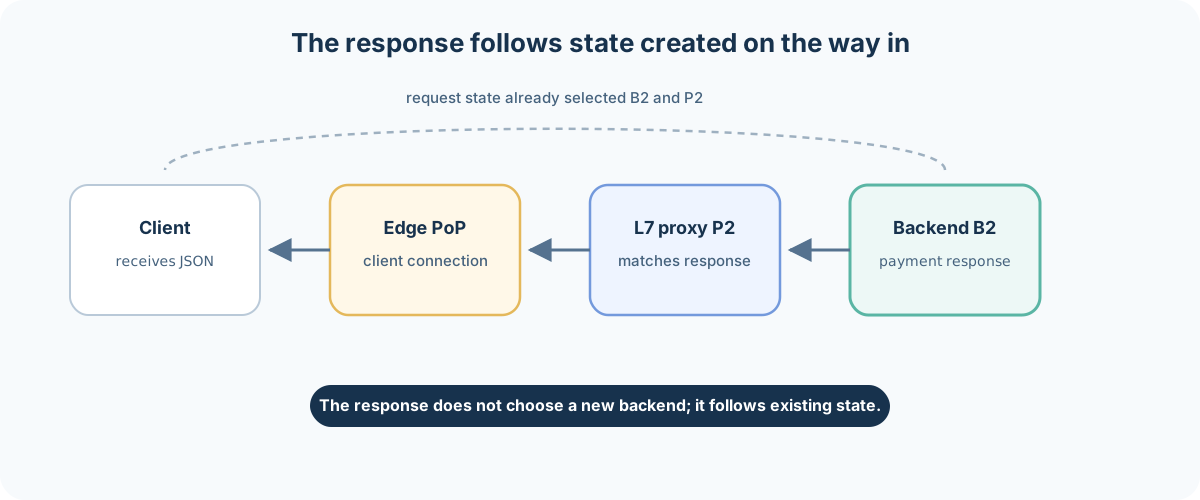
The response does not rediscover the system from scratch. It follows state created while the request moved inward.
9. What Each Layer Knows
The request path is easier to reason about as a table of ownership:
| Layer | Main decision | State it owns |
|---|---|---|
| DNS or Anycast | Traffic entry point | Routing policy, BGP reachability, health of entry points |
| Edge proxy | Local response or forwarding decision | Client connection, TLS state, cache metadata, edge route config |
| Backbone transit | Regional ingress target | Internal routing policy and network reachability |
| L4 load balancer | L7 proxy for this flow | Flow mapping or deterministic hash state |
| L7 proxy | Service route and backend pool | HTTP parsing, route table, timeout, retry, auth, pool snapshot |
| Scheduler | Backend for this request | Eligibility, load signals, locality, weights, circuit breakers |
| Backend | Application operation | Business logic, local process state, database/cache calls |
No layer has perfect information. Global routing sees reachability, not application load. The L4 tier sees transport identity, not HTTP paths. The L7 proxy sees application routing through a local snapshot. The backend sees the business operation, not the whole global path.
10. Complete Walkthrough
For GET /payments/42, one possible path is:
- The client resolves or routes to
api.example.com. - DNS steering or Anycast brings the packet to a nearby edge PoP.
- The edge accepts the client connection and terminates TLS when configured.
- The edge matches
Host: api.example.comand path/payments/42. - The request is classified as dynamic rather than cacheable.
- The edge forwards the request across provider-controlled transit toward the payments region.
- Regional ingress receives the traffic.
- The L4 load-balancing tier hashes the flow to L7 proxy
P2. P2parses the HTTP request and matches the payments route.P2reads its local payments pool snapshot.B3is filtered out because it is unhealthy or ejected.- The scheduler chooses eligible backend
B2. P2forwards the request over a backend connection toB2.B2executes the payment lookup and constructs the response.- The response returns through the proxy and edge path to the client.
The client experiences one HTTP request. Internally, the system answers a series of smaller routing questions:
global entry point
edge policy
region
L7 proxy
route
eligible backend
That is the core story of a global request path: scale comes from placing each decision at the layer that has enough information to make it.
11. Summary
A global request path is a layered system. Global routing finds an entry point. The edge applies cache and policy decisions. Regional L4 load balancing assigns transport flows to proxies. L7 proxies parse the application request and select a service route. Schedulers choose eligible backends. Backends execute the business operation and return the response.
The central design principle is scoped responsibility: each layer should make the decision it is equipped to make and preserve only the state required by that decision.
Leave a Comment