Designing the Top K Songs by Active Listeners
Published:
A listener opens a music app and starts song_101. Its listener count increases by one. A few minutes later, that listener switches to song_202: the first song loses a listener and the second gains one. A popular-songs widget needs to reflect those changes and return the K songs with the most listeners.
The platform has 10 million registered users, around 1 million concurrent listeners, and millions of songs. The leaderboard should respond quickly—a p99 target of 50 ms—and normally reflect playback changes within five seconds. K is supplied by the caller, up to a configured maximum.
For this design, each user contributes to one current song. The player reports starts and stops, including a stop when playback pauses or finishes. These reports are the source of the counts. A client that disappears without sending a stop can leave a stale listener; automatic cleanup is a production extension at the end.
Build a Leaderboard That Works
The first step is to connect a playback change to a count. The player already knows the song it is starting or stopping, so it can report an event like this:
{
  "user_id": "user_36",
  "playback_id": "playback_901",
  "song_id": "song_101",
  "type": "START"
}
playback_901 identifies this particular listening attempt. Replaying the same song or resuming after a pause creates a new playback ID. A stop identifies the playback and song being ended. The playback service validates the event and passes it to the program that updates counts, called the count processor. It can forward the event without knowing the user’s previous song.
Suppose the current counts are:
| Song | Active listeners |
|---|---|
| song_101 | 120,000 |
| song_202 | 100,000 |
| song_303 | 90,000 |
A start adds one to a counter; a stop subtracts one. The query API also needs to find the largest counters. A Redis sorted set supplies both operations: each entry is a song ID, its score is the listener count, and Redis maintains the score order as counts change.
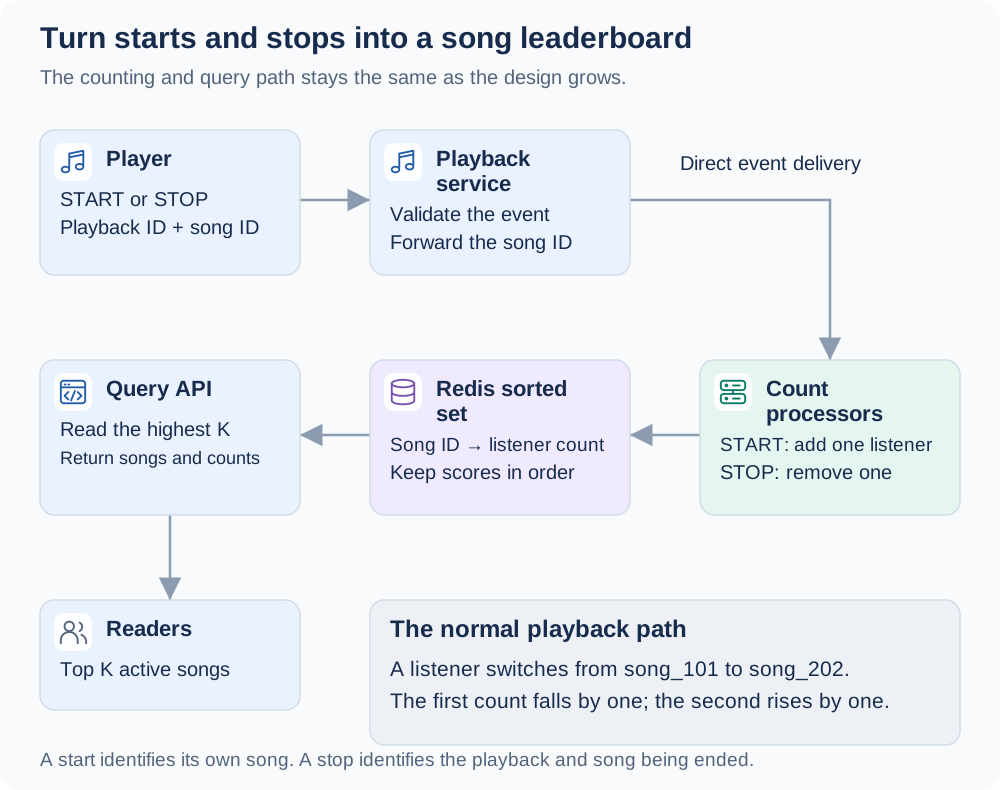
Follow user_36, who is currently included in song_101’s count. The player switches songs and reports these two events:
STOP  playback_901, song_101 → song_101: 120,000 → 119,999
START playback_902, song_202 → song_202: 100,000 → 100,001
The corresponding Redis score changes are:
ZINCRBY active_songs -1 song_101
ZINCRBY active_songs  1 song_202
The same mechanism handles someone stopping at the end of a song. Remove a song with ZREM when its count reaches zero, so the leaderboard contains only songs with listeners.
The widget calls GET /rankings?k=5. The query API reads:
ZRANGE active_songs 0 4 REV WITHSCORES
REV returns the largest scores first. For another K, the end index is K - 1. Equal counts are ordered by descending song ID, the ordering Redis uses for a reverse-range query. If fewer than K songs have listeners, return those songs.
With D active songs, a score change takes O(log D) and reading K entries takes O(log D + K). A separate ranking algorithm is unnecessary at this stage: the sorted set already keeps the songs in order.
The widget can now retrieve the leaders, and reported playback changes update the appropriate scores. An interruption between the player and Redis exposes the first weakness of this design.
Keep Playback Events During an Outage
Suppose Redis is unavailable for 30 seconds. Listeners continue changing songs during that interval. The playback service needs somewhere to save their events until counting can resume.
Place Kafka between the playback service and the count processors. Kafka retains accepted events, and processors read them as capacity becomes available. The playback service acknowledges an event after Kafka durably accepts it. A player that receives no acknowledgement retries the same event with the same playback ID and event type.
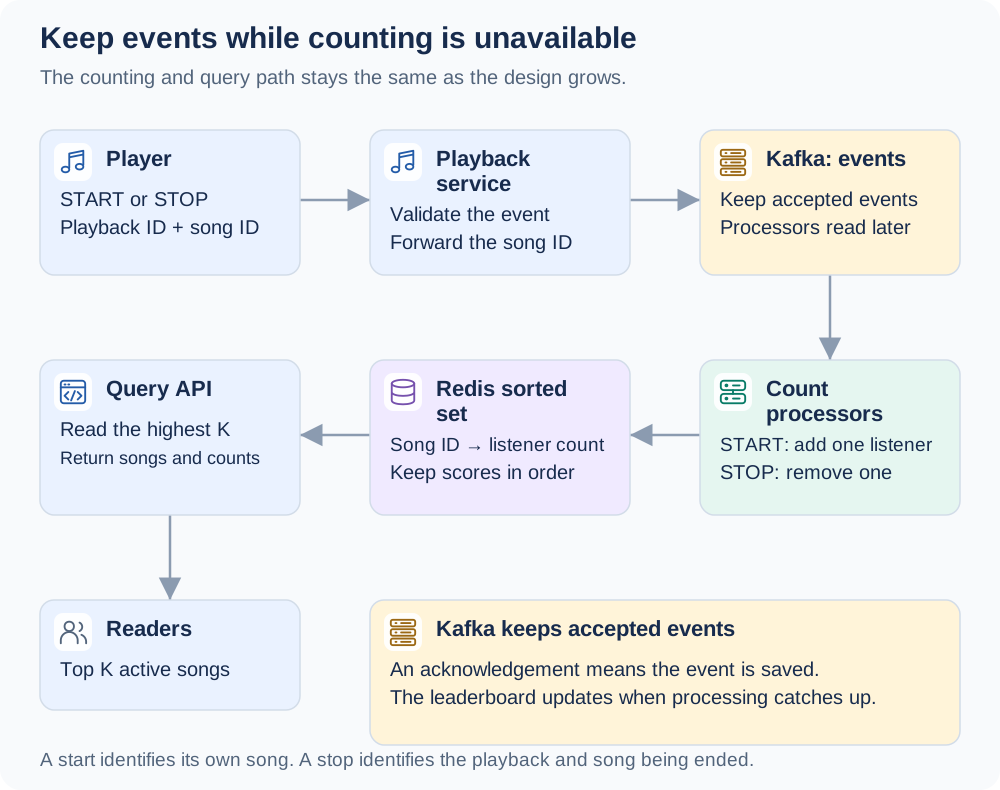
Kafka acceptance and leaderboard visibility happen at different times. The five-second freshness target measures the processing delay between them. A query reads the counts processed so far; its response time is not proof that all events through that moment have arrived.
That delay is usually acceptable for a live popular-songs widget. The design can continue serving while a brief backlog catches up. It also means an event can be delivered more than once, which changes the counting problem.
Keep the Counts Correct When Events Repeat or Arrive Late
Consider the start of playback_901 again. A processor increments song_101, then crashes before saving its Kafka progress. Its replacement receives the same start. A second increment would add a listener who does not exist.
The processor needs to remember whether that playback has already been counted. Keep a small record in Redis beside the song scores:
playback_901:
    user_id: user_36
    song_id: song_101
    status: PLAYING
When the start is repeated, the record already says PLAYING, so the count stays unchanged. The first stop changes the record to CLOSED and subtracts one. A repeated stop finds CLOSED and subtracts nothing.
The record also solves a less obvious case. A stop can reach the processor before its start. Subtracting immediately would produce an incorrect count. Instead, save CLOSED without decrementing. When the delayed start arrives, the processor sees that the playback has ended and leaves it closed.
| Saved state | Incoming event | Action |
|---|---|---|
| No record | START | Save PLAYING; add one listener. |
| PLAYING | START | Keep the existing contribution. |
| PLAYING | STOP | Save CLOSED; remove one listener. |
| No record | STOP | Save CLOSED; change no count. |
| CLOSED | START or STOP | Keep it closed; change no count. |
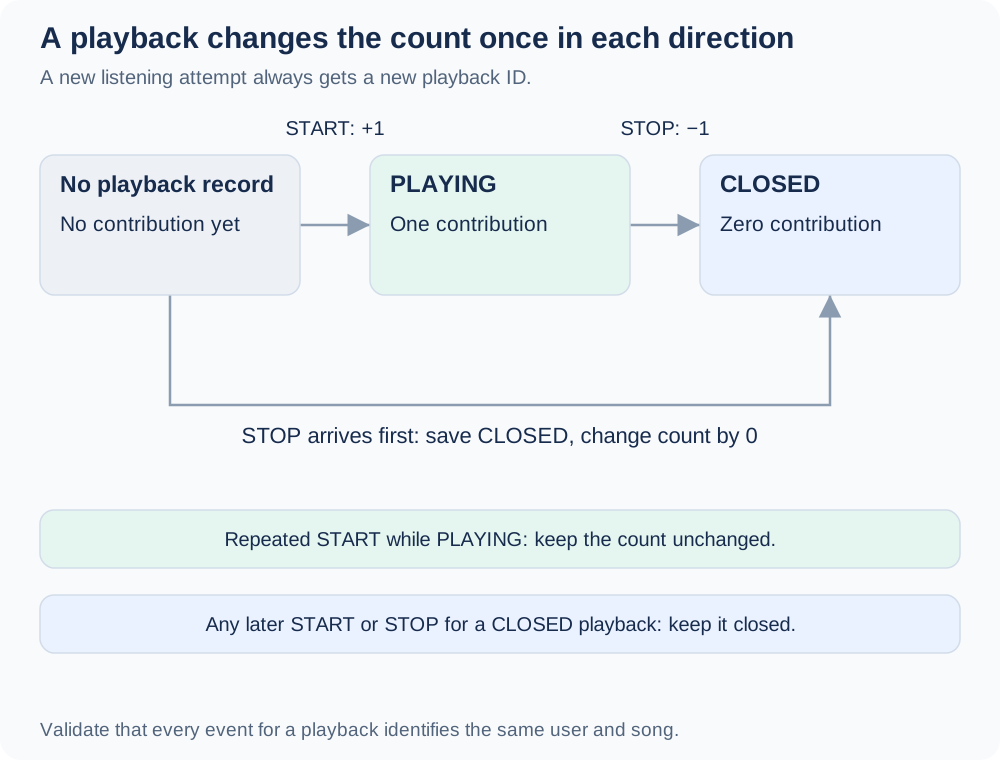
The playback service checks that all events for a playback identify the same user and song. Keeping a closed record is part of correctness: deleting it while its old start can still be retried would let that start count again. Set a supported retry and replay interval, then retain closed records for that interval or reject older playback IDs when accepting events.
Save the Record and Score Together
There is another failure between saving PLAYING and incrementing the score. If either write succeeds alone, a retry can leave a missing or duplicate listener. Both changes therefore belong in one Redis operation.
A short Redis function or Lua script reads the playback record, decides the allowed change, and writes the new record and song score without another command running between them. It also saves the processed Kafka position. After that operation succeeds, the processor acknowledges its progress. Repeating it after a lost response encounters the same saved state and changes no count. Redis describes this atomic execution model.
Validate the operation before writing: Redis scripts do not roll back earlier writes after a runtime error. Keep the script short, and reconcile state after an unexpected partial failure. In Redis Cluster, the record and leaderboard keys touched by the script must share a hash slot; a common hash tag such as {active} places them together. This deliberately keeps the initial counting state on one shard.
Retries are now safe for an individual playback. Returning to user_36’s song switch reveals why that guarantee alone is not enough for a user leaderboard.
Count the User Once During a Song Switch
Suppose the start of playback_902 arrives while the stop of playback_901 is delayed. Both playback records can say PLAYING, even though the user has already moved to the second song. Two devices can create the same overlap.
The requirement is one contribution per user. Add a current-user record:
user_36:
    playback_id: playback_901
    song_id: song_101
When the start for playback_902 arrives, the processor reads this record and finds the previous contribution. In one Redis operation, it closes playback_901, subtracts one from song_101, adds one to song_202, and saves playback_902 as the user’s current playback.
The old stop eventually arrives and finds playback_901 already closed. It changes nothing. The processor learned the previous song from accepted events; the playback service still only had to forward each event’s own song ID.
A late start from an old device also needs a clear rule. The playback platform’s authorization service can assign increasing playback versions: 42 for the old playback, 43 for the new one. The processor accepts the newer authorized version and ignores the older one. A client cannot choose its own version to regain control of playback. The user record retains the latest authorized version alongside the current song and playback ID.
Keep the latest version after a stop, including a stop that arrives before its start. A newer stop closes any older counted contribution and records the new playback as closed. Its later start stays closed. This prevents a stopped or superseded playback from reappearing because of delayed delivery.
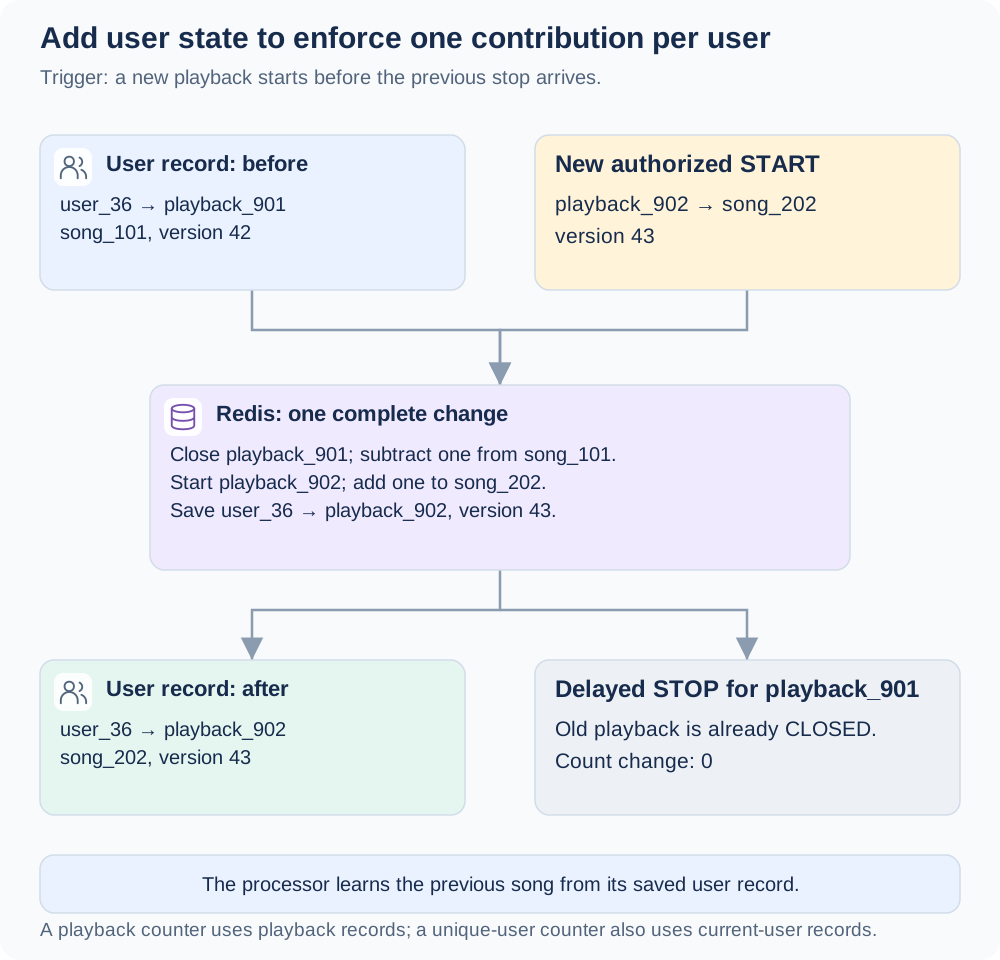
The extra record has a specific job. Playback records protect individual starts and stops; the user record enforces one current contribution across playbacks. If an upstream system already supplies that exclusive contribution stream, the leaderboard can rely on that guarantee instead.
Recover the Same Design After a Worker Fails
The Redis operation is the same for every user, so several processors can share the work. A worker is a running copy of that processing program. Kafka divides the event stream into numbered groups called partitions and assigns each partition to one worker in a consumer group.
Use user_id as the routing key so all events for one user reach the same input partition. For example, partition 7 contains events for user_36 and user_52; Worker 1 reads that partition. Partition 8 contains user_83 and user_94; Worker 2 reads it. Each worker can read several partitions.
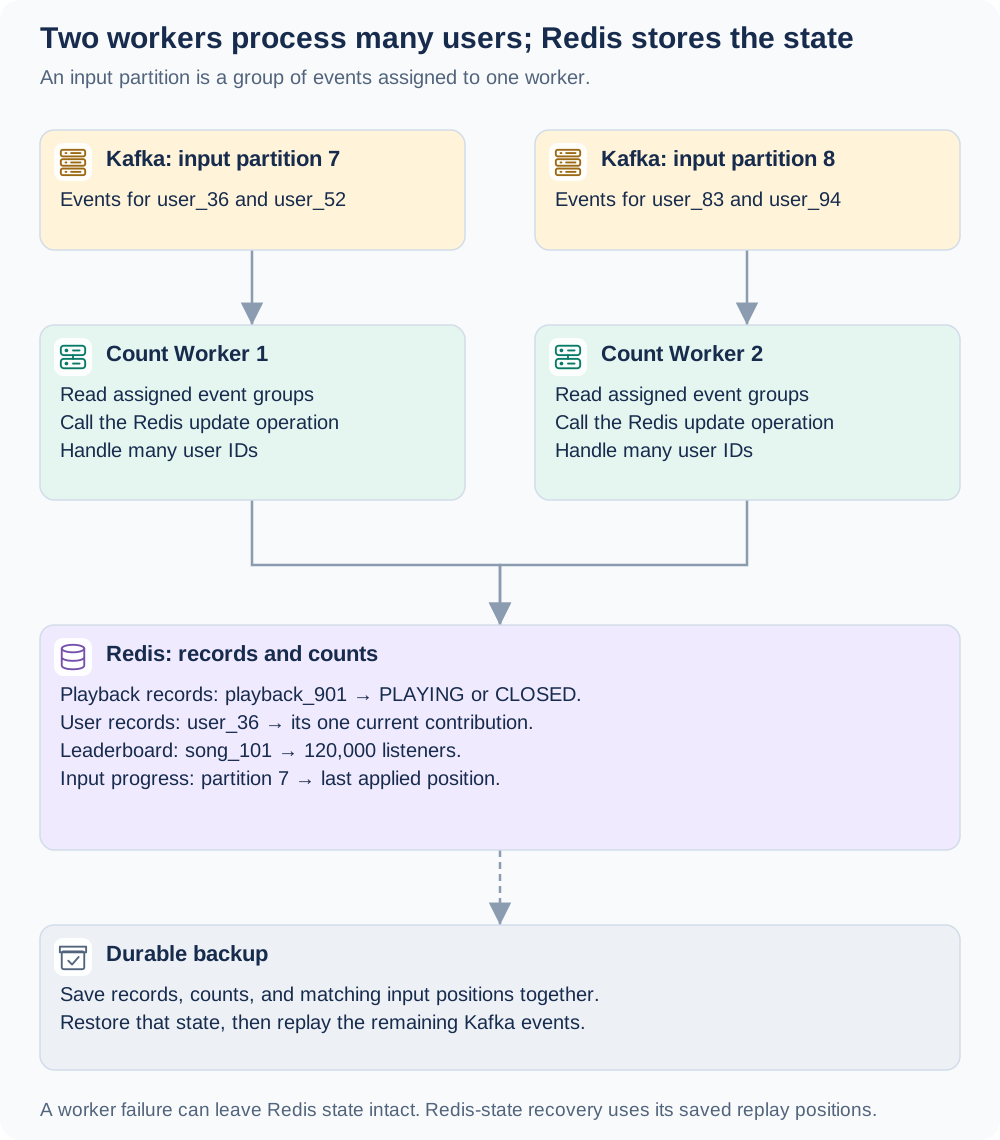
If Worker 1 dies, its replacement resumes partition 7. The records for user_36 remain in Redis. Any repeated start or stop is handled by the checks already introduced. A separate copy of every user’s record inside the worker is unnecessary in this design.
A disconnected old worker might return after its replacement starts. Give each partition assignment an increasing ownership version, and check that version inside the Redis operation. Once a new assignment is active, the old worker’s new writes are rejected. This number identifies the authorized processor; the playback version identifies the user’s newest playback decision.
Recover When Redis Also Loses State
Now suppose Redis restores an older backup. Kafka can supply the missing events, but recovery needs a position that matches the restored data.
A Kafka offset is an event’s position in one partition. If the restored Redis state includes partition 7 through offset 92,000, replay starts at 92,001. Using a newer consumer acknowledgement would skip events whose count changes disappeared with the lost Redis writes.
Save song scores, playback records, user records, and their processed input positions together. Restore that consistent copy, then replay later events. Persistence and replicas reduce the amount of replay, but their guarantees depend on configuration; Redis documents the relevant failover and write-safety limits.
A complete rebuild needs an authoritative current-playback snapshot with matching log positions, or enough retained history to reconstruct every still- counted playback. A fixed recent window can miss a playback whose start was much earlier. Closed-record retention and admission rules must support the chosen replay boundary as well.
Rebuild into separate keys and switch the query API after catch-up and validation. An optional cached Top K can serve during the outage with its saved time and stale status. If no usable result exists, return unavailable.
The system now handles the main failure cases without changing its overall shape: Kafka retains the input, processors retry safely, and Redis holds the current records and ranking. The remaining question is how far that shape can scale.
Grow Beyond One Redis Leaderboard
One million concurrent listeners does not mean one million updates per second. If each listener changes songs every three minutes on average:
1,000,000 / 180 ≈ 5,600 song changes/second
5,600 × 2      ≈ 11,200 START/STOP events/second
With 100 input partitions and 10 workers, each worker handles roughly ten partitions, 100,000 active users, and 1,120 events/second under this assumption. Starts, stops, retries, and synchronized traffic add to that load. These are sizing assumptions to test, not a benchmark result.
Redis receives the record checks and accepted score changes from all workers. Measure the full operation, including the overlapping starts and stops that become no-ops. Useful signals are input lag, Redis CPU and memory, update and Top-K latency, and restore time.
State size deserves the same attention. One million 128-byte user records would occupy 128 MB before database overhead. Playback records, song entries, replicas, and retained closed records add more. At 5,600 completed playbacks per second, keeping closed records for an hour adds about 20 million records. The retry policy can cost more memory than the current leaderboard.
Adding workers helps event processing, but one sorted-set key remains on one Redis shard. Redis Cluster distributes keys, not the members of one sorted set. That is the boundary described by Redis Cluster’s key distribution.
If the complete workload fits within that shard’s latency, memory, and recovery targets, the design is sufficient. Sustained saturation or an unacceptable restore time justifies the next architecture change.
Split Song Counters Across Workers
Until this point, each processor made a user decision and changed Redis in the same operation. To distribute counting, separate those responsibilities. User workers retain the playback records and decide each user’s accepted contribution. Song workers maintain the totals for groups of songs. A group of song counters is a song partition.
Follow the same switch again:
user_36 starts song_202 while counted against song_101
    → User Worker 1 accepts the new contribution
        → song_101 −1 → song partition 3 → Song Worker 1
        → song_202 +1 → song partition 9 → Song Worker 2
user_36 continues to reach User Worker 1. The accepted count changes take a second route, by song_id, so changes from every listener of a song meet at its owner. A worker can own many song counters and several partitions.
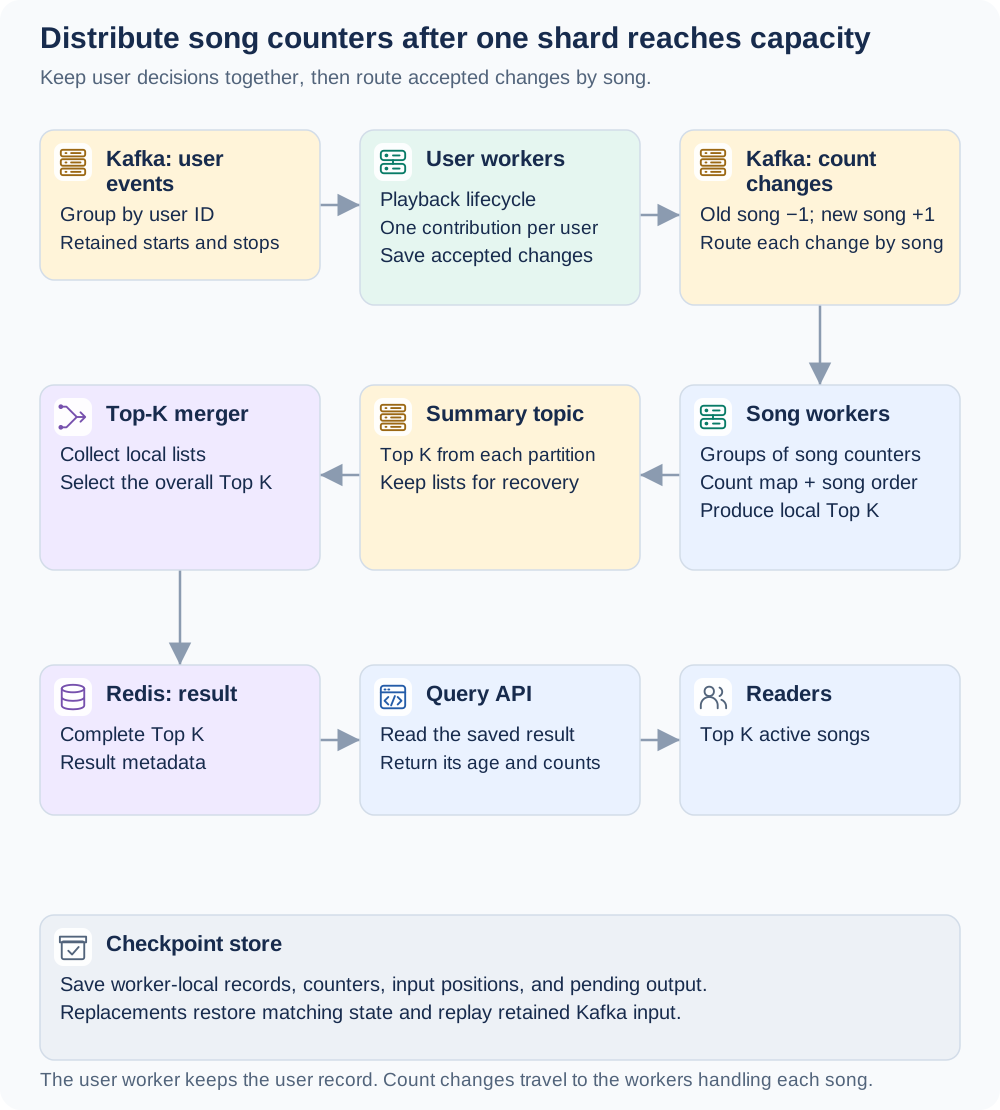
The new boundary creates a new failure case: a user worker might save the song switch but crash before sending its two count changes. Save its decision and pending output together. A transactional stream-processing handoff, or a saved list of changes that can be resent, makes the output recoverable. Give each accepted change a stable identity so song workers can apply a resend once.
These workers can keep local state for throughput. A durable checkpoint saves that state, matching input positions, and pending output. A replacement restores the checkpoint and replays Kafka. This checkpoint is necessary because records now live in worker-local stores, unlike the earlier design where every processor used shared Redis state.
Find the Global Winners From Local Rankings
Each song worker needs the same operations Redis previously provided: a count map and an index ordered by count and then descending song ID. Updating a song replaces its old index entry. A balanced tree gives O(log D) updates for D songs in the partition and O(log D + K) local reads.
Keep every active song in the local index. If the fifth-ranked song loses listeners, the sixth may replace it. Storing only the five winners would lose that replacement candidate.
A merger combines the local leaders into the overall Top K. Consider a later result with these complete song counts, using K=5:
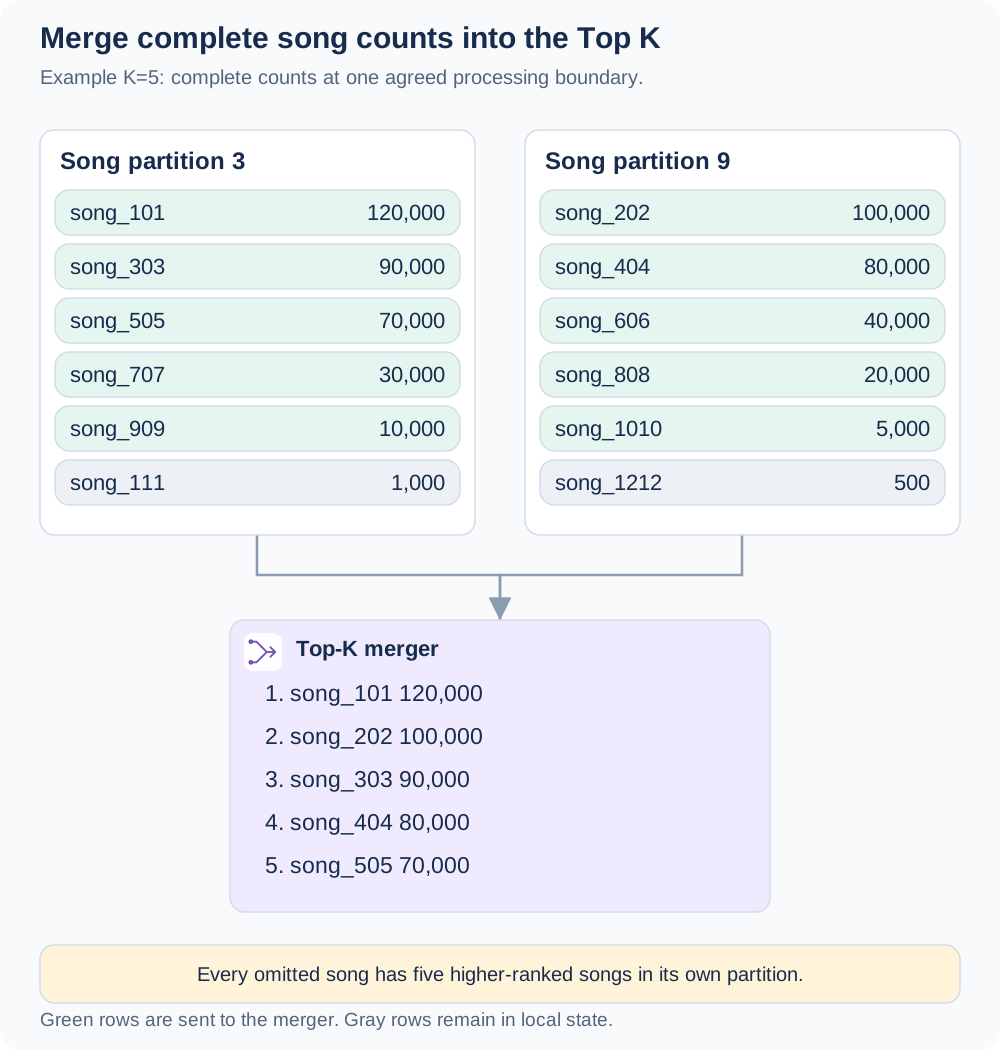
An omitted song already has K songs ahead of it in its own partition. Those songs also rank ahead of it globally, so the omitted song cannot be a global winner. With P partitions, the merger examines at most P × K candidates. For 200 partitions and K=5, that is 1,000 candidates. A size-K heap selects the result in O(PK log K). Retain lists for K_max when supporting smaller request sizes through the same API.
This reasoning depends on complete counters. A song split across regions needs its regional counts added before candidate pruning. Local winners from partial counters are insufficient to identify every global winner.
Handle a Popular Song That Overloads Its Owner
Partitioning spreads different songs across workers. A new release can still send a large burst of changes for one song to a single owner.
First combine accepted changes into batches. Hundreds of additions and removals can become one net update, such as +300. A batch needs its own stable identity so retrying it does not apply another +300. Preserve the result’s chosen processing boundary when combining changes.
If batching is insufficient, split the hot song into groups based on a stable hash of user_id. A small group number is called a salt. For example, hash(user_36) % 4 = 2 places that user’s contribution in group 2.
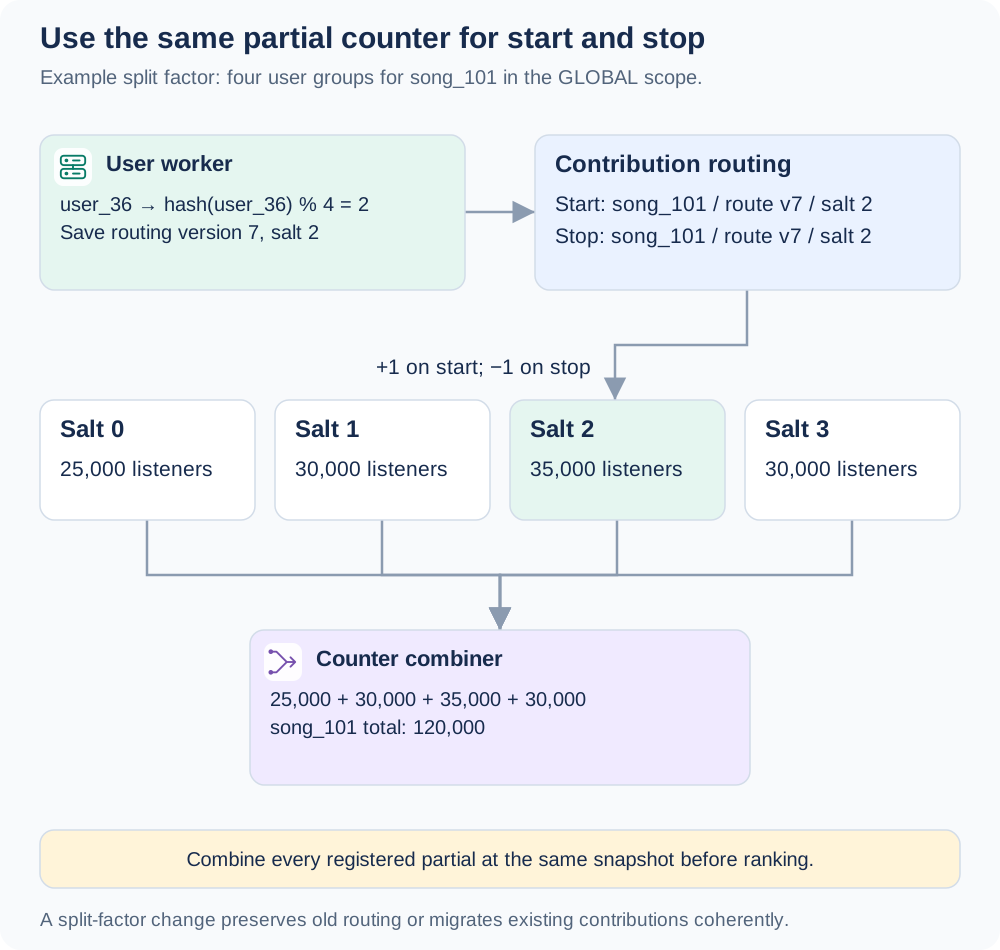
A combiner adds every registered partial for that song before the result enters global ranking. Send all partials even when none is locally popular. Exclude the split song from ordinary local Top-K lists so its reconstructed count appears once.
Save the contribution’s salt and routing version with the user record. If the number of groups changes, existing removals must still find their original partial, or a migration must move those contributions coherently. Keeping old routing until playback ends is simpler, but long-running playbacks can keep that version alive indefinitely.
Decide Which Local Results Can Be Combined
Distribution also changes what a query means. The original Redis read observes one database state. Two song workers can be at different positions in the stream: the decrement for song_101 may be processed while the increment for song_202 is still waiting.
For a live popular-songs widget, the merger can combine the latest local lists and tolerate this temporary skew. Track each partition’s lag and list age, and set a limit on how much skew is acceptable. The combined ranking reflects those local states, with no claim of a common source-time boundary.
If the product requires each accepted switch to appear as one completed change, add a common snapshot. A barrier is a marker naming the input positions included in that snapshot. User workers emit all earlier decisions before the marker. Song workers process their preceding changes before producing a local list for that marker.
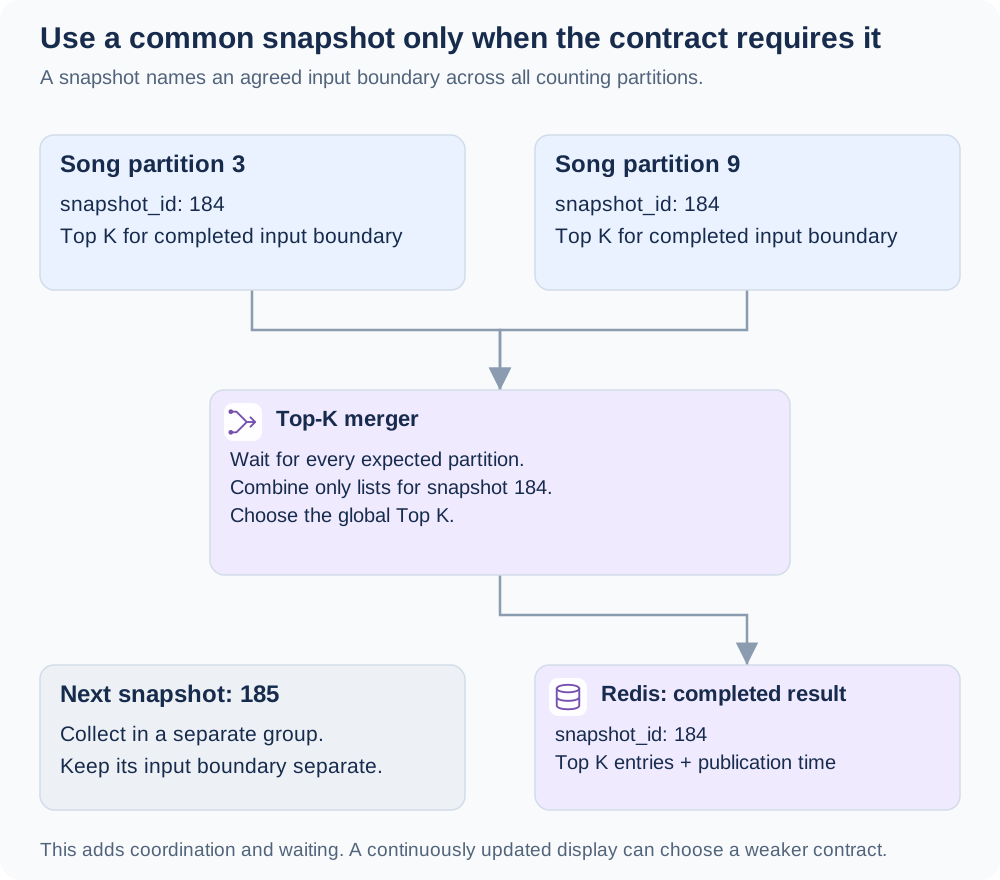
The marker must reach every expected downstream route, including empty ones. A stage with several inputs waits for the marker from each input and buffers later data while aligning that boundary. The merger combines lists with the same snapshot and routing versions. An empty partition sends an empty list to confirm completion. A retry replaces its previous list, adding no extra count.
Publish the finished ranking and snapshot ID as one Redis object. Check the current publisher’s ownership version and increasing snapshot ID so an old publisher cannot overwrite a newer result. If a contributor falls behind, serve the last complete result with its saved metadata and bound the pending snapshot buffers.
The snapshot identifies a consistent processing boundary. Calling it as_of=10:05:00 additionally requires every source to establish that all accepted input through 10:05:00 has been included. A publication timestamp alone does not establish that completeness. Stream processors provide checkpoint and replay mechanisms for coordinating this state across stages.
The added waiting and recovery state are the cost of the stronger guarantee. A continuously updated widget can keep the simpler contract; a product that needs a consistent snapshot pays for coordination explicitly.
Verify the Design Against the Same Playback Story
The example now supplies a useful set of checks:
| Event or failure | Expected result |
|---|---|
| Repeat the start of playback_901 | song_101 gains one listener in total. |
| Deliver its stop before its start | The playback stays closed and contributes zero. |
| Start playback_902 before the old stop arrives | user_36 moves from song_101 to song_202 once. |
| Deliver the old stop afterward | song_202 keeps the user’s contribution. |
| Deliver an old-device start | Its older authorized version changes no count. |
| Crash after the Redis update | Replaying the event leaves the counts unchanged. |
| Restore an older backup | Replay begins at the input positions saved with that backup. |
| Delay a required distributed snapshot list | Keep serving the previous complete snapshot. |
For one contribution per user, the sum of song counts equals the number of counted user records at the same processing boundary. A negative count or a mismatch calls for reconciliation and replay. Forcing a negative count to zero would hide the error that caused it.
Monitor input lag, Redis operation latency, duplicate and obsolete events, active and closed record counts, query latency, and restore time. After distribution, add missing local lists, partial-counter coverage, snapshot age, and progress differences between partitions. Validate sampled results against authoritative playback state, including retry storms and device transfers.
Add Disconnect Detection When the Product Needs It
The ranking relies on reported stops. If a player loses connectivity before sending one, its last contribution remains. A production deployment can add activity reports—for example, every 15 seconds—and remove a contribution after 45 seconds without accepted activity.
That timeout uses the same removal path as a stop. Check the saved playback identity, version, and deadline before removing it, so an old timer cannot remove a newer playback. Recovery restores deadlines and catches up on retained activity before expiring contributions. This extension adds heartbeat traffic, timers, and a delay before silent disconnects disappear from counts.
Related Design: Recent Playback Counts
The sliding-window Top-K design ranks songs by plays during the last five minutes. It covers time buckets, window expiration, and approximate heavy hitters.
Leave a Comment