Inside a Load Balancer: Connections, Scheduling, Health, and Failover
Published:
1. Why Load Balancing Exists
A service often begins with one application server:
client -> application server
The client resolves the server’s address, opens a connection, sends work, and receives a response. There is no choice to make because there is only one server.
That design stops being sufficient when one machine cannot handle the traffic, needs maintenance, or fails. The service adds replicas:
backend B1
backend B2
backend B3
Replicas solve the capacity problem, but they create a routing problem:
Which address should the client call?
Which backend should handle this connection or request?
Clients should not need to know every backend address. Backend machines are added, removed, replaced, drained for deployment, or marked unhealthy. If clients cached those addresses directly, every fleet change would become a client problem.
A load balancer gives clients one stable service endpoint and chooses a backend behind it:
                    -> backend B1
client -> balancer  -> backend B2
                    -> backend B3
The client keeps calling the same public address. The load balancer uses its current view of the fleet to choose an eligible backend, meaning a backend that exists, is healthy enough, and is allowed to receive new work.
The word “balance” can be misleading. A load balancer is not merely trying to give every backend the same number of requests. Equal request counts are not necessarily equal work. One request may finish in a millisecond while another streams for an hour. One connection can remain idle while another consumes an entire CPU core or large amounts of bandwidth.
A more precise definition is:
A load balancer assigns packets, transport flows, protocol requests, or application sessions to eligible backends while preserving the correctness required by that unit of traffic.
That definition sounds abstract because different systems balance different units of work. A simple TCP load balancer may choose once per connection. An HTTP proxy may choose once per request. A sticky-session policy may try to send several related requests to the same backend.
In production, this responsibility includes more than choosing a name from a list. A load balancer must:
- keep packets from one stateful flow on a compatible path;
- stop assigning new work to failed or draining backends;
- preserve deadlines and bound retries;
- prevent slow backends from exhausting proxy memory;
- shed work when the remaining fleet has no capacity;
- remain reachable when a load-balancer instance fails;
- expose whether delay occurred in the proxy, its queue, or the backend.
Adding the balancer also inserts another dependency:
client -> load balancer -> backend
Every request can now depend on its network reachability, connection state, CPU, memory, backend view, and failure policy. A load balancer can isolate a backend failure, but a bad retry or health policy can amplify the same failure.
What to remember: A load balancer provides a stable service path over a changing backend fleet. It chooses from the backends it currently believes are eligible, using incomplete and time-delayed information about health and load.
2. One Request at a Load Balancer
A load balancer is easiest to understand from one local decision. Assume a request has already reached a load-balancer instance responsible for the payments service:
GET /payments/42 HTTP/1.1
Host: api.example.com
The balancer has a backend pool for the payments route:
payments pool
    B1 = 10.0.1.11:8443
    B2 = 10.0.1.12:8443
    B3 = 10.0.1.13:8443
For this request, the balancer performs four local steps:
1. match the request to the payments pool
2. remove unhealthy or draining backends
3. choose one eligible backend
4. forward the request and remember the choice as needed
If B3 is unhealthy, the eligible pool becomes:
known pool:     B1, B2, B3
eligible pool:  B1, B2
selected:       B2
The selected backend record contains a concrete address and port, not only a name. Choosing B2 means forwarding to 10.0.1.12:8443 using the data path owned by this balancer: full proxying, NAT, tunnelling, or another forwarding mode.
This post focuses on that local operation: how the balancer learns the pool, filters it, selects a backend, preserves correctness for the selected traffic, and behaves when health, load, or membership changes.
What to remember: Global request routing may involve many layers, but a load balancer’s core job is local: choose an eligible backend for a defined unit of traffic and preserve that choice for as long as correctness requires.
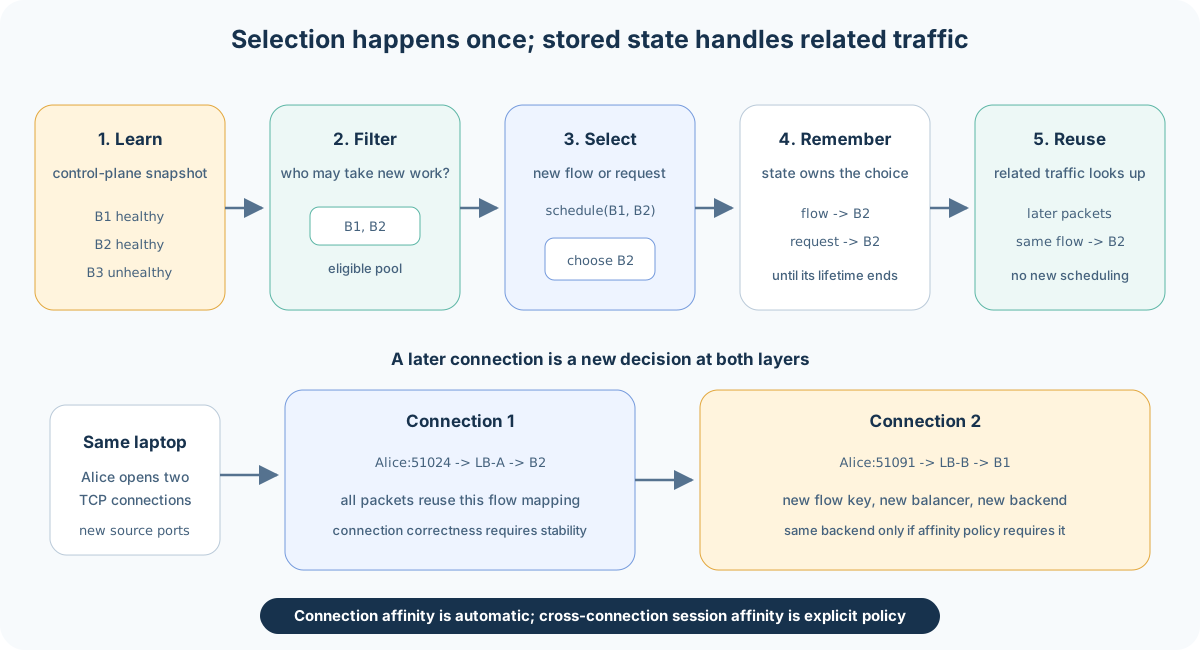
3. The Shared Load-Balancing Loop: Learn, Filter, Select, Remember
The central load-balancing operation can be reduced to six steps:
learn the available backends
    -> filter them into an eligible pool
    -> select one when a new unit of work begins
    -> remember the choice for its required lifetime
    -> reuse the choice for related traffic
    -> forget it when that lifetime ends
This answers two different questions that are easy to combine accidentally:
Which load-balancer instance receives the connection?
Which application backend does that instance select?
The network can choose load-balancer instance LB-A, while LB-A separately chooses application server B2. Those decisions can use different keys, algorithms, and state.
How Does the Load Balancer Know Which Servers Exist?
The balancer does not discover a suitable server by searching the network when a client packet arrives. Its control plane already has a configured route and a current backend snapshot.
That information may originate from:
- a static configuration file;
- DNS records;
- a Kubernetes or another orchestration API;
- a service registry populated as application instances start and stop;
- a management system pushing endpoints and weights to the proxy fleet.
For the payment route, a control-plane update might describe:
route: payments
configured endpoints: B1, B2, B3

B1  discovered, healthy, accepting new work
B2  discovered, healthy, accepting new work
B3  discovered, unhealthy
The set known to exist is not yet the set that may receive traffic. Health, administrative drain state, locality, and policy produce the eligible pool:
known pool:     B1, B2, B3
eligible pool:  B1, B2
Each load-balancer instance normally keeps a local, versioned copy of this snapshot. It can therefore select a backend without asking the registry or a database during every request. Two instances may briefly have different snapshot versions while an update propagates, but both continue making local decisions from complete snapshots.
When Does It Choose a Server?
A backend is selected only when a new selection unit begins. What counts as new depends on the layer:
- an L4 balancer commonly selects when the first packet of a TCP connection or UDP pseudo-flow arrives;
- a full TCP proxy selects while establishing its backend-side connection;
- an HTTP proxy can select for each request or multiplexed protocol stream;
- a session-affinity policy can constrain several new connections to the same backend.
An L4 lookup therefore has two paths:
packet arrives
    -> existing flow mapping? yes -> reuse its backend
                             no  -> select from eligible pool and store mapping
It would be incorrect to run round robin for every TCP packet. Consecutive packets could go to different servers, none of which owns the complete TCP connection. The scheduling algorithm runs at the start of the connection; the connection table handles subsequent packets.
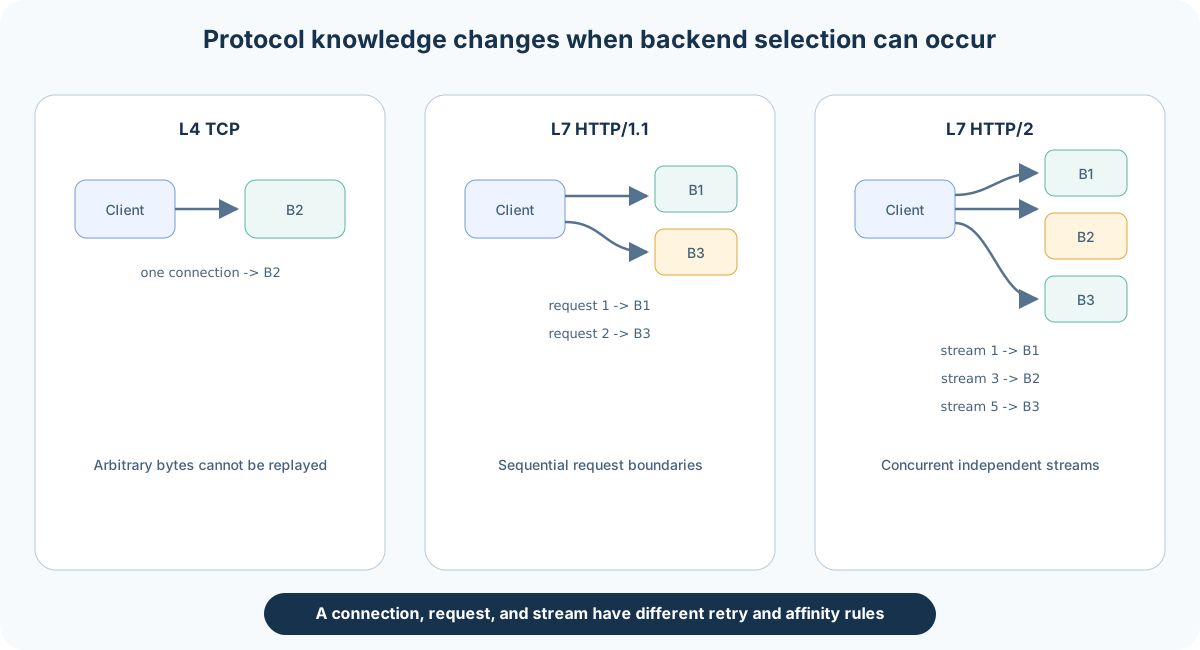
At L7, the safe boundary can be smaller. An HTTP/1.1 keep-alive connection may carry several sequential requests, and an HTTP/2 connection may carry several concurrent streams. A proxy that understands those protocols can make a new backend choice at each request or stream boundary even though the client TCP connection remains attached to the same proxy.
On What Basis Is the Server Selected?
Selection has two stages:
candidates = filter(pool_snapshot, health, drain, locality, policy)
backend    = schedule(candidates, traffic_key, observed_load)
The filter decides who is allowed to receive new work. The scheduler decides which allowed backend receives this unit of work.
The scheduler may use:
- a rotating counter for round robin;
- configured capacity weights;
- active connection or outstanding-request counts;
- recent latency or endpoint-reported load;
- locality, such as preferring the client’s region or the proxy’s zone;
- a stable hash of a cookie, tenant, or other affinity key.
This is what “load” means in load balancing: an estimate chosen by the policy. The balancer cannot see future cost. Evenly distributing ten requests does not balance the system if one request performs a large report and the other nine read a cached value. Algorithms choose among imperfect signals; they do not measure an objective quantity called load.
What Does It Keep Track Of?
The required memory depends on what the balancer terminates or forwards:
| Component | State it keeps | Typical lifetime |
|---|---|---|
| Router or ECMP layer | Hash configuration or an optional flow assignment | Network flow |
| L4 NAT balancer | Client flow to backend mapping and reverse translation | TCP connection or UDP idle timeout |
| Full TCP proxy | Client socket, backend socket, buffers, deadlines, selected backend | Proxied connection |
| L7 proxy | Parsed request/stream, route, selected endpoint, timeout and retry state | Request or stream |
| Backend connection pool | Reusable proxy-to-backend connections and capacity | Longer than one request |
| Affinity mechanism | Cookie, stable hash input, or session-to-backend mapping | Configured affinity lifetime |
| Application | Login, cart, payment, or other business state | Application-defined session |
Remembering does not always require a table entry. A stateless hash can recompute the same choice from the same flow or affinity key, as long as every instance uses compatible membership and hash configuration. Stateful NAT, full proxying, active counters, and retry handling do require mutable records.
The first six rows are routing or transport state. The last row is application state. A load balancer may preserve a routing preference for a session, but it does not automatically own the user’s authenticated login, shopping cart, or payment transaction.
For an L4 NAT flow, a simplified record might be:
(TCP, client IP, client port, VIP, 443)
    -> backend B2
    -> translated addresses and ports
    -> last packet time
For a full proxy, the record is not merely client -> B2. It includes two live kernel sockets and the userspace buffers joining them:
client socket <-> proxy connection object <-> B2 socket
That difference explains why copying a NAT mapping to a standby can sometimes preserve packet forwarding, while copying the name B2 cannot reconstruct a TCP connection terminated by a failed proxy.
Does the Load Balancer Maintain the Client Session?
It depends on what “session” means.
The balancer maintains the network and protocol state that it owns. A full TCP proxy maintains sockets and buffers for the client connection. An HTTP proxy maintains enough state to match requests with responses. Both release that state when the relevant connection or request ends.
Application session state is different. A login, cart, or payment workflow is normally stored in the application, a shared database or cache, or a protected client token. The load balancer does not learn that state merely by forwarding the connection.
When stickiness is enabled, the balancer maintains or interprets only the routing association—for example, affinity cookie 7f2a -> B2. That association says where to send the next request; it is not the contents of the user’s cart. A self-contained signed cookie or stable hash can make this routing choice consistent across balancer instances without a shared session table. A mutable affinity table must instead be shared, replicated, or allowed to disappear on failure.
Does the Same Client Reach the Same Balancer and Server?
Not necessarily. Consider two connections opened by the same laptop:
connection 1: Alice -> LB-A -> B2
connection 2: Alice -> LB-B -> B1
This is normal. A new TCP connection usually has a new source port, so its network flow key changes. ECMP may consequently send it to another load-balancer instance. That instance has its own scheduler state and can select another backend.
The rules are:
- packets belonging to connection 1 must continue through compatible flow state and normally remain attached to
LB-AandB2; - a new connection from Alice is a new selection and can reach
LB-BandB1; - several HTTP requests on one client connection remain attached to the same L7 proxy, but that proxy may select different backends per request;
- Alice returns to
B2across connections only when an explicit affinity policy requires it.
The source IP alone is a poor definition of Alice. Thousands of users may share one public IP through NAT, and Alice’s address may change when her laptop moves from Wi-Fi to a mobile hotspot. A new address and source port create a new flow identity; neither TCP nor the load balancer inherently knows that the new connection belongs to the same person.
Cross-connection affinity needs a more durable application-visible key. An L7 proxy can set an integrity-protected cookie, hash a tenant or account ID, or consult a shared affinity table. All load-balancer instances must interpret that mechanism consistently if a later connection may reach any one of them.
Often the more resilient design stores durable session data in a shared store or a client token so any healthy backend can serve the next request. Affinity can still improve cache locality, but it is then an optimization rather than the only place the session can survive.
The Payment Request as One Complete Loop
The local payment example now has a precise sequence:
- configuration and discovery tell the balancer that
B1,B2, andB3belong to the payments pool; - health and drain state produce an eligible snapshot containing
B1andB2; - a new request reaches the balancer, creating a new selection boundary;
- the scheduler chooses
B2using its configured algorithm and current local signals; - the balancer records
B2in the request state and obtains a backend connection associated withB2; - response bytes are matched to the same in-flight request and returned on the correct client connection;
- after completion, request state is released, while the backend connection may remain in
B2’s pool for reuse; - the next request can select
B1, unless an affinity rule deliberately constrains it toB2.
What to remember: Load balancing is not repeated guesswork for every packet. The balancer learns a pool, filters it, selects at a defined boundary, and remembers that choice for exactly as long as correctness or policy requires.
4. What Exactly Is Being Balanced?
Several units are commonly conflated:
packet != flow != connection != request != session
A packet is one network-layer transmission. A TCP byte stream spans many packets.
A flow is a sequence of packets treated as belonging together. For TCP, the flow corresponds to a transport connection. For connectionless UDP, a load balancer usually creates a temporary pseudo-flow from packet headers.
A request is an application-protocol operation such as one HTTP request or RPC. One transport connection can carry one request, many sequential requests, or many concurrent streams.
A session is application state that can outlive a connection: a login, shopping cart, game, or database session. TCP does not automatically preserve that identity after reconnection.
| Selection unit | Typical mechanism | Stability required |
|---|---|---|
| Packet or flow | ECMP, NAT, packet steering | Related packets normally converge on compatible state |
| TCP connection | L4 load balancing | One backend path for the connection lifetime |
| HTTP request or protocol stream | L7 proxying | Backend may change at a request boundary |
| Application session | Cookie or application-key affinity | Selection can persist across connections |
Layer 4 Sees Transport Information
A Layer 4, or L4, balancer works mainly with IP addresses, ports, and transport protocol. It can distribute TCP connections or UDP flows without understanding an HTTP path such as /payments/42.
For ordinary TCP forwarding:
one client TCP connection -> one selected backend path
If TLS passes through unchanged, the L4 balancer sees encrypted application bytes. It can route using transport identity and sometimes limited handshake metadata, but it cannot parse the encrypted HTTP request body or path.
Layer 7 Understands an Application Protocol
A Layer 7, or L7, proxy terminates or decodes a protocol such as HTTP, gRPC, or Redis. It can select using hostname, path, header, method, or another validated protocol field.
HTTP/1.1 connection
    request 1 -> B1
    request 2 -> B3

HTTP/2 connection
    stream 1 -> B1
    stream 3 -> B2
    stream 5 -> B3
An L7 HTTPS proxy normally terminates client TLS before parsing HTTP. It can then use plaintext or a second, independent TLS connection to the backend:
client == TLS A ==> proxy == TLS B ==> backend
The two TLS sessions have separate keys and peer identities. Client-to-proxy encryption says nothing by itself about proxy-to-backend encryption.
A WebSocket begins as an HTTP request, so an L7 proxy can choose a route during the opening handshake. After upgrade, it becomes a long-lived bidirectional stream normally attached to that chosen backend.
QUIC uses UDP but has its own connection identity and migration semantics. A packet-only balancer can use a flow mapping or QUIC connection ID-aware steering; an HTTP/3 proxy terminates QUIC and can select at the request-stream layer.
What to remember: The selected unit determines everything that follows: the available routing information, how long affinity must last, what can be retried, and which state is lost on failure.
5. L4 Flow Identity and Connection Tracking
A TCP or UDP flow is commonly keyed by:
(protocol, source IP, source port, destination IP, destination port)
The source port matters. One client can open many connections to the same VIP, and thousands of users can share one public address through NAT.
struct FlowKey {
    IpAddress sourceIp;
    IpAddress destinationIp;
    std::uint16_t sourcePort;
    std::uint16_t destinationPort;
    std::uint8_t protocol;

    bool operator==(const FlowKey&) const = default;
};
For a stateful packet balancer, the first packet and later packets take different paths:
first TCP SYN
    -> flow-table miss
    -> select eligible backend
    -> install forward and reverse mapping

later packet
    -> flow-table hit
    -> reuse the existing mapping
Selecting independently for every packet could send one TCP sequence space to several backends. Each backend would see only part of a connection it never established.
An abbreviated mapping operation is:
BackendId routeNewOrExistingFlow(const Packet& packet) {
    FlowKey key = fiveTuple(packet);

    if (auto entry = connectionTable.find(key);
        entry != connectionTable.end()) {
        entry->second.lastSeen = Clock::now();
        return entry->second.backend;
    }

    BackendId backend = scheduler.select(key, eligiblePool());
    installBidirectionalMapping(key, backend, Clock::now());
    return backend;
}
The reverse mapping is essential when addresses are translated: backend reply packets must be restored to the VIP/client identity expected by the client.
Mappings also need a lifetime. TCP flags and timers help expire state after a close or long inactivity. UDP has no SYN, FIN, or transport-level connection state, so its pseudo-flow normally expires after an idle timeout. A timeout that is too short breaks valid idle flows; one that is too long fills the table with dead state.
Connection-table capacity can dominate a balancer serving millions of mostly idle flows. Requests per second alone does not describe that load.
Stateless L4 Balancers Use the Same Math Everywhere
Not every high-performance L4 balancer synchronizes a live per-flow table across all physical machines. Systems such as Maglev-style software load balancers can instead make forwarding deterministic.
Each L4 machine runs the same algorithm over the same configuration snapshot:
packet five-tuple
    -> hash
    -> local lookup table
    -> selected backend or proxy
The lookup table is local to each machine, but every machine builds it from the same backend membership and weights. If packet 1 for a TCP connection reaches L4-A, L4-A hashes the five-tuple and forwards to P2. If packet 2 reaches L4-B, L4-B hashes the same five-tuple against the same table and also forwards to P2.
L4-A: hash(client:51000, VIP:443, TCP) -> P2
L4-B: hash(client:51000, VIP:443, TCP) -> P2
This avoids synchronizing active connection memory between L4 machines. The cluster does not need to replicate every new flow before another machine can forward a packet consistently.
The tradeoff is that configuration consistency becomes important. If L4-A and L4-B use different backend snapshots, the same five-tuple can map to different targets. Real systems therefore roll out table updates carefully and use hashing schemes that minimize remapping when proxies are added or removed.
What to remember: Scheduling chooses a backend only when a new selection unit begins. Connection tracking preserves that choice for later packets and removes it only when its lifetime ends. Stateless designs preserve the same property by making every L4 machine compute the same answer from the same flow key and configuration.
6. L4 Forwarding Modes Own Different State
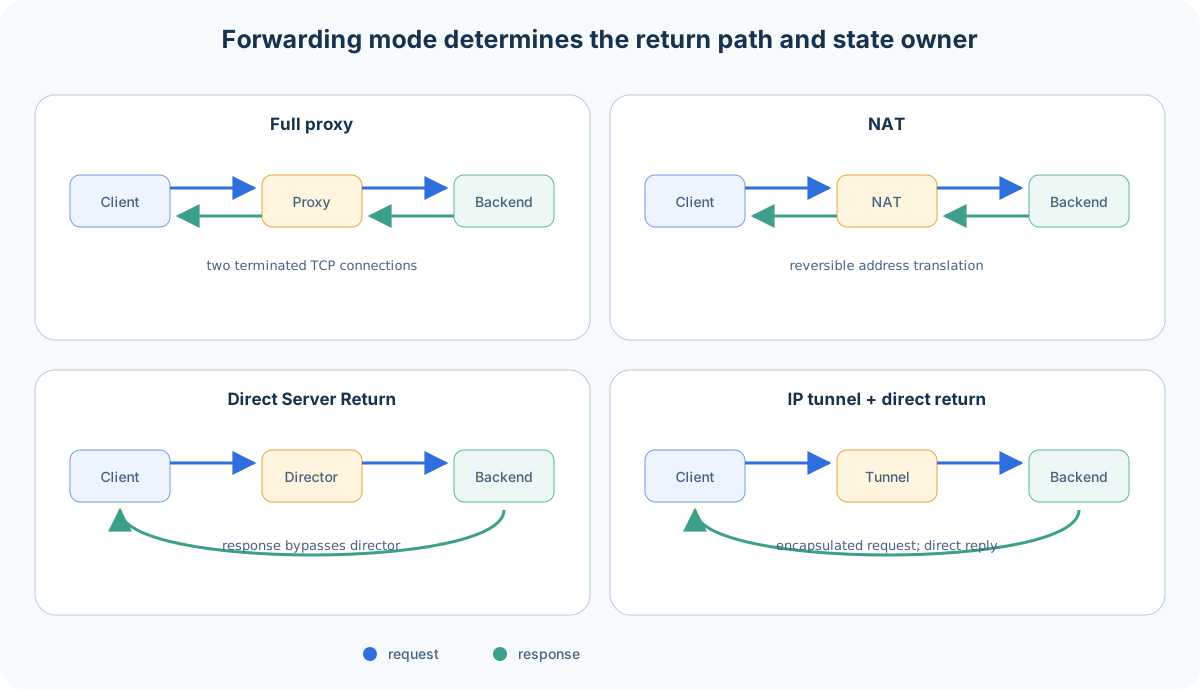
“L4 load balancer” describes the selection layer, not one fixed data path. Four common forwarding shapes make different address, performance, and failure tradeoffs.
Full TCP Proxy
A full proxy owns two independent connections:
client <-- TCP A --> proxy <-- TCP B --> backend
The client has a TCP connection to the proxy, not to the backend. The proxy can use independent buffers and timeouts on each side and can pass the original client address using a trusted metadata protocol.
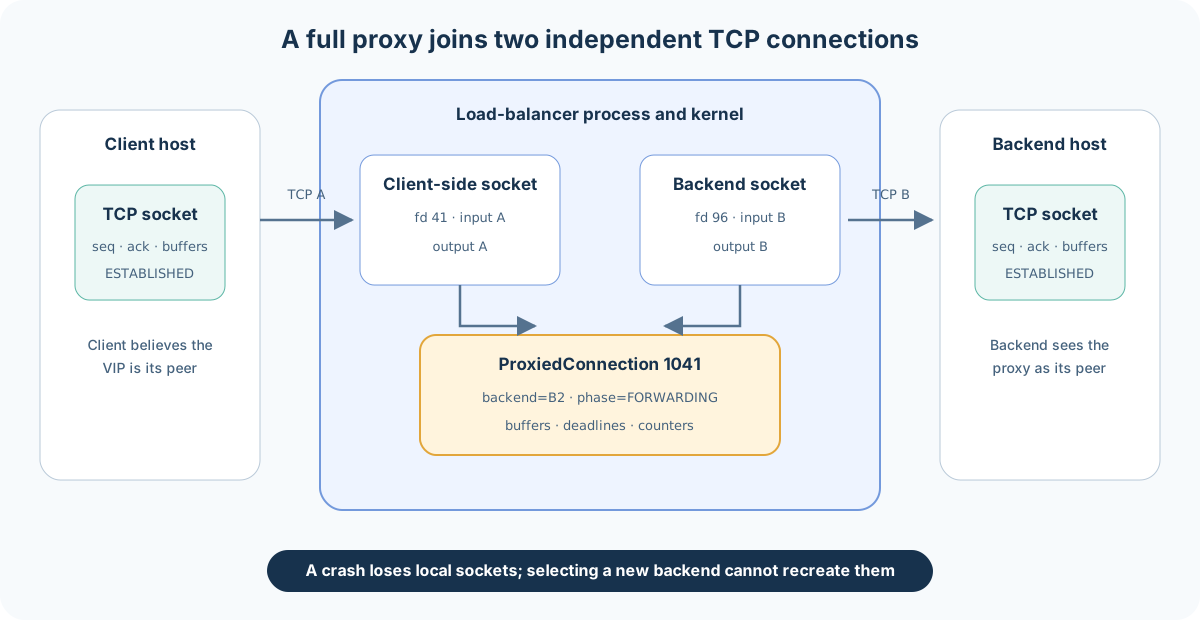
Both request and response bytes traverse the proxy. A proxy crash loses the kernel TCP sockets it terminated; another process cannot reconstruct those live sequence spaces from the backend list alone.
Destination and Source NAT
In a NAT design, the client addresses the VIP. The balancer rewrites the destination to the selected backend and often rewrites the source so the reply is forced back through the balancer.
client -> VIP
src = 203.0.113.8:51024
dst = 198.51.100.10:443

balancer -> backend
src = 10.0.0.5:43001
dst = 10.0.1.17:8443
The reply needs the inverse translation:
backend -> balancer
src = 10.0.1.17:8443
dst = 10.0.0.5:43001

VIP -> client
src = 198.51.100.10:443
dst = 203.0.113.8:51024
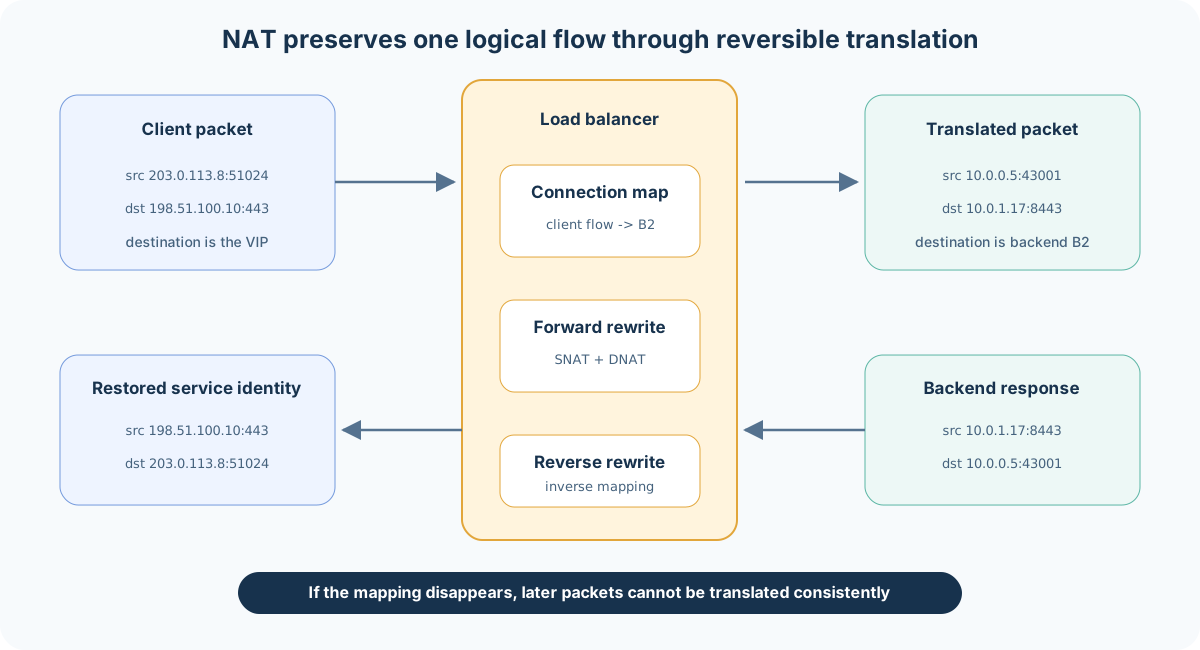
Source NAT simplifies the return path but hides the original client address from the backend and consumes translated source-port space.
Direct Server Return
With Direct Server Return, or DSR, the balancer selects the inbound path but the backend sends response packets directly to the client:
request:  client -> balancer -> backend
response: client <----------- backend
The backend must accept the VIP without incorrectly advertising ownership on its local network, and the reply must use the address the client contacted. DSR removes high-volume response traffic from the balancer but creates an asymmetric path and reduces response visibility at the balancer.
IP Tunnelling
Tunnelling wraps the original packet in an outer packet addressed to the backend. After decapsulation, the backend sees the original destination VIP and can reply directly. This allows backends beyond the balancer’s local Layer 2 network, at the cost of encapsulation overhead and maximum transmission unit (MTU) planning. The MTU is the largest packet a network link can carry without fragmentation; adding an outer tunnel header leaves less room for the original packet.
The forwarding mode determines what can survive failure. Full proxies own transport endpoints. NAT systems own translations. DSR and tunnel directors may not see replies. A standby can preserve an existing flow only when traffic reaches it and it has—or can reproduce—the exact state its mode requires.
What to remember: Performance and failure semantics come from the data path, not from the label “L4.” Always draw both request and response paths.
7. Backend Eligibility Comes Before Scheduling
A scheduler cannot safely choose from every address it has ever heard about. It chooses from the current eligible pool.
Eligibility combines independent inputs:
configured for this route
AND present in discovery
AND administratively accepting new work
AND sufficiently healthy
AND within locality and policy constraints
Discovery Describes Intended Membership
Endpoints can come from static configuration, DNS, an orchestrator, a service registry, or a dynamic discovery stream. Discovery answers:
Which backend instances are intended to exist for this service?
It does not prove that an endpoint is reachable from this proxy or capable of serving useful work now.
Health Is Evidence, Not Truth
Health can be observed at increasing depth:
TCP port accepts
    -> TLS handshake completes
    -> protocol check succeeds
    -> application check succeeds
    -> real requests finish within deadline
Deeper checks provide stronger evidence but cost more and can depend on shared downstream services. Thousands of proxies repeatedly probing a database-backed health endpoint can create significant production load.
Active health checking sends synthetic probes, so it can detect failure without user traffic. Passive health checking, often called outlier detection, observes real connection failures, resets, timeouts, latency, or responses. Passive evidence sees the actual path but must distinguish a broken backend from a request-specific error or proxy-local network problem.
Health Needs Thresholds and Recovery
One lost probe should not flap a backend in and out of service. A useful health state machine includes failure thresholds, success thresholds, and gradual recovery:
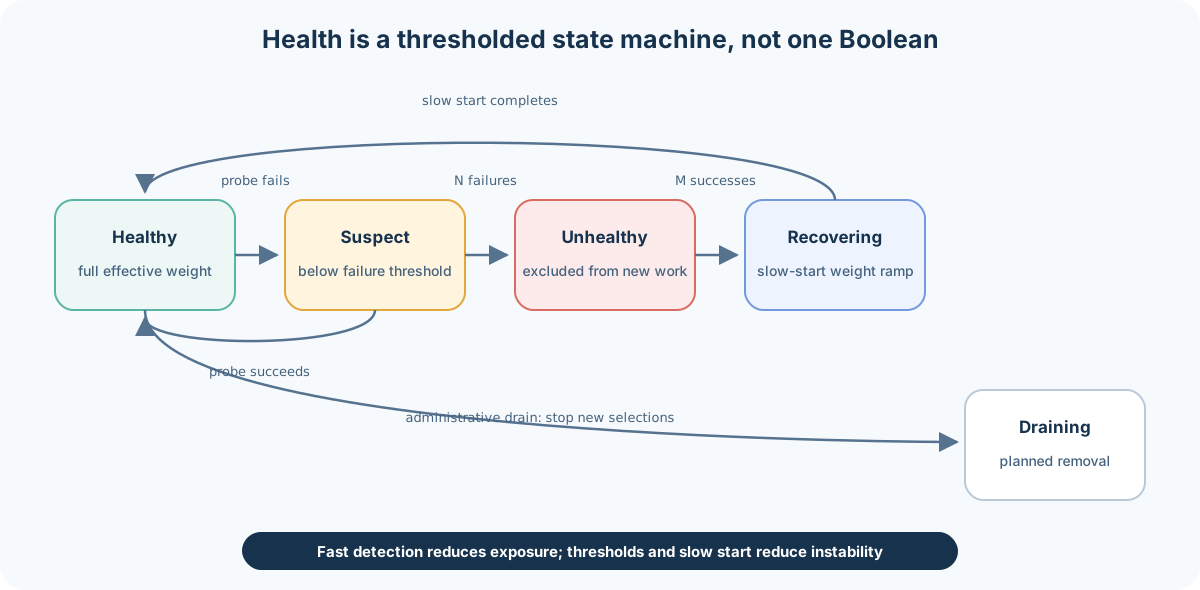
Observed health and administrative eligibility should remain separate:
enum class ObservedHealth {
    Healthy,
    Suspect,
    Unhealthy,
    Recovering
};

struct BackendState {
    ObservedHealth health{ObservedHealth::Healthy};
    bool acceptingNewWork{true};  // false while draining
    std::uint32_t consecutiveFailures{0};
    std::uint32_t consecutiveSuccesses{0};
};
The important transitions are complete in both directions:
Healthy --failure--> Suspect --threshold--> Unhealthy
Suspect --success-------------------------> Healthy
Unhealthy --success threshold------------> Recovering
Recovering --slow start completes---------> Healthy
any state --administrative drain----------> no new selections
A recovering backend may have cold caches, empty connection pools, or delayed dependency initialization. Slow start ramps its effective weight from a small value to the configured value instead of sending a full share immediately.
Publish Complete Pool Snapshots
The data plane processes live client traffic and performs local selection. The control plane receives configuration, discovery, health, and drain updates, then publishes the state that the data plane uses.
The data plane should not synchronously query discovery or a configuration database. The control plane combines membership, health, policy, and drain state, then publishes an immutable version:
struct PoolSnapshot {
    std::uint64_t version;
    std::vector<std::shared_ptr<Backend>> eligible;
};

std::atomic<std::shared_ptr<const PoolSnapshot>> activePool;
Readers see either the old complete snapshot or the new complete snapshot. Existing flows retain their chosen backend; new selections use the latest eligible pool.
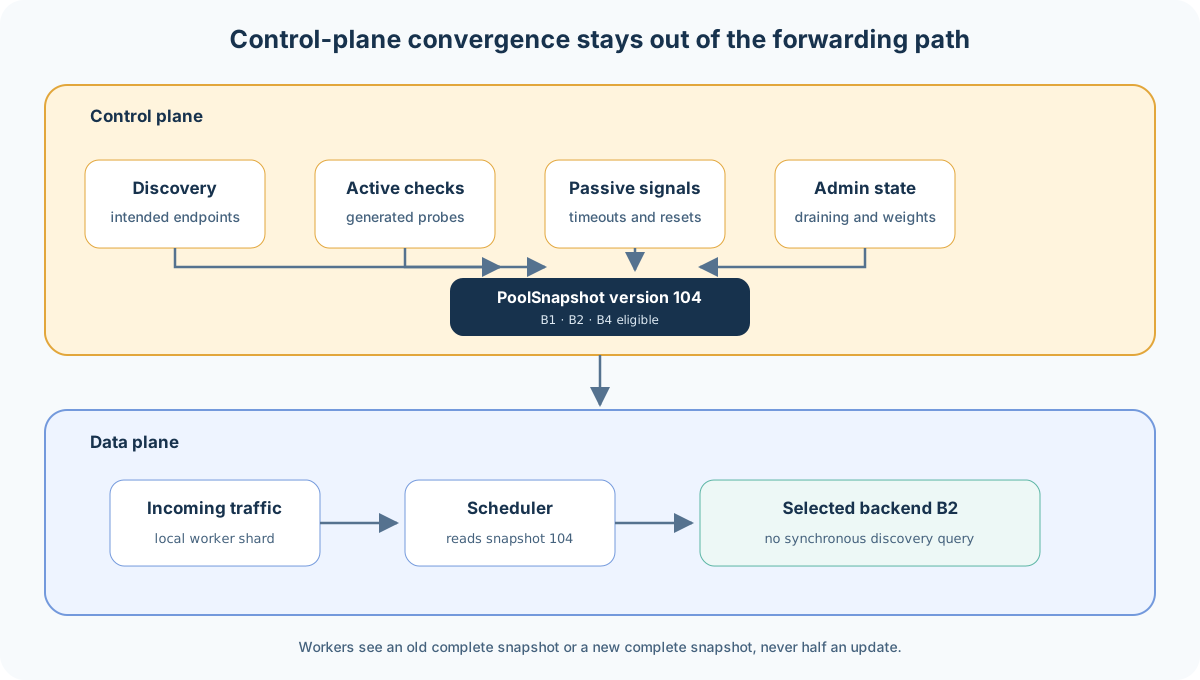
Different balancer instances can temporarily hold different versions. That is usually safer than putting global consensus into every selection, provided snapshot age is bounded and locally observed failures can suppress an endpoint quickly.
If no backend is eligible, policy must explicitly fail fast, use a lower-priority pool, or enter a carefully bounded degraded mode. Sending to known unhealthy servers can recover some requests or intensify a cascading failure.
What to remember: Discovery says which backends should exist. Health says what this balancer has observed. Administrative state says whether new work is allowed. Scheduling begins only after those inputs produce an eligible pool.
8. Scheduling Chooses Which Imperfection to Tolerate
The abstract selection is:
backend = select(traffic_key, eligible_pool, observed_load, policy)
No scheduler sees future work. Most see only approximate local counters or delayed backend measurements.
Round Robin
Round robin rotates through eligible endpoints:
Backend& roundRobin(
    std::span<Backend* const> backends,
    std::atomic<std::uint64_t>& next) {

    const auto position =
        next.fetch_add(1, std::memory_order_relaxed);
    return *backends[position % backends.size()];
}
It is cheap and predictable when backends and work are similar. It distributes selections, not CPU time, bytes, or completion latency.
Weighted Least Connections
Connection duration makes active count a useful—but incomplete—load signal:
score_i = active_connections_i / configured_weight_i
select the lowest score
An idle WebSocket and a connection streaming hundreds of megabits both count as one. For L7 work, outstanding requests, queue depth, endpoint-reported utilization, or an exponentially weighted moving average (EWMA) of latency may be better approximations. EWMA gives recent measurements more influence while retaining some history, so it reacts without following every brief spike.
Power of Two Choices
Scanning a very large pool for every selection is expensive. A bounded alternative samples two eligible endpoints and chooses the less loaded one:
Backend& powerOfTwo(
    std::span<Backend* const> backends,
    Random& random) {

    Backend& a = *backends[random.index(backends.size())];
    Backend& b = *backends[random.index(backends.size())];
    return normalizedLoad(a) <= normalizedLoad(b) ? a : b;
}
It avoids much of the skew of one random choice while keeping selection work constant.
Rendezvous Hashing
Affinity can choose the backend with the greatest stable score:
selected = arg max over b in eligible:
           hash(affinity_key, stable_backend_id_b)
Unlike hash(key) % backend_count, rendezvous hashing does not remap most keys when membership changes. Removing one equally weighted backend mainly moves the keys previously assigned to it.
Hashing balances keys, not their popularity. One celebrity account or dominant tenant can remain a hot spot.
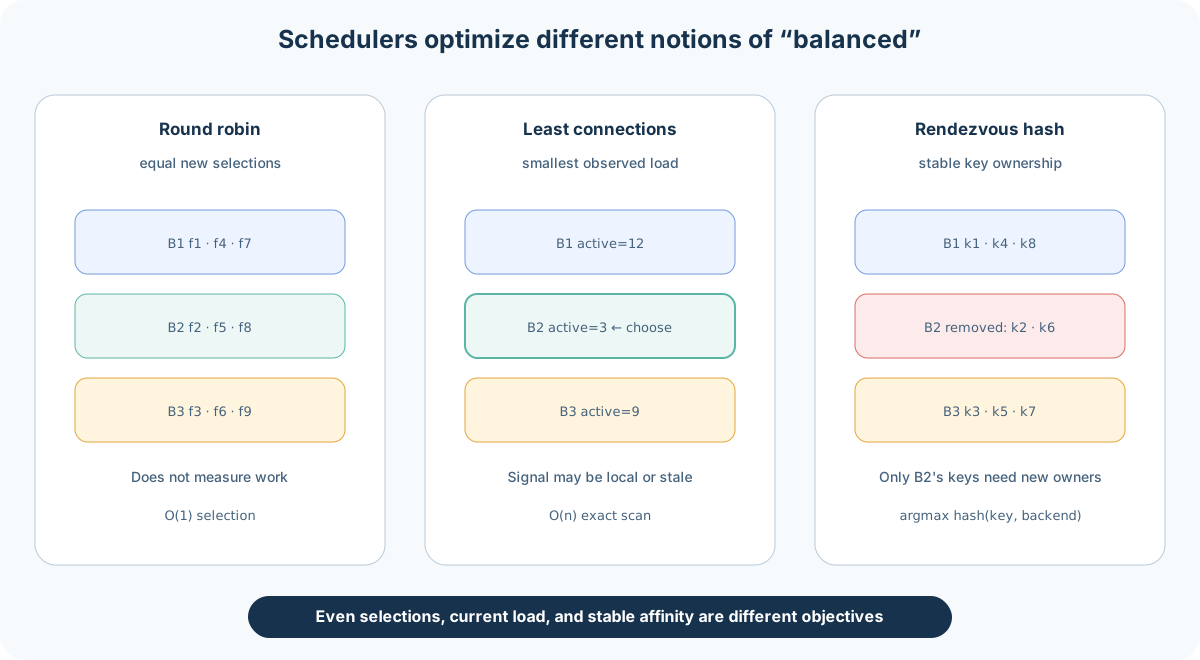
| Algorithm | Useful property | Information required | Typical weakness |
|---|---|---|---|
| Round robin | Cheap even selection counts | Counter | Ignores work size and duration |
| Weighted least connections | Adapts to long connections | Active counters and weights | Connection count is not actual load |
| Power of two | Good balance with bounded work | Sampled load | Each proxy’s observations can differ |
| Latency-aware | Reacts to service time | Rolling statistics | Feedback can oscillate or punish cold nodes |
| Rendezvous hash | Stable affinity | Stable key and endpoint IDs | Hot keys stay hot |
Locality policy can first prefer an availability zone or region, then schedule within it. Failing over too early increases network cost; failing over too late can overload a damaged locality. Capacity and health thresholds must match that policy.
What to remember: A scheduling algorithm does not create balance. It chooses a backend using a particular approximation of work and a particular tolerance for movement or skew.
9. L7 Proxying Adds Routing and Connection Pools
An L7 proxy parses a validated request before choosing a route and endpoint:
Route matchRoute(const HttpRequest& request) {
    if (request.host() == "api.example.com" &&
        request.path().starts_with("/payments/")) {
        return routeTable.at("payments");
    }

    if (request.headers().contains("x-canary")) {
        return routeTable.at("canary");
    }

    return routeTable.at("default");
}
Real proxies use hardened protocol implementations. Ambiguous framing, authority, path, or header interpretation must be rejected or normalized before routing. A proxy and backend parsing the same request differently is a security boundary failure.
After endpoint selection, the proxy normally uses a backend connection pool instead of creating a TCP connection per request:
request selects B2
    -> find reusable B2 connection with stream capacity
    -> otherwise open one within the pool limit
    -> otherwise queue briefly or reject
Frontend and backend connection counts therefore differ. HTTP/1.1 often needs several upstream connections for concurrency. HTTP/2 and HTTP/3 can multiplex many request streams on one upstream connection, subject to stream limits and head-of-line or loss behavior at their transport layer.
Preserve Client Identity Through a Trust Boundary
A full proxy’s backend connection originates from the proxy, so the backend naturally sees the proxy address. Original address or authenticated identity can be passed through trusted L7 headers or a connection preface such as PROXY protocol.
The backend must trust those fields only from known proxies that remove or overwrite client-supplied versions. Otherwise a client can forge its apparent source or identity.
What to remember: L7 routing selects after parsing a protocol unit. The selected request then competes for capacity in that endpoint’s backend connection pool.
10. Affinity Is Stronger Than Ordinary Load Balancing
Once an L4 balancer chooses a backend path for a TCP connection, preserving that mapping is required for transport correctness. This connection affinity is automatic and ends with the connection.
Application-session affinity, often called persistence or stickiness, can span several requests or connections. It needs an application-level key.
Why Source-IP Hashing Is Coarse
Source-IP hashing requires no cookie:
backend = hash(client_ip) over eligible_backends
It performs poorly when many clients share one NAT address, mobile clients change networks, IPv6 privacy addresses rotate, or one organization’s address range dominates traffic. An IP address is a network locator, not a durable user-session identity.
Cookie or Application-Key Affinity
An L7 proxy can set a cookie or hash a stable application key:
Set-Cookie: LB_AFFINITY=backend-17
The value should be integrity-protected or opaque so clients cannot select arbitrary internal endpoints. The proxy must also decide what happens when the named backend fails or drains. Affinity cannot override unavailability forever.
Strong stickiness can preserve backend-local caches or state, but it also preserves hot spots and complicates failover. Moving durable session state out of one backend often makes the pool easier to balance, at the cost of a shared state dependency or client-token semantics.
Useful mitigations for hot affinity keys include bounded-load hashing, read-only replication, finer-grained keys, tenant quotas, and deliberately breaking affinity when an endpoint crosses an overload threshold.
What to remember: Connection affinity preserves a transport flow. Session affinity preserves an application choice. Neither guarantees even resource consumption.
11. Backpressure and Overload Decide Who Waits
A load balancer is also a collection of queues, even when configuration never uses that word:
accepted connections
pending TLS handshakes
requests waiting for a backend connection
bytes waiting for a slow client or backend
retries waiting for another attempt
Backpressure Crosses a Full Proxy
If a backend reads slowly:
backend receive buffer fills
    -> proxy backend send path stops accepting bytes
    -> proxy userspace output queue grows
    -> proxy pauses reads from the client
    -> client send buffer fills
    -> client write slows
TCP eventually propagates transport pressure, but the proxy must bound its own buffers while that happens. Unlimited buffering converts one slow backend into proxy-wide memory exhaustion.
Every connection table, pending-connect set, request queue, output buffer, and retry path needs both a limit and a policy for reaching it.
Latency Multiplies Concurrency
Little’s Law relates average in-flight work L, arrival rate lambda, and average time in the system W:
L = lambda * W
At 20,000 requests per second and 50 ms average latency:
L = 20,000 * 0.050 = 1,000 in-flight requests
If backend latency rises to 500 ms at the same arrival rate:
L = 20,000 * 0.500 = 10,000 in-flight requests
Traffic did not increase, but memory, request concurrency, pool pressure, and timeout exposure increased tenfold.
Bound the Waiting Room
Useful limits include:
- accepted and established connections;
- concurrent TLS and QUIC handshakes;
- pending backend connects;
- upstream connections and concurrent streams per endpoint;
- pending requests and their maximum age;
- buffered bytes per connection and process;
- per-route and per-tenant concurrency;
- retries as a fraction of original traffic.
Once useful capacity is exhausted, failing quickly can be safer than accepting work that cannot finish before its deadline. Load shedding deliberately rejects a bounded part of offered traffic to protect work already admitted.
Failure Detection Does Not Create Capacity
If four equal backends normally run at 80% utilization, losing one asks the remaining three to absorb:
4 * 0.80 / 3 = 1.067
or approximately 107% of one backend’s capacity. Health checking can remove the failed endpoint perfectly and still cause the other three to fail.
What to remember: A balancer chooses where pressure accumulates. Bounded queues and admission policy determine whether overload remains contained or becomes a fleet-wide collapse.
12. Timeouts and Retries Operate Under One Deadline
A request can have several timers:
- client handshake timeout;
- backend connect and TLS timeout;
- time to first response byte;
- per-attempt timeout;
- overall request deadline;
- idle connection timeout;
- maximum stream duration.
They must fit inside one budget. If two seconds of a three-second client deadline have elapsed, three new two-second attempts are impossible.
overall deadline
    -> time already spent
    -> budget for current attempt
    -> optional budget for a bounded retry
An L7 proxy can make a retry decision at a request boundary. A generic L4 proxy cannot safely replay an arbitrary partial byte stream on a new backend connection because it does not know the application operation or how much the backend already processed.
A Missing Response Creates an Ambiguous Outcome
Consider:
proxy sends POST /charge
    -> backend commits the charge
    -> response is lost
    -> proxy observes a timeout
The timeout does not prove the operation failed. Retrying could charge twice. Safe retry policy depends on method semantics, application idempotency keys, whether the request body can be replayed, and how much deadline remains.
Automatic retries are strongest when:
- the operation is idempotent or deduplicated by a stable idempotency key;
- no response has been committed to the client;
- the body is buffered or reproducibly replayable;
- a different eligible endpoint exists;
- the overall deadline still has useful budget;
- attempts and aggregate retry traffic are bounded.
Retry Amplification
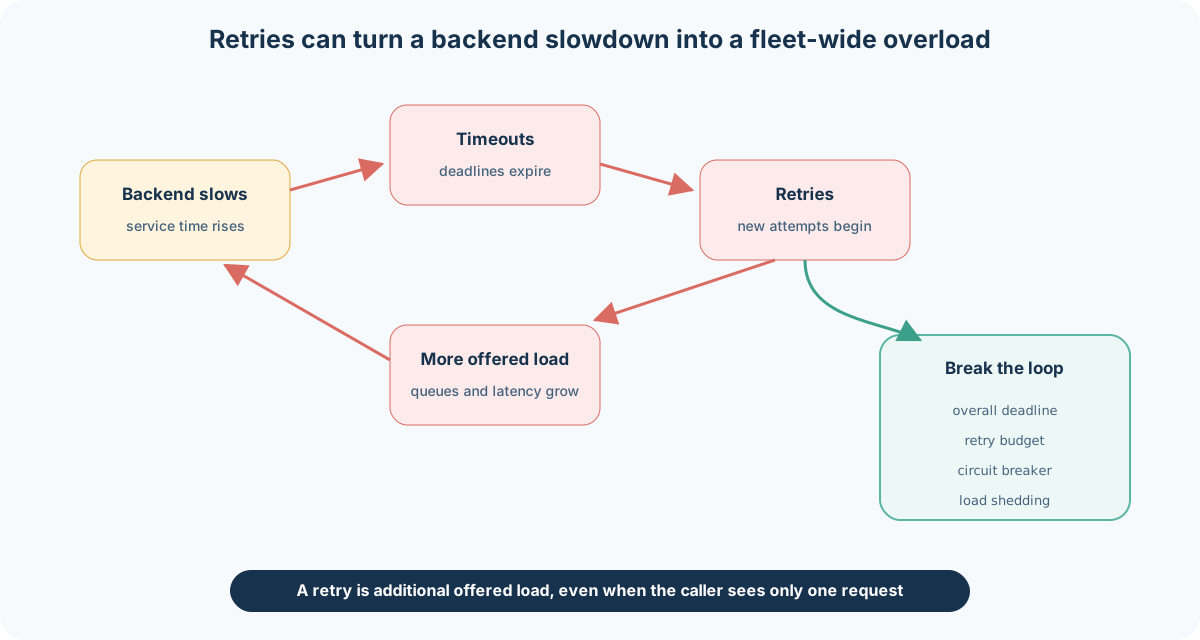
The unstable loop is:
backend slows
    -> requests time out
    -> proxies retry
    -> backend fleet receives more work
    -> queues and latency grow
    -> more requests time out
A retry budget limits retries relative to original traffic. Randomized delay reduces synchronized attempts. Circuit breakers stop new work from accumulating behind a dependency with no remaining capacity.
Metrics must preserve original failures even when a retry eventually succeeds; otherwise retries can hide the incident while consuming the headroom needed to recover.
What to remember: A timeout is not proof that an operation did nothing. A retry is another request with additional load and potentially ambiguous side effects.
13. Draining and Failure Affect New and Existing Work Differently
Removing a backend for deployment should not resemble a crash:
mark backend not accepting new work
    -> publish an eligible snapshot without it
    -> preserve existing connections and requests
    -> wait for completion or deadline
    -> notify long-lived clients when possible
    -> close remaining work
    -> remove endpoint state
The backend object cannot disappear as soon as discovery removes it. Existing connections and in-flight requests still hold references to their selected endpoint.
Short HTTP requests may drain in seconds. WebSockets, database sessions, long-polling requests, and streaming RPCs can remain open for hours. A finite policy needs a grace period, protocol-specific notice where possible, a hard deadline, and randomized client reconnect behavior.
Unexpected Backend Failure
When a backend crashes:
- new selections should stop after local evidence reaches policy threshold;
- existing TCP connections reset or time out;
- safe L7 requests may retry within their original deadline;
- arbitrary L4 byte streams cannot migrate;
- discovery and health views converge afterward.
Choosing a replacement for new work is much easier than preserving existing transport or application execution state.
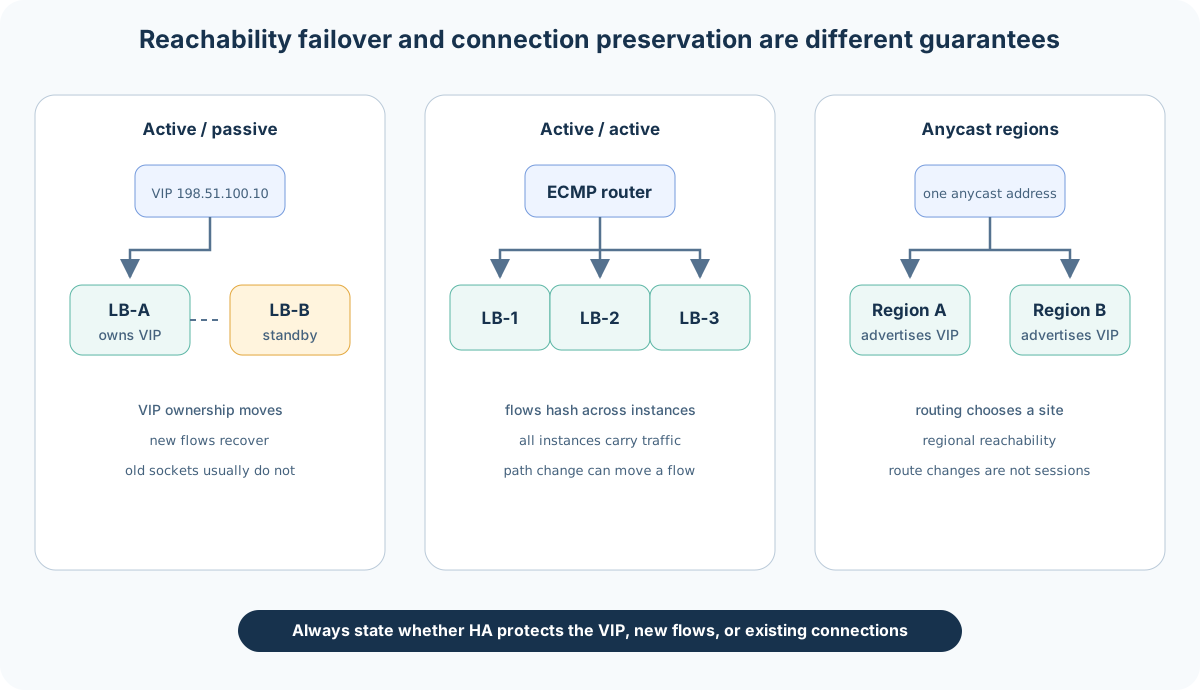
The Load-Balancer Tier Must Also Be Redundant
Once several backends sit behind one proxy, that proxy is the next failure domain.
Active/Passive
One instance owns or advertises the VIP while another waits. On failure, the standby takes over and network state converges. New connections can recover once the VIP is reachable. Existing full-proxy connections usually cannot, because their client and backend TCP sockets belonged to the failed kernel.
Active/Active
ECMP can distribute flows across several instances. Routers commonly hash packet headers so one flow converges on one next hop. Membership changes can alter paths, flow sizes remain uneven, and each stateful connection still has one actual owner.
Anycast Across Sites
Several regions can advertise the same service address. Routing selects a reachable, policy-preferred site. A route change can move new connections, but Internet routing is not an application-session migration protocol.
State Synchronization Has a Precise Limit
Packet-forwarding balancers can replicate NAT or connection mappings to a standby. Replication has delay, ordering, bandwidth, and fencing requirements. A copied mapping may preserve forwarding but cannot recreate terminated userspace TCP/TLS sockets.
“Highly available” should therefore be qualified:
VIP becomes reachable again
new connections succeed
existing packet mappings survive
terminated TCP connections survive
in-flight requests are retried
application sessions resume
Each line is a stronger and different guarantee.
What to remember: Topology changes first affect eligibility for new work. Existing flows survive only when their exact owner and state survive or the application has an explicit reconnect and retry mechanism.
14. Optional Implementation Deep Dive: A Full TCP Proxy
The system model does not require a particular implementation. This section shows why a production full proxy uses explicit non-blocking state instead of one blocking thread per relay direction. It can be skipped without changing the load-balancing decisions above.
The simplest conceptual relay is:
read client bytes -> write them to backend
read backend bytes -> write them to client
Using two blocking threads demonstrates TCP’s full-duplex behavior, but cleanup is subtle. One direction can fail while the other sleeps indefinitely; an uncaught exception in a worker thread can terminate the process; and requesting thread cancellation does not interrupt an arbitrary blocking recv() by itself. Production code coordinates socket shutdown and ownership explicitly.
The C++ fragments below expose those state contracts. They are connected pieces of a proxy design, not a complete server with listener setup, TLS, backend selection, logging, and every error path.
One Object Joins Two Independent Sockets
enum class Phase {
    ConnectingToBackend,
    Forwarding,
    ClientHalfClosed,
    BackendHalfClosed,
    Closing
};

struct Endpoint {
    int fd{-1};
    std::deque<PendingWrite> output;
    std::size_t queuedBytes{0};
    bool readPaused{false};
    bool readClosed{false};
    bool writeClosed{false};
};

struct ProxiedConnection {
    std::uint64_t id;
    Endpoint client;
    Endpoint backend;
    BackendId selectedBackend;
    Phase phase{Phase::ConnectingToBackend};
    TimePoint connectDeadline;
    TimePoint idleDeadline;
};
An event loop watches both descriptors. Readiness means a non-blocking operation may make progress; it does not promise a complete application message or that every queued byte can be written.
On Linux, epoll is the kernel interface commonly used for this watch list. The proxy registers each socket descriptor and the events it currently cares about, such as readable or writable. A call to epoll_wait() then returns only descriptors whose state may permit progress:
register client and backend sockets
    -> epoll_wait() returns a ready descriptor
    -> attempt non-blocking recv(), send(), accept(), or connect completion
    -> update buffers and the events of interest
    -> return to epoll_wait()
The proxy does not ask every connection whether it has work on each loop. The kernel records relevant state changes and returns a batch of candidates. The application still must call the non-blocking socket operation and handle EAGAIN, because readiness can change before the operation runs and one event does not imply that an entire request is available.
The Read Handler Enforces a High-Water Mark
The destination queue limit is checked before reading more source bytes:
void ProxyConnection::onReadable(
    Endpoint& from,
    Endpoint& to) {

    while (true) {
        if (to.queuedBytes >= limits_.highWaterBytes) {
            pauseReadableInterest(from);
            from.readPaused = true;
            return;
        }

        const std::size_t remaining =
            limits_.highWaterBytes - to.queuedBytes;
        const std::size_t capacity =
            std::min(readBuffer_.size(), remaining);

        const ssize_t n =
            ::recv(from.fd, readBuffer_.data(), capacity, 0);

        if (n > 0) {
            enqueueCopy(
                to,
                readBuffer_.data(),
                static_cast<std::size_t>(n));
            continue;
        }

        if (n == 0) {
            from.readClosed = true;
            requestHalfCloseAfterFlush(to);
            return;
        }

        if (errno == EINTR)
            continue;
        if (errno == EAGAIN || errno == EWOULDBLOCK)
            return;

        failConnection(ReadError{errno});
        return;
    }
}
The write handler advances offsets only by the number of bytes send() accepts. Once the destination queue falls below a lower watermark, it can resume readable interest on the opposite endpoint:
client read -> backend output queue reaches high watermark
    -> pause client reads
backend writes -> queue falls below low watermark
    -> resume client reads
Using separate high and low thresholds avoids rapidly toggling read interest at one exact byte count.
Half-Close Is Directional
TCP is full duplex. If the client sends FIN, it has closed only its sending direction. The proxy can finish flushing already-read client bytes, half-close the backend write direction, and continue relaying a backend response. Closing both sockets immediately can truncate valid data.
Multi-Core Ownership
Modern NICs expose several receive queues. Receive-side scaling hashes flows so different queues and CPUs can process traffic in parallel while preserving flow locality.
A high-throughput proxy often aligns:
NIC receive queue
    -> CPU
    -> event-loop shard
    -> connection-table shard
    -> backend connection ownership
struct WorkerShard {
    EpollLoop loop;
    ConnectionMap connections;
    BackendCounters localCounters;
};
Each connection has one mutable owner. Configuration snapshots can be shared immutably. Local load counters are cheap but incomplete; globally synchronized counters are fresher but introduce contention. Approximate local information is often preferable on the live data plane.
Implementations can use ordinary sockets, kernel facilities such as IPVS or eBPF, or userspace packet frameworks. Moving forwarding earlier in the packet path can reduce per-packet work, but application-aware routing still requires protocol state somewhere.
What to remember: The proxy owns two independently progressing transport endpoints. Explicit buffers, watermarks, half-close state, deadlines, and one event-loop owner make that relationship bounded and race-resistant.
15. The Proxy Is a Security Boundary
An Internet-facing proxy commonly enforces:
- TLS versions, ciphers, certificates, and client-certificate policy;
- connection, request, and tenant rate limits;
- header and body size limits;
- protocol framing and normalization;
- route authorization and backend reachability;
- trusted propagation of client identity.
A permissive route can expose an internal backend. Conflicting HTTP framing or authority interpretation can make proxy and backend enforce different rules. Trusting an unsanitized forwarding header lets a client forge identity.
Resource Exhaustion Is Often About State
An attacker need not send high bandwidth if it can hold scarce state:
- incomplete TCP connections;
- slow TLS handshakes;
- slowly transmitted headers or bodies;
- many idle keep-alive connections;
- oversized or high-cardinality routing values;
- requests that occupy expensive backend slots.
Protection is staged:
connection-establishment limit
    -> handshake deadline
    -> header size and time limit
    -> body and route limit
    -> backend admission and retry limit
One global requests-per-second limit cannot protect every resource.
When TLS terminates at the proxy, the backend authenticates its proxy-side peer, not the original TCP peer. Client identity must travel through an authenticated, trusted mechanism. Re-encrypting to the backend and validating backend identity prevents the internal hop from becoming an unauthenticated plaintext boundary.
16. Capacity and Observability Must Follow the Decision Path
A load balancer can saturate on different dimensions:
- packets per second for small packets;
- bytes per second for large responses;
- new connections or TLS handshakes per second;
- concurrent connections and L7 streams;
- request parsing and policy evaluation;
- connection-table entries;
- pending requests and buffered bytes;
- metric and log cardinality.
“One million requests per second” says little without message size, connection reuse, protocol, TLS behavior, latency distribution, and failure state.
Measure Each Stage
Separate at least:
proxy queue time
backend connect time
backend TLS time
time to first response byte
response transfer time
total proxy time
Useful data-plane metrics include:
- accepted, active, and rejected connections;
- requests, packets, and bytes;
- flow-table occupancy and expiration;
- pending backend connects and pool saturation;
- request queue depth and oldest age;
- buffered bytes per connection, worker, and process;
- original attempts, retries, and retry outcomes;
- resets, timeouts, and shed traffic;
- selections, completions, and latency per backend and locality.
Useful control-plane metrics include:
- pool snapshot version and age;
- discovery additions and removals;
- active-health transitions and passive ejections;
- eligible fraction and all-unhealthy events;
- drain and slow-start duration;
- rejected configuration and rollback.
Fleet averages can hide one overloaded backend, route, tenant, worker shard, or availability zone. Dimensions must be rich enough to locate skew but bounded enough not to overload the monitoring system.
Capacity for Failure
Planning includes the largest expected burst plus:
- one proxy instance unavailable;
- one backend or availability zone unavailable;
- deployment overlap;
- retry and health-check traffic;
- certificate rotation and cold backend caches;
- long-lived connection reconnection storms;
- observability overhead during an incident.
The target is predictable latency and recovery with spare capacity, not the largest benchmark number under a perfectly healthy steady state.
17. The Payment Failure, End to End
Return to the local payment path:
client -> balancer LB-A -> payment backend B2
Suppose B2 develops a dependency problem.
- Requests to
B2exceed their per-attempt timeout. - Passive outlier detection records local timeouts.
- A replayable
GET /payments/42receives one bounded retry onB3within its original deadline. - The retry budget prevents every failure from creating another attempt.
B2crosses the ejection threshold and disappears from new local selections.- Active probes also fail, providing independent evidence.
- Metrics retain the original timeout even if the retry succeeds.
The client may receive a response, but the incident was not free: the proxy spent additional latency and backend capacity to hide it.
When B2 begins passing probes, it enters Recovering. Slow start raises its effective weight while real success and latency confirm that it can serve a normal share again.
If LB-A fails during the client connection, any client-side TCP/TLS state, backend connection state, buffers, and retry state owned by that instance disappear. Another balancer instance can accept a new connection, but it cannot recreate the old one from route configuration alone. The client reconnects, and only semantically safe operations are retried.
Existing flows survive only when the forwarding design and replicated state provide that exact guarantee. New flows can usually move to another healthy balancer instance.
What Load Balancing Can Provide
With correct policy and sufficient capacity, the layer can provide:
- one service endpoint over a changing backend fleet;
- local selection among eligible endpoints;
- connection, request, or stream distribution;
- isolation and draining of failed or planned-removal backends;
- bounded admission, queues, and retries;
- protocol termination and application routing;
- observability at a shared traffic boundary.
It does not automatically provide:
- exactly-once request execution;
- preservation of arbitrary TCP connections after their owner fails;
- durable application sessions;
- perfect or instantaneous health knowledge;
- equal CPU or bandwidth consumption;
- spare capacity after a failure;
- safe retries for non-idempotent work;
- globally identical backend views at every instant.
The complete model is:
stable service address
    -> a new flow, connection, request, or session boundary begins
    -> filter the known pool into eligible backends
    -> select using an imperfect load signal or affinity key
    -> turn the selected endpoint into a connection or forwarding action
    -> remember and reuse the choice for related traffic
    -> expire the mapping at its defined lifetime
    -> bound queues, deadlines, and retries
    -> drain or fail over at an explicit state boundary
A load balancer makes a changing fleet appear as one reachable service only when its ownership, capacity, and recovery guarantees are stated precisely.
Compact Glossary
| Term | Direct meaning |
|---|---|
| Backend | Server endpoint eligible to receive selected work. |
| Pool | Set of candidate backends for a service or route. |
| VIP | Virtual service IP presented by a load-balancer tier. |
| Listener | Configured address, port, and protocol accepting traffic. |
| Selection unit | Packet, flow, connection, request, stream, or session assigned as one unit. |
| Backend snapshot | One complete local version of known endpoints and their selection metadata. |
| L4 load balancer | Balancer selecting mainly from network and transport information. |
| L7 proxy | Proxy parsing an application protocol before route or backend selection. |
| ECMP | Equal-Cost Multipath routing; commonly hashes flows across equivalent next hops. |
| Flow key | Fields used to associate packets with one forwarding decision. |
| Connection tracking | State preserving a chosen mapping for later packets in a flow. |
| Full proxy | Proxy terminating one connection and opening another to a backend. |
| NAT | Reversible rewriting of network addresses or ports. |
| DSR | Direct Server Return; backend response bypasses the inbound director. |
| Eligibility | Whether configuration, discovery, health, drain, and policy allow new work. |
| Active health check | Synthetic probe generated by the load-balancing system. |
| Passive health check | Failure evidence observed from real traffic. |
| Slow start | Gradual restoration of a recovering backend’s effective weight. |
| Affinity | Policy preserving a backend choice beyond one independent selection. |
| Application session | Business state such as a login or cart that may outlive one connection. |
| Backpressure | Downstream capacity is lower than offered upstream work. |
| Load shedding | Deliberate rejection used to protect admitted work during overload. |
| Retry budget | Bound on retry attempts or retry traffic relative to original work. |
| Draining | Stop new assignments while allowing existing work a bounded completion period. |
| Data plane | Components processing and forwarding live traffic. |
| Control plane | Components distributing configuration and backend eligibility state. |
References
- IETF, RFC 9293: Transmission Control Protocol
- IETF, RFC 9110: HTTP Semantics
- IETF, RFC 9000: QUIC
- Linux kernel documentation, IPVS sysctls
- Linux kernel documentation, Scaling in the Linux Networking Stack
- Envoy, Life of a Request
- Envoy, Service Discovery
- Envoy, Health Checking
- Envoy, Outlier Detection
- HAProxy, Backends and Load-Balancing Algorithms
Leave a Comment